What Broke the Foundations?
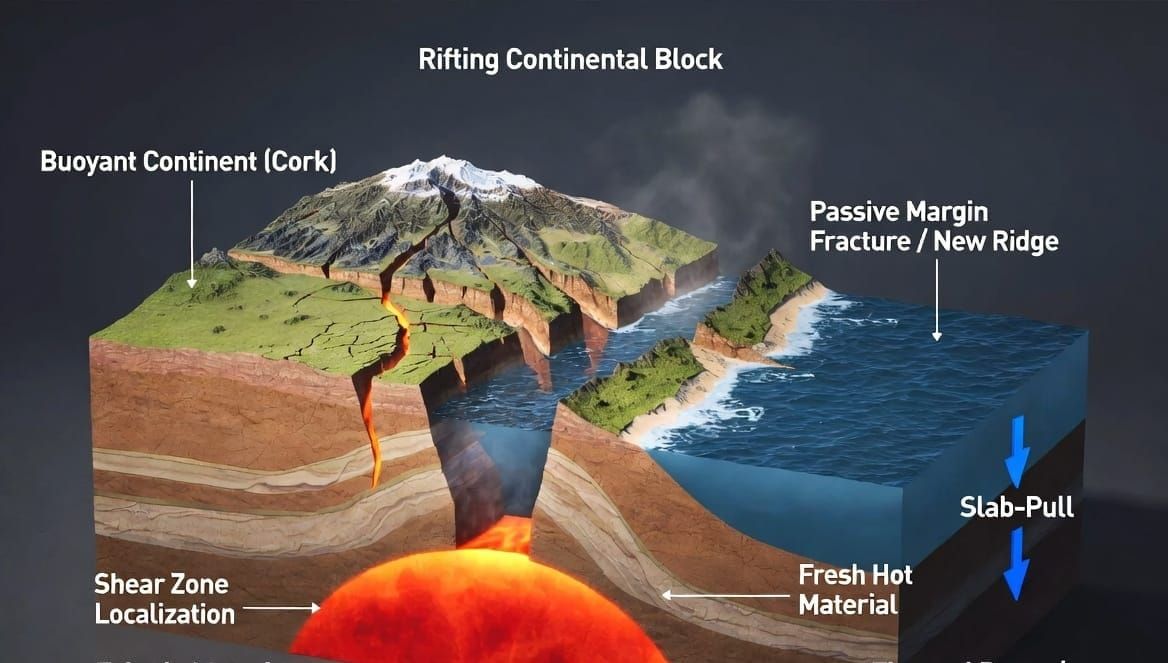
When the combined slab-pull and thermal-dome stress exceeds the yield strength of the passive margins, the eggshell breaks. The cork pops, the continents tear apart. The velocity that follows comes from the force balance, on parameters the laboratory already reports.
What Broke the Foundations?
A Mechanism for the Initiation of Catastrophic Plate Tectonics
Meaning Books, April 2026
Standalone Paper — Foundation for the Diversification, Diaspora, Deposition, and Differentiation Series
Abstract
The ocean floor preserves a record of Earth's magnetic history in alternating stripes of normal and reversed polarity, conventionally read as a tape recorder of slow seafloor spreading across hundreds of millions of years. This paper proposes an alternative reading, based on a specific physical mechanism.
Oceanic lithosphere is negatively buoyant from the moment it begins cooling — denser than the asthenosphere beneath it at every age and every thickness. It does not sink because the continuous lithospheric shell distributes the load through its mechanical integrity. But the total gravitational instability grows continuously as the lithosphere thickens, while the shell's yield strength does not keep pace.
In a Pangea configuration, the supercontinent acts as both a structural and a thermal asymmetry. Compositionally buoyant, the continental block sits high while the surrounding oceanic ring grows heavier. Simultaneously, the continent insulates the underlying mantle, building a thermal dome that adds extensional stress to the passive margins from below. The margins are loaded from both sides: oceanic pull-down and continental push-up.
When the accumulated stress at these margins exceeds the local yield strength, the shell fails catastrophically. Elastic stress waves propagate through the lithosphere at 5–8 km/s, reaching the entire basin perimeter within two hours and triggering simultaneous failure at forty to eighty sites around it. The continent does not sink with the ocean floor. It is torn apart — a cork popped from the surrounding shell, and fractured.
This paper asks whether that mechanism can satisfy four constraints set outside it: the observed continental separation of approximately 5,000 km, the present-day mean plate velocity of 5 cm/yr, an elapsed time of 4,725 to 7,200 years derived from human mutational load rather than from any tectonic argument, and material properties confined to their published experimental ranges. A one-dimensional forward model incorporating grain-size evolution, hydration from ringwoodite dehydration, continental thermal-dome insulation and partial melt lubrication at the rifting margins produces a peak global-average plate velocity of approximately 12 km/yr on a melt fraction near 0.7%, decaying as the localized shear zones heal through grain regrowth, until a velocity-gated transition closes those pathways and motion shifts to the broad margin-interface contact zones where continents ride over oceanic lithosphere. The observed separation and the peak velocity together determine the early decay constant; across the published factor-of-three spread in olivine grain-growth kinetics this pairs decay times of 300 to 800 years with peaks of 6.3 to 16.7 km/yr, requiring melt fractions between 0.4% and 0.9% against the 0.1% to 2.0% documented in active rift zones. The approach to modern velocity is governed by margin-interface healing, for which no direct experimental calibration exists; this paper states a ceiling rather than an arrival date. No unknown physics is required, and every mechanism is documented in the experimental and computational geodynamics literature.
The tear produces a three-basin thermal architecture. Frictional heat at subduction zones — about 72% of the driving force — is sequestered in the mantle, since thermal diffusion lengths are orders of magnitude shorter than the distance to the ocean floor at catastrophic descent rates. Surface heat from new crust formation at the rift is governed by the boiling point of water: the basin surface cannot exceed 100 °C, and evaporation removes the excess as latent heat. The Atlantic and Indian rifts boil briefly and cool over centuries; the remnant ocean, which receives heat only by transport and none by contact, stays within reach of its prior state. The heat that had to leave the new basins for today’s measured flux to be what it is amounts to roughly 1.8 × 10²⁸ J — comparable in magnitude to classic runaway-subduction estimates, but delivered through a self-regulating three-phase mechanism of buoyant ponding, boiling-mode delivery and a conductive tail. Averaged over the boiling window the load runs five to eight times the planet’s modern outgoing longwave radiation, and it is confined to the newly opened basins rather than distributed across the globe. That confinement is what makes the event survivable: the basins that boil are surfaces the event itself created, and the remnant ocean — where the biology is — is not a contact surface. No exotic cooling mechanism is required (Appendix F).
The mechanism simultaneously provides a plausible driver for rapid magnetic reversals — cold slabs disrupting the geodynamo at the core-mantle boundary — together with catastrophic water release through ringwoodite dehydration in the mantle transition zone, and rapid plate motion. Three observable signatures from a single initiating event. The analysis rests on one- and two-dimensional scaling models with idealized geometry; full three-dimensional computational confirmation is invited, and the specification it would be tested against is set out in Appendix D.
1. The Stripes on the Ocean Floor
Every geology textbook includes the image: symmetric bands of alternating magnetic polarity, spread across the ocean floor like a barcode centered on the mid-ocean ridge. The Vine-Matthews-Morley hypothesis, confirmed by the late 1960s, reads these stripes as history. New crust forms at the ridge, cools through the Curie temperature (~580°C), and locks in the ambient magnetic field direction. As the seafloor spreads, it carries that magnetic snapshot away from the ridge, and the next batch of crust records whatever the field is doing at that moment.
The interpretation is elegant and well-supported. But it rests on two assumptions that are rarely examined together.
First, it assumes the spreading rate is slow — centimeters per year, roughly constant over time. This means each stripe represents a long reversal epoch. A stripe 20 km wide at 2 cm/yr spreading corresponds to a million years of stable field direction.
Second, it assumes the reversals are essentially random — stochastic fluctuations in the geodynamo with no external driver.
This paper proposes that both assumptions may be wrong for the same reason. If spreading was rapid and driven by a catastrophic event, the stripes are not recording million-year epochs. They are recording rapid-fire reversals during a mantle overturn event, frozen into basalt that cooled in days or weeks. The reversals, in this reading, are not random — they are driven by the physical disruption of the geodynamo when cold lithospheric slabs arrive at the core-mantle boundary, altering the thermal conditions that sustain the dynamo. Numerical geodynamo simulations have demonstrated that the field is sensitive to exactly this kind of change in core-mantle boundary heat flux (Glatzmaier & Roberts 1995; Olson et al. 2013), though no study has yet modeled the specific scenario of catastrophic slab arrival.
This reinterpretation keeps what does the work in the Vine-Matthews-Morley mechanism: basalt locks in the ambient field as it cools through the Curie point, so a spatial sequence of cooling records a temporal sequence of the field — and because the sequence runs inward from both margins, the pattern is still symmetric about the axis. What changes is the emplacement regime, and only during the catastrophic phase: the floor is not accreted at an axis and carried outward but emplaced as a body that freezes from the margins inward, so the freeze front rather than the spreading rate is what lays the stripes down. Once the basin is solid, ordinary axial accretion resumes, and everything laid since is Vine-Matthews-Morley in the conventional sense.
To evaluate that question, we need a mechanism capable of producing rapid spreading, rapid magnetic reversals, and — as will become clear — catastrophic water release, all from a single physical event.
2. The Constraints
Before constructing the mechanism, this paper states the conditions any candidate mechanism must satisfy. They are set out here, in advance, so that the remainder of the paper can be read as a test rather than as a construction.
Constraint 1 — Total displacement. The continents have separated by approximately 5,000 km since breakup, from paleogeographic reconstruction of conjugate margins. Whatever velocity history a mechanism produces, its integral must equal this.
Constraint 2 — Present-day velocity. Plates presently move at approximately 5 cm/yr in global average, measured geodetically. The velocity history must arrive at this value and remain there.
Constraint 3 — Elapsed time. The event is dated independently of any tectonic argument, by private mutational load in human whole-genome data divided by the germline mutation rate measured in parent–offspring trios: 4,725 to 7,200 years. This is a window, not a target. The requirement is that the velocity history reach modern rates somewhere inside it — no particular year is to be matched, and a mechanism that lands anywhere in the window satisfies this constraint as fully as one that lands in the middle. What the window does not permit is arrival by truncation: the crossing must be the endpoint of a continuous deceleration governed throughout by the mechanism's own physics, not the point at which the history was stopped.
Constraint 4 — Published parameters. Every material property the mechanism relies on must lie inside the range reported in the experimental literature: melt fraction 0.1–2.0% (Kohlstedt & Holtzman 2009), hydration weakening factor 100–400 (Hirth & Kohlstedt 1996, 2003; Girard et al. 2013), olivine grain-growth kinetics spanning a factor of approximately three (Faul & Jackson 2007), thermal dome magnitude 150–250 °C (Lenardic et al. 2011; Coltice et al. 2007), and cork-popping resistance factor 0.5–0.8. A mechanism that reaches the required velocities only by taking a parameter outside its published range has not solved the problem; it has moved it.
What the specification contributes. The specification under examination describes a distinct opening interval and then marks its end with a change of terms, after which the account's character changes from catastrophe to recession. That is information about the shape of the history: a process severe at onset and then subsiding, rather than one proceeding at a steady rate or building toward a peak. It is consistent with a decaying velocity profile. It supplies no rate, no duration and no transition time, and no parameter in this paper is taken from it. The specification is not the geological record and is not treated as one; the two are kept separate throughout.
What the forward model is asked to supply, and what it is not. A one-dimensional treatment can reasonably deliver two things, and this paper asks it for those two only: the peak velocity, from the force balance under the cork-popping geometry with published rheology, and the functional form of the early decay, which is grain-growth controlled and approximately exponential. It is not asked to deliver the total displacement. A 1-D model cannot capture the interacting rift arms, return flow and distributed strain that sustain higher velocities for longer in three dimensions, so the separation it accumulates is smaller than the observed one. That difference is a property of the dimensionality, not a verdict on the mechanism.
What is fixed by the constraints rather than chosen. No parameter is adjusted to make anything land. Constraint 1 does not permit an adjustment to the early decay timescale — it determines it, once the force balance has supplied a peak velocity. The regime-transition criterion, the post-transition entry velocity and every material property are taken from the forward model or from published ranges. The long-tail healing time is not determined by anything available here, so this paper bounds it rather than naming it, and does not date the arrival at modern velocity.
What is deliberately not constrained here. This paper does not specify a peak velocity, a decay timescale, or a functional form for the decay in advance. Those are outputs of the mechanism, and prescribing them would make the exercise circular — the forward model would be reproducing a curve this section had already drawn. The four constraints above are all external to the mechanism, and three of the four are measurements.
The question this paper asks is therefore narrow and answerable: can lithospheric shell failure under cork-popping geometry produce a velocity history that integrates to 5,000 km, arrives at 5 cm/yr within the stated window, and does so on parameters taken from the published literature? The remainder of the paper constructs the mechanism and tests it against those four conditions. If no path exists that satisfies all four with parameters inside their published ranges, the mechanism is not viable under the stated constraints, and the paper says so.
3. The Eggshell
Oceanic lithosphere forms at mid-ocean ridges as hot mantle material rises, partially melts, and solidifies. From that moment, it begins cooling from the top down. The standard half-space cooling model describes the process precisely: the lithosphere thickens as approximately 2.32 × √(κt), where κ is the thermal diffusivity and t is time.
As the lithosphere cools, it contracts. Cold rock is denser than hot rock. The thermal contraction coefficient for mantle peridotite is approximately 3 × 10⁻⁵ per degree Celsius. This means the cooled lithosphere is denser than the hot asthenosphere beneath it.
A straightforward calculation (Appendix A) establishes a remarkable result: the depth-integrated average density of oceanic lithosphere exceeds the asthenosphere density by approximately 59 kg/m³ (self-consistent thermal reference) — and this is true for any lithospheric thickness, at any age, from the first moment of cooling. The density contrast is a fixed ratio determined entirely by the self-similar shape of the temperature profile.
Oceanic lithosphere is thermally negatively buoyant from the day it forms. At very young ages, compositional effects — depleted harzburgite residue and hydrothermal alteration in the upper crust — can partially offset the thermal density excess. But as the lithosphere matures and thickens past approximately 30–40 km, the accumulated thermal contraction overwhelms these compositional effects. Mature oceanic lithosphere is unambiguously denser than the asthenosphere beneath it. It does not sink because it is mechanically supported: by the yield strength of the rock, by viscous coupling to the underlying mantle, and — critically — by the geometric rigidity of the continuous lithospheric shell.
A continuous shell is dramatically stronger than the sum of its parts. This is a basic principle of structural engineering. An eggshell supports loads far exceeding what any fragment of the same thickness could bear, because the shell distributes stress across its entire surface. The oceanic lithosphere works the same way. Each local patch is negatively buoyant and would sink if unsupported, but the continuous shell carries the load globally.
The problem is that the load is not constant. While the density contrast is fixed, the total excess mass per unit area grows as √t because the lithosphere thickens continuously. Every year, the shell gets heavier. Every year, the downward pull increases. The yield strength of the rock does not increase at the same rate.
The system is metastable — held together by the shell's structural integrity while the force working to break it grows continuously.
4. The Cork
But the shell is not uniform. In a Pangea configuration, a single supercontinent occupies a substantial fraction of the surface, surrounded by a single large ocean basin. The supercontinent is compositionally different from the ocean floor — granitic crust approximately 35 km thick, with an average density of approximately 2,700 kg/m³ compared to 3,000 kg/m³ for oceanic crust. The continent is buoyant. It is not going anywhere.
This asymmetry has two critical consequences.
First, the boundary between the continent and the ocean — the passive margin — is the point of maximum stress differential on the entire shell. On one side, increasingly heavy oceanic lithosphere pulls downward. On the other, buoyant continental lithosphere sits high. The passive margin carries the full tension between a sinking load and a floating cap. It is not just a pre-existing weakness. It is the geometrically inevitable failure point.
Second, the continent acts as a thermal blanket. Oceanic lithosphere radiates heat efficiently through the water column. Continental crust, with its lower thermal conductivity (~2.5 W/m·K versus ~3.0 for mantle rock) and greater thickness, insulates the mantle beneath it. Over time, this builds a thermal dome — a region of hotter, less dense mantle pushing upward beneath the supercontinent.
Appendix A quantifies the effect. The steady-state temperature excess beneath a Pangea-scale continent is approximately 150–250°C. The resulting buoyancy pressure over the ~100 km depth of the anomaly produces an extensional force at the margins of approximately 1.9 TN/m (≈28% of the corrected total driving force of 6.8 TN/m). The margins are loaded from both directions: the ocean floor pulling down and outward on one side, and the thermal dome pushing up and outward from the other.
Combined loading crosses published yield-strength estimates for weakened passive margins — the 1–10 TN/m band — when the oceanic lithosphere reaches only 60–75 km thickness, at a driving force of 4.0–5.2 TN/m. That is thinner than the 80–100 km threshold calculated from slab-pull alone (Appendix A). The 6.8 TN/m above is the mature value, reached once the foundering slab has descended well past its own thickness; failure begins earlier and at less. The continental insulation makes the shell fail earlier.
When it fails, the continent does not sink with the ocean floor. The oceanic lithosphere founders at the margins. The buoyant continent is pulled apart from both sides by the descending oceanic ring. The cork pops and splits.
5. The Cascade
The question is how fast the failure propagates — and the answer depends on the physics operating in the shear zones between the descending oceanic slabs and the surrounding mantle.
Four mechanisms, all well-established in the experimental and computational literature, operate together to produce catastrophic acceleration.
Grain-size evolution. When olivine — the dominant upper-mantle mineral — deforms under high stress, grains physically break down. The Austin & Evans (2007) piezometric relation describes the process quantitatively: steady-state grain size decreases with increasing stress. When grains shrink below approximately 100 micrometers, the dominant creep mechanism switches from dislocation creep (power-law, grain-size independent) to diffusion creep (linear, viscosity proportional to grain size squared or cubed). This is a change in the controlling physics, providing orders of magnitude more weakening than temperature alone.
Imposed-velocity boundary condition. In a cascading failure, each segment does not deform in isolation under its own weight. Adjacent segments are already failing and pulling on it. The velocity is imposed by the global geometry. As the shear zone narrows, the local strain rate must increase to accommodate the imposed motion. This is a fundamentally more aggressive feedback loop than constant-stress deformation.
Water. As descending slabs cross the mantle transition zone at 660 km depth, they trigger dehydration of ringwoodite and wadsleyite, releasing water that migrates upward into the upper mantle. Hirth and Kohlstedt (1996, 2003) showed that water dissolved in olivine reduces viscosity by two to three additional orders of magnitude beyond the dry case. The water does not just go to the surface as the "fountains of the deep." It weakens the very medium the plates are moving through.
Partial melt. At the rifting margins, the combination of high strain rates, hydration, and the ~200°C thermal anomaly from the continental insulation dome produces localized melting. Thin partial-melt films along the slab interfaces — requiring only approximately 0.7% melt fraction — reduce resistance by an additional order of magnitude. This melt fraction is conservative: rift zones routinely sustain 0.1–2% melt under far less extreme conditions.
When all four mechanisms operate together, the model produces genuine localization and runaway (Appendix B). The shear zone between a descending slab and the surrounding mantle narrows from approximately one kilometer to less than twenty meters as grain sizes progressively decrease. Then, once the zone crosses below a critical width and diffusion creep fully dominates, the system tips: viscosity collapses, deformation accelerates catastrophically, and plate velocities jump to kilometers per year — the whole acceleration inside about a century.
The transition is abrupt. A long, invisible strain concentration, then catastrophic acceleration inside a hundred years. Gradually, then suddenly.
The timescales in that integration are a single margin segment’s own, not the event’s. Appendix B follows one segment in one dimension; what the basin does with forty to eighty of them running at once is the subject of Section 6.
A two-dimensional extension incorporating the natural stress concentration at the slab hinge — the point where the lithosphere bends downward — confirms that the geometry itself provides sufficient perturbation to seed the localization. No artificial initial conditions are required.
6. The Eggshell Breaks
In a Pangea configuration with a single large ocean basin, the oceanic lithosphere is approximately uniform in age. The passive margin segments along the basin perimeter are loaded to near their critical threshold simultaneously — now lower than the uniform-shell estimate, because the continental thermal dome adds extensional stress from below.
When the first segment fails — wherever the margin is weakest — the sudden rupture generates elastic stress waves that propagate through the lithosphere at 5–8 km/s. These waves reach the entire 40,000 km perimeter in approximately two hours. For a shell near its yield, even a modest dynamic stress pulse — 0.1 to 1 megapascal — is sufficient to push many pre-existing weaknesses past threshold nearly simultaneously.
These pre-existing weaknesses are not hypothetical. They are the suture zones where earlier continental collisions assembled Pangea — the Appalachian-Caledonian belt, the Variscan-Hercynian belt, the Uralides. These zones contain reworked, hydrated, and metamorphosed rock from the original collisions — structurally weaker than intact lithosphere, and pre-loaded with the hydrous minerals that enable the grain-size collapse and partial melt lubrication described in Appendix B. The shell breaks where it was welded, using the water the welding left behind.
The cascade does not require perfect uniformity. Real passive margins and transform faults vary in strength by factors of 2–5. If the elastic pulse triggers even 30–50% of the weaknesses simultaneously rather than all of them, the result is still multi-point initiation with parallel incubation — and the total reorganization timescale is still compressed by an order of magnitude or more compared to sequential propagation. The segments that do not trigger immediately will be loaded progressively by the imposed velocity from their already-failing neighbors, shortening their own incubation. The cascade is robust to significant stress heterogeneity; it degrades gracefully rather than failing catastrophically.
This is not a fuse burning sequentially around the perimeter. It is an eggshell shattering. Multiple initiation points — potentially every 500 to 1,000 km — begin their own localization sequence simultaneously. Each segment undergoes the same gradual-then-sudden progression, but because all segments start at roughly the same time, the entire perimeter completes the process in one incubation period rather than the cumulative sum of sequential failures.
Appendix C presents the cascade analysis. What parallel initiation buys is a ratio. With forty to eighty segments around the perimeter, the basin reorganizes in one incubation rather than in forty to eighty of them end to end. That factor is the whole of the claim. The absolute duration is not computed there, and the single-segment incubation time it consumes is not offered as this work’s estimate of how long the event took — that is a figure a three-dimensional treatment would have to produce.
What the cascade does fix is the schedule. Consumption follows the velocity profile of Section 10 directly, highest at onset and decaying from there, with the number of simultaneously active segments rising and then falling as the perimeter completes. The result is front-loaded rather than flat: ninety-five percent of a segment’s displacement is taken up inside the same window over which the segments finish their runaway. The rifts receive their material on the schedule the reorganization sets — that is the v(t) Appendix F integrates.
That is as far as the cascade goes. It does not fix how much heat reaches the ocean, at what rate, or whether the event is survivable. Those are settled in Section 9 and Appendix F, on the energy that actually arrives at the surface.
7. The Tear
The cascade has fired across the 40,000 km perimeter. The shell has failed at multiple points simultaneously. The pieces begin to move.
The coastlines of South America and Africa are complementary across 10,000 km of continental margin — not as an artifact of erosion, but as the fracture surfaces of a single separation. North America and Europe, India and Madagascar, Australia and Antarctica show the same interlocking geometry. These complementary coastlines are the expected outcome of a continental mass torn apart along irregular pre-existing weaknesses.
The separation follows the velocity profile developed in Section 10. Peak separation is approximately 12 km/yr at onset, decaying as the localized shear zones heal. The profile integrates to the observed 5,000 km of continental separation, which is one of the constraints it is required to satisfy rather than a result it is compared against. The one-dimensional forward model of Appendix D supplies the peak and the shape of that decay; it does not accumulate the full separation, because a single-axis calculation cannot represent the interacting rift arms, return flow and distributed strain that sustain velocity across several simultaneous margins — a limitation of dimensionality set out in Appendix E. The qualitative sequence described here does not depend on that difference.
As the continental fragments separate, three processes operate simultaneously in the widening gaps.
Mantle rises. With the lithospheric lid removed along the fracture, hot asthenosphere at approximately 1,200°C wells up into the opening rift. At separation rates of kilometers per year, the gap widens faster than a stable lithospheric lid can form through conductive cooling. For a time the entire rift floor is molten basalt — flooded by seawater from above and gripped by the cold continental blocks at either edge.It does not freeze uniformly. A semisolid lid crystallizes on the molten basalt, nucleating wherever the melt is chilled — against the cold continental margins on both sides, and at the seawater-quenched surface — and thickening inward. The margins solidify first: they are pressed against continental lithosphere that has sat at ambient temperature through the entire pre-event history, a vast heat sink that draws the freeze front inward from both walls. The axis solidifies last. It is flanked by hot rock rather than cold, and it is continuously resupplied with fresh mantle from below for as long as separation continues. So the lid closes from the edges toward the center but never seals at the center — new melt punches through the still-open axis faster than it can freeze. That persistent opening in the floating lid, the one line the crust never manages to close, is the mid-ocean ridge: not a slow-spreading center operating over geological epochs, but the residual thermal seam of a rapidly frozen basin, held open from below while the old ocean floor subducts on the far side and keeps the magma coming. New crust forms there, at the axis, and is carried outward as the basin widens — youngest at the ridge, oldest against the welded margins. The symmetric age progression is not a feature the model must explain around; it falls out of the simple fact that the center is the last thing to cool.
Water enters. Seawater from the pre-event ocean floods into the widening fractures. The initial contact between 15°C seawater and 1,200°C exposed mantle in a rift only tens of kilometers wide produces intense flash vaporization. The confining continental walls on either side of the rift channel the resulting steam vertically. The cycle is continuous: water floods in, contacts hot rock, flashes, rises as steam, and is replaced by the next pulse of incoming water. In the earliest phase, while the basin is narrow and the heat flux per unit area is at its maximum, the rift functions as a heat pipe — the water column cannot persist and all energy exits as steam. As the basin widens, a water column forms and the mechanism shifts to surface evaporation governed by the boiling cap at one atmosphere. Appendix F quantifies the resulting heat budget and its implications for the post-event ocean thermal structure.
The old ocean floor descends. The oceanic lithosphere that surrounded Pangea — the dense shell whose failure initiated the event — is individually unstable once freed from the geometric support of the continuous shell. Each fragment is denser than the asthenosphere beneath it. Released from the constraint that held it in place, it sinks. The old ocean floor subducts along the leading edges of the separating continental fragments, descending into the mantle at velocities governed by the same force balance that drives the separation. This is the origin of the subduction zones. The future Ring of Fire is the consumption front where the pre-event ocean floor descends as fast as new floor is created at the rifts.
The result is a global reorganization on the timescale the velocity profile specifies. South America separates west from Africa. North America separates northwest from Europe. India tears away from the eastern margin and begins its northward transit toward Asia — a transit that ends in the continental collision that builds the Himalayas, whose isostatic rebound is still measurable by GPS today. Australia detaches from Antarctica and moves northeast.
Two new ocean basins open: the Atlantic and the Indian. Both are newly formed rift basins — narrow initially, widening as the separation proceeds, floored with fresh basalt from the rising mantle. The Pacific is not new. It is the remnant of the pre-event ocean floor that has not yet been consumed by subduction — the old shell, still intact, being reduced at its margins. The East Pacific Rise marks the boundary where new rift-generated crust meets the old remnant. The MELT experiment documented the asymmetry at this boundary: the western flank of the EPR has thicker crust, lower shear-wave velocity, and higher electrical conductivity than the eastern flank — consistent with old, thermally mature remnant shell to the west and young, newly formed crust to the east. The half-space cooling constraint (Appendix A) independently limits the thermal age of intact lithospheric shell to approximately 20–33 million years; the Pacific plate carries a radiometric age of approximately 180 million years. If the thermal constraint is correct, the radiometric age reflects inherited isotopic signatures, not time since formation.
The geography of the modern world is the geometry of this separation, preserved as the velocity decayed to modern rates. The thermal consequences of this geometry — the contrast between the hot new rift basins and the cool remnant ocean — are developed in Section 9.
8. Three Signatures, One Event
The cascading shell failure provides a single physical driver capable of producing three observable consequences in principle simultaneously. This convergence is the mechanism's signature.
Water. As the descending slabs cross the mantle transition zone at 660 km depth, they encounter ringwoodite and wadsleyite. Laboratory synthesis shows these phases can incorporate on the order of 1–3 wt% H₂O in their structures under water-saturated transition-zone conditions — 2.4 wt% in wadsleyite and 2.7 wt% in ringwoodite at saturation (Kohlstedt, Keppler & Rubie 1996), and 3.3 wt% in the hydrous wadsleyite Mg₁.₇₅SiH₀.₅O₄ (Inoue, Yurimoto & Kudoh 1995) — and a natural ringwoodite inclusion in diamond records about 1.4 wt% (Pearson et al. 2014). That is storage capacity, not a measurement that the transition zone is filled to it. The cold slabs disrupt the pressure-temperature equilibrium that keeps this water locked in the minerals. Dehydration releases it catastrophically, and a substantial fraction migrates upward through the fractured mantle to the surface. How much is not estimated here.
A note for readers familiar with the biblical text: Genesis 7:11 describes this event in three Hebrew words: nibeq'u kol-ma'ayanot tehom rabbah — "all the fountains of the great deep were broken up." Not one fountain. All of them. Simultaneously. The physics of multi-point shell failure on a uniformly loaded lithosphere produces exactly this: multiple points of simultaneous rupture and water release along the entire basin perimeter. The text was not reverse-engineered from the model. The model was constructed from geophysics. The correspondence is noted.
Magnetic disruption. The geodynamo that generates Earth's magnetic field is sustained by convective heat flow in the liquid outer core. The thermal gradient at the core-mantle boundary governs the dynamo's behavior. Numerical geodynamo simulations have demonstrated that the magnetic field is sensitive to changes in heat-flux patterns at the core-mantle boundary (Glatzmaier & Roberts 1995; Olson et al. 2013). When cold lithospheric slabs — material hundreds of degrees cooler than the ambient lower mantle — arrive at the core-mantle boundary, they could plausibly alter this thermal gradient on a timescale far shorter than the dynamo's normal adjustment period, potentially driving rapid and repeated field reversals.
This paper does not model the dynamo response. It notes that the trigger mechanism delivers cold material to the core-mantle boundary as a direct physical consequence of the shell failure, and that the geodynamo literature establishes the field's sensitivity to exactly this kind of thermal perturbation. Whether the result is the rapid reversal sequence recorded in the ocean-floor stripes remains an open question — but the mechanism provides a specific, physically grounded driver where the conventional model provides none.
Rapid plate motion. The slab-pull force from descending lithosphere, operating through mantle weakened by grain-size collapse, hydration, and partial melt, drives the continental fragments apart at velocities far exceeding modern tectonic rates. The cork-popping geometry — buoyant continents pushed apart by the foundering oceanic ring — produces higher velocities than a uniform-shell model because the continent offers less resistance once the crack opens at the margin.
One event. Three signatures. All preserved in the geological record. All pointing at the same moment.
9. The Thermal Architecture
The tear described in Section 7 does not merely rearrange geography. It creates a specific thermal structure that governs the planet's climate, ocean circulation, atmospheric dynamics, and sediment transport for thousands of years afterward. This section describes that structure and its consequences. The quantitative heat budget is developed in Appendix F.
Three Basins
The tear produces three thermally distinct ocean basins.
The Atlantic and Indian basins are newly opened rifts. Their floors are fresh basalt from the rising mantle, initially at approximately 1,200°C, cooling by conduction and by contact with flooding seawater. These basins begin narrow — tens of kilometers at the onset — and widen as the continental fragments separate. At the active ripping front, where fresh rock is being exposed for the first time, seawater contacts 1,200°C mantle and flashes to steam — there is no water column, only rock, water, and the violent transition between them. Behind the front, where the basin has already opened, water accumulates faster than it can vaporize and a pool forms. The surface of this pool approaches the boiling point — 100°C at atmospheric pressure — and evaporates at extreme rates, removing heat as latent energy carried into the atmosphere. Whether the phase change occurs at the rock surface (flash vaporization at the front) or at the water surface (evaporation from the pool behind the front), the energy exits the basin as steam. The distinction matters for the visual spectacle. It does not matter for the energy budget.
The Pacific is different. It is not a new basin. It is the remnant ocean — what survives of the pre-event ocean floor, old, cold, dense lithosphere not yet consumed by subduction. No new crust forms there. No mantle is exposed at its floor. It is called the remnant throughout what follows, because what matters about it is not where it is but that the event did not create it.
The thermal contrast between these basins is extreme. The Atlantic and Indian basins, during the early post-event phase, reach temperatures far above the global mean — constrained by the rate at which evaporation and steam venting can remove heat from the confined geometry. The remnant is not a contact surface, and warms only through two indirect routes: atmospheric heat redistribution (latent heat released by precipitation of moisture evaporated from the hot basins) and exchange at the northern and southern contacts with the new basins. Neither route is quantified here, and no rate is claimed for either.
The Geometric Heat Partition
The thermal structure is governed by a geometric partition that routes heat into three pathways (Appendix F).
Heat generated by frictional dissipation at subduction zones — where the old oceanic shell descends into the mantle — is produced at depths of tens to hundreds of kilometers. At the descent rates the velocity profile specifies, this heat cannot conduct to the ocean floor within the timescale of the event. Thermal diffusivity in rock is approximately 1 × 10⁻⁶ m²/s. A slab descending at kilometers per year transits the upper mantle in decades. The thermal diffusion length during that transit is tens to hundreds of meters — negligible compared to the 50–100 km distance to the ocean floor. The slab-pull dissipation, which accounts for approximately 72% of the total driving force (Appendix A: 4.9 of 6.8 TN/m), is effectively sequestered in the mantle. It emerges over millennia through mantle convection and arc volcanism — the damped-tail observables discussed in the Dating Capstone — but it does not heat the ocean during the event.
Heat generated by new crust formation at the continental rifts enters the ocean through direct magma-to-water contact. As the continental plates slide off the underlying mantle, fresh mantle material — under pressure from the thermal dome and the subduction pump — wells up into the widening basins. Two density comparisons govern what happens next, and they point in opposite directions. Against the asthenosphere, everything is buoyant: liquid basaltic magma (~2,700 kg/m³), crystal mush (~2,850 kg/m³) and solid basalt (~3,000 kg/m³) are all lighter than the 3,171 kg/m³ Appendix A derives for the mantle beneath, so the material stays at the surface. Against the melt it is mixing with, the quench products are denser, so crust founders back into the pond rather than accumulating as a lid. The negative buoyancy described in Section 3 arises from the cooled peridotite root that develops beneath basaltic crust as lithosphere matures — a root that does not exist in newly emplaced rift material. It ponds at the surface, forming a growing body of hot rock in continuous turbulent contact with seawater — analogous to Kilauea lava pouring into the ocean, scaled to basin dimensions. The heat budget is fixed by three observations: the measured flux through the new basins, the solidus at the base of the solidified column, and the basin area. Those give a heat content at emplacement of 2.7 × 10²⁸ J, of which roughly 1.8 × 10²⁸ J reached the ocean and 8.8 × 10²⁷ J remains held in the present thermal gradient. The delivery proceeds in three phases: an initial charging phase when magma arrives faster than the basins can boil it away, a discharge phase when the basins boil across their full surface area drawing down stored heat (the ice age engine at full power, sustained for 310 to 478 years depending on the transport ceiling), and a long conductive tail at the observed modern flux. The cooling mechanism throughout the boiling phases is evaporation. The surface temperature cannot exceed the boiling point, so the system self-regulates at every phase without requiring any external mechanism. Appendix F quantifies the full energy budget, the three-phase delivery, and the atmospheric energy balance.
The ocean absorbs the heat that evaporation does not remove instantaneously. As the basin cools from 100°C toward ambient, the evaporative removal rate decreases and the residual heat enters the bulk water. The northern and southern contacts between the new basins and the remnant are open and are mixing points, but the water moves in one direction: into the new basins, which are opening while the remnant is being consumed. Heat reaches the remnant by transport rather than by contact (Appendix F), and the exchange is argued here by direction and not by volume. The sea-surface temperature in each basin is determined by the balance between heat input and evaporative removal at each moment in time.
Atmospheric Circulation
The thermal contrast between the hot rift basins and the cool Pacific drives a characteristic atmospheric circulation pattern.
At the surface, air flows from the cooler regions toward the thermal lows over the Atlantic and Indian basins. These surface winds are deflected by the Coriolis effect — to the right in the Northern Hemisphere, to the left in the Southern. The resulting surface wind pattern is sustained, directional, and predictable from the basin geometry.
At altitude, the air heated over the rift basins rises and spreads outward — flowing away from the steam boilers in the upper troposphere, deflected by Coriolis in the opposite sense to the surface winds. This upper-level flow carries three things: moisture evaporated from the hot basins (which condenses and precipitates at high latitudes as snow), volcanic aerosols from the ridge eruptions (which dim incoming solar radiation at the poles), and sensible heat (which warms the atmosphere globally).
The vertical structure is a supercharged version of the Hadley circulation, driven not by the modern equator-to-pole temperature gradient but by the far steeper gradient between the hot rift basins and the cool Pacific and polar regions.
This circulation pattern has three directly testable consequences documented elsewhere in the project.
First, the surface wind directions predict the depositional patterns observed in the Deposition Series. The episodic wind-driven model (Paper 7) validated 27 of 29 predictions across the Colorado Plateau and the Flinders Ranges — two continents in opposite hemispheres, with Coriolis deflection reversed in each case. The wind directions that produced those matches are derivable from the thermal architecture: surface flow from the cool Pacific toward the hot Atlantic steam boiler, deflected by Coriolis, carrying sediment across the intervening continental surfaces.
Second, the upper-level moisture transport drives the ice-age engine (Paper 5). Massive evaporation from the hot basins feeds extreme snowfall at the poles, building the ice sheets. The volcanic aerosols distributed by the same upper-level flow dim polar insolation, keeping the deposited snow from melting. The combination — extreme precipitation and reduced solar input at high latitudes — produces rapid ice accumulation on the timescale the velocity profile specifies.
Third, the atmospheric heat redistribution warms the remnant from above. Latent heat released by precipitation of moisture evaporated from the hot basins raises global atmospheric temperature, which warms the remnant surface by downward sensible heat flux. This is the mechanism by which the remnant — which receives no emplacement heat at all — warms slowly, and not by much. There is no single meaningful basin-wide temperature to quote: the ocean is thermally bimodal, a hot Atlantic and Indian rift system against a cold remnant, and it is that contrast — not any average — that drives the circulation described here.
Survivability
The three-basin thermal structure resolves a long-standing objection to catastrophic plate tectonics models: the heat problem as it relates to biological survival.
If the ocean heated uniformly to the temperatures required to dissipate the total tectonic heat, surface temperatures would exceed the tolerance of marine organisms. This is the objection Baumgardner (2003) identified as the most significant remaining challenge.
The geometric partition answers this objection. The Atlantic and Indian basins are lethally hot during the early event — but they contain no pre-existing ecosystem to destroy. They are newly opened rifts in previously dry continental crust. The basin floors themselves carry no ecosystem, because those surfaces did not exist before the tear made them. That is not the whole of the argument, since the crust the rifts opened in was land, and land adjoined it. What the geometry gives is a gradient rather than a boundary: conditions are severe at and near the new basins and grow milder with distance from them, and the ground least exposed is continental interior farthest from the openings. The biology — marine and terrestrial — is in and around the remnant ocean, which is what survives of the pre-event basin. The remnant stays cool because it is not a contact surface: no new crust forms there and no mantle is exposed at its floor, so it receives no emplacement heat. It warms gradually through atmospheric and oceanic redistribution, and not by much. No temperature is quoted for it here. Neither the exchange at the contacts nor the atmospheric return is quantified in this work, and a figure produced without them would be an assertion rather than a result (Appendix F).
The geometry that creates the heat also separates the heat from the biology. This is not a designed feature of the model. It is an intrinsic consequence of the cork-pop mechanism: the new basins are hot because they are new. The old basin is cool because it is old. The life is in the old basin because that is where it was before the event.
10. The Velocity Profile
The forward model (Appendices A through D) constructs the global-average plate-velocity curve from first principles: asymmetric shell failure at continental passive margins, cascading localization with grain-size collapse and melt weakening, multi-point initiation, and water-mediated mantle hydration. It supplies two things — the peak velocity, from the force balance, and the functional form of the early decay, from grain-growth kinetics (Appendix D).
The peak global-average plate velocity reaches approximately 12 km/yr. It is governed by the combined viscosity reduction in the localized shear zones: thermal weakening, grain-size collapse to diffusion creep, hydration from ringwoodite dehydration, and thin partial-melt films requiring only about 0.7% melt fraction.
The decay occurs in three regimes, each governed by distinct physics.
Phase 1 — Fast localized decay. The catastrophic velocities are carried by the localized shear zones, narrow bands where grain size has collapsed and melt films are present. When those zones heal through grain-size regrowth and melt solidification, the runaway phase ends. Olivine grain-growth experiments at mantle temperatures give grain recovery times of 10² to 10³ years, and melt solidification and migration operate on 10¹ to 10² years. The velocity decays faster than the grains recover, because diffusion-creep viscosity scales as the square to the cube of grain size.
Phase 2 — Regime transition. When the localized pathways close entirely, the plates can no longer move through narrow weakened channels, and motion must be accommodated along the broad margin-interface contact zones where the continental plates ride over the old oceanic lithosphere at the consumption fronts. Effective viscosity rises by several orders of magnitude. The transition is velocity-gated: it occurs when the decaying velocity reaches v_crit ≈ 26.7 m/yr, the point at which grain regrowth overtakes strain-induced refinement. The velocity entering the margin-interface regime is of order 0.1–1 m/yr (Appendix D, D.1); a representative 0.5 m/yr is used where a single figure is needed, and no result here depends on where in that band the true value lies.
Phase 3 — Margin-interface sliding. The continental plates continue riding over the remnant pre-event Pacific lithosphere at the subduction zones. As the subduction-channel interface heals through grain regrowth and progressive fluid consumption — dehydration reactions, arc volcanism, serpentinization — margin drag increases and velocity declines toward the modern 0.05 m/yr. The rate of that decline is not determined here; no experiment calibrates the healing of a broad subduction-channel interface. What can be said is a ceiling, derived in Appendix D: healing must be fast enough that the plates have already reached the velocity now measured.
The profile the constraints require
The observed separation and the peak velocity together determine the early decay constant. For a decay running until velocity reaches v_crit, the displacement delivered is τ₁ × (v_peak − v_crit), so a 12 km/yr peak and 5,000 km of separation require τ₁ = 417.5 years. Nothing is fitted; the constant follows from an observation and a force-balance output.
v(t) = 12,000 × exp(−t / 417.5) m/yr t < t_trans
where t_trans = 417.5 × ln(12,000 / 26.7) ≈ 2,550 yr. The regime transition is velocity-gated rather than imposed, so its timing is a consequence of the decay constant rather than a separate assumption; v_crit is taken from the forward model without adjustment. No functional form is given for the decline after the transition, because none is determined — see Phase 3 above.
| Time (yr) | Phase | Velocity (m/yr) | Cumulative displacement (km) |
|---|---|---|---|
| 0 | Catastrophe peak | 12,000 | 0 |
| 50 | Fast decay (Phase 1) | 10,646 | 566 |
| 100 | Fast decay (Phase 1) | 9,444 | 1,067 |
| 200 | Fast decay (Phase 1) | 7,433 | 1,907 |
| 300 | Fast decay (Phase 1) | 5,849 | 2,568 |
| 500 | Fast decay (Phase 1) | 3,623 | 3,497 |
| 750 | Fast decay (Phase 1) | 1,991 | 4,179 |
| 1,000 | Fast decay (Phase 1) | 1,094 | 4,553 |
| 1,500 | Fast decay (Phase 1) | 330 | 4,872 |
| 2,000 | Fast decay (Phase 1) | 100 | 4,968 |
| 2,550 | Regime transition (velocity-gated) | 26.7 → ~0.1–1 | 4,999 |
This is the profile used for the downstream physics — the heat budget of Appendix F, the ocean thermal and sea-level work of the Diaspora series, and the deposition modeling that follows it. Phase 3 carries on the order of a kilometer of the five thousand, so the displacement is effectively complete before the regime transition, and no downstream result depends on where the approach to modern velocity terminates.
The one-dimensional forward model, run at its own parameters, produces the same peak and the same functional form but a faster early decay, and therefore accumulates less than the observed separation. That difference is a consequence of dimensionality: a single-axis calculation cannot represent the interacting rift arms, return flow and distributed strain that sustain velocity across several simultaneous margins. Its output is tabulated in Appendix D, and the difference between the decay it produces and the decay the observation requires is a measure of those three-dimensional effects — one of the quantities a full treatment would supply.
The pre-event incubation — approximately 1,250 years, the single-segment figure the one-dimensional integration of Appendix B produces rather than an estimate of the event's own duration — is geologically invisible; surface velocities during that phase are indistinguishable from background tectonic motion.
The heat budget is fixed by observation rather than by the velocity profile — the measured flux through the new basins, the solidus, and the basin area — and is therefore independent of how the displacement is distributed in time. The heat budget (Appendix F) shows that evaporative self-regulation handles that energy without changing the peak sea-surface temperature, which is capped by the boiling point of water regardless of the total generated.
11. What This Paper Does Not Claim
This paper does not claim that the trigger mechanism is proven. It claims that the mechanism is physically grounded, internally consistent, and produces plate velocities of the required order on parameters taken from the experimental literature. Full three-dimensional thermo-mechanical confirmation is needed to verify the combined effects of melt migration, toroidal flow, and mantle convection under these boundary conditions.
This paper does not claim that the velocity profile presented here is the only one that could satisfy the constraints. The early decay constant follows from two observations — total displacement and the peak velocity the force balance produces — under an exponential decay assumption. A different functional form connecting the same endpoints would give different parameters. The mechanism’s validity does not depend on the specific numbers: it depends on whether lithospheric shell failure can produce rapid plate motion of the right magnitude and the right qualitative shape, on material properties that the literature supports.
This paper does not claim anything about pre-catastrophe chronology. The mechanism requires a lithospheric shell at critical thickness. How long it took to reach that thickness — whether measured in millions of years or some other timescale — is not addressed and does not affect the mechanism.
This paper does not claim that the partial melt fraction (~0.7%) has been measured in situ during a catastrophic event. It claims that this fraction is within the documented range for rift zones and high-strain mantle conditions, and that it is the value required by the force balance. Whether this specific fraction is realized under catastrophic boundary conditions is a question for three-dimensional modeling.
This paper does not model the geodynamo response to slab arrival at the core-mantle boundary. It notes that the trigger mechanism delivers cold material to the CMB as a direct physical consequence, and that published dynamo simulations establish the field's sensitivity to CMB heat-flux changes. The specific prediction of rapid, repeated reversals remains unmodeled and is presented as a testable consequence, not a demonstrated result.
This paper does not claim that the Steens Mountain magnetic reversal data constitutes settled evidence for rapid field reversals. It is cited as suggestive, consistent with the model's predictions, and contested in the literature.
This paper does not claim that the Vine-Matthews-Morley mechanism is wrong. It accepts the magnetization physics and the symmetry that follows from it. What it questions is the emplacement regime during the catastrophic phase — a freeze front advancing from the margins rather than accretion at an axis — and the timescale that regime implies. Everything laid down since the basin solidified is accepted as conventional axial spreading.
This paper does not trace downstream consequences through the geological, biological, or archaeological record. The trigger paper addresses the trigger. What happens afterward is the subject of separate work.
This paper does not claim that the heat budget is fully closed. The evaporative self-regulation mechanism and the geometric partition demonstrate that the thermal problem is manageable — the system self-regulates at the boiling point of water without thermal runaway. What is fixed is the total, which three observations pin without a tunable parameter. What is not fixed is any climate result: no atmospheric model was run, and the paper produces no global mean temperature, no regional temperatures and no storm regime. A fully coupled ocean-atmosphere treatment is a defined future target (Appendix F).
12. Predictions
The trigger mechanism generates specific, testable predictions that are direct consequences of the shell failure:
Magnetic reversal stripes should show characteristics consistent with rapid emplacement: irregular spacing, anomalous stripe widths, and possible evidence of field-direction change within single cooling units. The conventional model predicts a pattern governed by stochastic reversal timing at constant slow spreading. The trigger model predicts a pattern governed by driven reversals during catastrophic spreading.
Oceanic lithosphere asymmetry should show a systematic difference between post-event crust (Atlantic, Indian Ocean — thin, young, formed at new ridges after the breakup) and pre-event remnant crust (Pacific — thick, old, surviving from the original oceanic shell). The oldest and thickest oceanic lithosphere should be in the western Pacific, which is observed. Atlantic crust should be systematically thinner and younger, which is also observed.
The Pacific as remnant shell. The Ring of Fire — the subduction zones encircling the Pacific — represents the ongoing consumption of the pre-event oceanic shell by the continental plates riding over it. The model predicts that the Pacific plate is the last remnant of the original thick lithosphere whose gravitational instability initiated the catastrophe. Its continued consumption is the source of modern slab-pull and the driver of present-day plate velocities. As the remnant is consumed, global plate velocities should show a long-term secular decline.
Slab graveyards — remnants of the subducted lithospheric shell — should be detectable in the lower mantle via seismic tomography. These are well-documented in the existing literature. What the trigger model contributes is a claim about their origin: a single episode of shell failure rather than protracted accumulation, which should leave them concentrated in depth and arrival time rather than spread through the mantle. Their volume, distribution and thermal signature are quantities a full treatment would have to produce before that claim could be tested against tomography. This paper does not compute them, and Appendix C does not evaluate the exchanged volume.
Mantle transition zone hydration should show evidence of a major dehydration event. Current seismic and mineralogical data indicating water in the transition zone are consistent with either ongoing processes or the aftermath of a single catastrophic release.
Continental margins should preserve structural evidence of the initial shell failure: passive margins with evidence of sudden onset of rifting rather than gradual extension. The cork-popping model specifically predicts that breakup initiates at the passive margins of the supercontinent, consistent with the observed Atlantic rifting pattern.
Rift-zone melt signatures at the oldest Atlantic margins should show evidence of enhanced melt production consistent with the continental thermal-dome anomaly predicted by the insulation effect.
The stripes on the ocean floor are waiting to be reread.
13. Conclusion
This paper presents a physically grounded mechanism for the initiation of catastrophic plate tectonics. The argument proceeds from standard geophysics — half-space cooling, olivine rheology, continental insulation, published yield-strength estimates, experimentally measured water-weakening and melt-weakening effects — and arrives at a specific result: a uniformly loaded lithospheric shell in a Pangea configuration will fail catastrophically at its passive margins, producing simultaneous water release, magnetic field disruption, and rapid plate motion.
The forward model produces the two quantities a one-dimensional treatment can supply. The peak velocity, near 12 km/yr, emerges from the force balance under the cork-popping geometry with parameters taken from the experimental literature. The early decay is grain-growth controlled, as the shear-zone healing physics requires. No unknown physics is invoked at any step.
What the paper delivers to a full treatment is a specification rather than a curve. The observed 5,000 km separation and the peak velocity together fix the early decay constant; across the published spread in grain-growth kinetics that pairs decay times of 300 to 800 years with peaks of 6.3 to 16.7 km/yr, and requires melt fractions of roughly 0.4% to 0.9% — inside what rift zones are observed to contain. A three-dimensional model that produced those melt fractions from its own thermal and strain-rate fields, rather than receiving them, would move the mechanism from a plausible scaling result to a demonstrated process. That is the single most valuable thing such a run could do.
Two things the present treatment cannot supply are named rather than absorbed. A one-dimensional calculation cannot represent the interacting rift arms, return flow and distributed strain that sustain velocity across multiple simultaneous margins, so the displacement it accumulates is not the observed separation and is not offered as such. And the closure of the localized pathways is represented here as a discontinuity; it has a finite width, resolving that width is beyond a one-dimensional treatment, and it is the quantity this work most needs from a full run.
The computational geodynamics community is invited to take that step. The appendices provide the complete parameter set with its published ranges and sources, the constraints any candidate profile must satisfy, and the specific conditions that would constitute confirmation or refutation.
The thermal consequences of the tear are a three-basin architecture: hot new rifts against a remnant ocean with nothing being emplaced beneath it. The surface temperature over the new basins is capped by the boiling point of water at one atmosphere, and the total energy is fixed by three observables — the measured flux, the solidus, and the basin area. No exotic cooling mechanism is required. The heat budget that Baumgardner (2003) identified as the most significant remaining challenge in catastrophic plate tectonics is answered here by the geometry of the tear and the physics of water. What the treatment does not settle is named in Appendix F rather than absorbed.
Appendices
The appendices present the quantitative backbone of the trigger mechanism. They were developed by Grok (xAI) under direction from D. L. White and Claude (Anthropic), using standard geophysical parameters from the published literature. All equations, constants, and numerical methods are fully specified and independently reproducible.
Half-space cooling model, negative-buoyancy calculation, and yield-strength threshold analysis establishing that oceanic lithosphere is never buoyant (shell failure at 80–100 km under slab-pull alone). Continental thermal-dome calculation for a Pangea-scale supercontinent, establishing the additional extensional stress (~40% of slab-pull) at passive margins and the reduced failure threshold (60–75 km under combined loading, where the driving force is 4.0–5.2 TN/m; the 6.8 TN/m total is the mature value once the foundering slab has descended past its own thickness, not the force at first yield). Complete cork-popping force balance.
Combined 1-D model with composite olivine rheology (dislocation + diffusion creep), grain-size evolution (Austin & Evans 2007), imposed-velocity boundary condition, hydration weakening (Hirth & Kohlstedt 1996, 2003), and partial melt lubrication. Demonstrates "gradually then suddenly" runaway: a long gradual narrowing followed by catastrophic acceleration inside about a century. Both figures are a single segment’s own, from a one-dimensional integration, and are not this work’s estimate of the event’s duration. Includes 2-D semi-analytic extension with slab-hinge stress concentration confirming that natural geometry seeds localization without artificial perturbation.
Global cascade analysis under the uniform-loading ("eggshell") assumption with cork-popping geometry. Elastic stress-wave coupling triggers simultaneous failure at 40–80 major weaknesses around the basin perimeter within approximately two hours. What parallel initiation buys is a ratio: the basin reorganizes in one incubation rather than in the forty to eighty required in series. The absolute duration is not computed there, and the single-segment incubation time it consumes is not offered as the event’s. What the appendix does supply is the consumption schedule — front-loaded, following v(t), with ninety-five percent of a segment’s displacement taken up inside the runaway window — and the ramp-up → peak → decay shape that follows from parallel initiation. No heat budget is computed and the exchanged volume is not evaluated.
Construction of v(t) from the cork-popping geometry, thermal-dome push, grain-size evolution, hydration and partial melt weakening. Peak global-average plate velocity approximately 12 km/yr. Three regimes: fast decay as the localized shear zones heal, a velocity-gated transition when those pathways close, and margin-interface sliding toward modern rates on a timescale this work bounds but does not determine. Derives the early decay constant the observed continental separation requires, and states the specification a three-dimensional treatment would be tested against.
Every parameter the mechanism depends on, with its published range, source, and what it controls, together with which parameters are prescribed from the literature and which emerge from the model’s own physics. Includes the coupling between peak velocity and decay constant introduced by the displacement constraint, the structural contribution of each physical ingredient, and the limitations of a one-dimensional treatment.
Thermal budget for the new ocean basins, closed on measured quantities rather than on a mass balance. The depth from which heat had to be removed follows from the observed flux as an equivalence rather than a measurement: a linear column carrying q from the ocean floor to the basalt solidus at its base has thickness H = (T_solidus − T_ocean)·k/q, giving 57.6 km at the working flux of 60 mW/m² (Lucazeau 2019; k = 3.3 W/m·K). Over 10⁸ km² of new basin that column holds 2.671 × 10²⁸ J at emplacement, of which 8.76 × 10²⁷ J — 32.8% — remains in the present thermal gradient, leaving 1.795 × 10²⁸ J delivered to the ocean. No volume calculation and no mass balance enters: material below the solidification front is still there, still warm, and never appears in the budget. Sensitivities, each term moved alone: interior temperature profile ±16%, flux −8%/+20%, solidus −3%/+4%. Three-phase delivery against a water-side transport ceiling of 10–20 kW/m² — Phase 1 charging while advective input exceeds removal, Phase 2 discharge at the ceiling sustained 310 to 478 years, Phase 3 conductive tail to the modern flux. The limiting interface is the sea surface over the basins, not the water–rock contact. Averaged over the boiling window the load runs five to eight times modern outgoing longwave radiation and stays confined to the new basins; the remnant ocean is not a contact surface and receives heat only by transport. Evaporative throughput over the full delivery is 7.9 × 10²¹ kg, the quantity a climate treatment takes as its input. The budget is fixed by three observables and no tunable parameter; the transport ceiling is the one quantity prescribed rather than derived.
What Does Not Work
Several configurations were run during development and did not produce the mechanism. The negative results are what constrain the positive one. They are stated here as results; no working documents are published and none is offered as citable.
Pure thermal feedback under constant stress, with fixed or self-consistent shear-zone width, does not run away at lithospheric scales. Conduction balances dissipation before significant weakening occurs.
Grain-size evolution under constant stress, without the imposed-velocity boundary condition, produces mild localization and no runaway. The imposed-velocity coupling is not a modeling convenience — it is what makes the feedback aggressive enough to tip.
A uniform shell without continental asymmetry — no cork geometry, no thermal dome — does not reach the velocities the displacement requires. Continental asymmetry and partial melt are both load-bearing.
Sequential cascade propagation, where each segment waits for its neighbor to finish incubating before its own begins, gives tens of thousands of years on any reading of the incubation time. That is too slow for the velocity profile Section 2 requires, and it is what forces the uniform-loading condition and multi-point initiation.
© 2026 D. L. White. Licensed under CC BY-ND 4.0. https://creativecommons.org/licenses/by-nd/4.0/
AI collaboration: this paper was developed collaboratively between D. L. White, Claude (Anthropic), and Grok (xAI). White directed the inquiry, posed the core questions, and introduced the propositions. Claude provided technical reasoning, identified physical mechanisms, and co-developed the argument chain. Grok performed quantitative calculations, ran numerical integrations, and produced most of the mathematical appendices; each appendix carries its own attribution. Neither AI system endorses all conclusions as settled. The intent is to explore where the physics leads, not to claim the case is closed.