The Bones
Story Three of the Canyon Series. The shop owner sorted her fossils by completeness and priced them by quality. She'd been grading burial speed for twenty-two years. Her grandmother called it a cabinet of last moments.
The Bones
Story Three of the Canyon Series
This story was developed collaboratively between Claude (Anthropic) and D. L. White. The scientific data underpinning the narrative is published and peer-reviewed. The characters and plot are fiction; the geology is not.
Winter was when Clara did her real work.
The tourist season ended in October. Ray pulled the boats and stored them under tarps behind the shop. The road quieted. The rim went cold. And Clara, who had spent eight months selling specimens to people who mostly didn't know what they were holding, finally had time to hold them herself.
Every winter she did the same thing. She cleared the back room table — the big steel one Ray had welded, the one that could hold a fifty-pound slab without wobbling — and she went through the unsold inventory. Piece by piece. Every specimen handled, examined, re-evaluated. Some got moved to the front table for next season's tourists. Some got promoted to the glass case. Some went back to the shelves to wait another year. And each one got a line in the ledger — condition update, pricing note, any observation Clara thought worth recording.
She didn't rush. There was nothing to rush toward. The canyon was still there. The shop was warm. Ruth was in her chair by the back door with a blanket over her knees now, watching the winter light on the rim, which was different from the summer light — sharper, lower, less forgiving.
Nita came home on a Thursday in December. Same truck. Same seven-hour drive. Same feeling of the road opening up as the plateau spread out ahead of her and the city fell away behind.
She'd had another semester. Invertebrate paleontology this time — the biology of the things her mother had been selling for two decades. She'd spent four months learning the taxonomy, the morphology, the ecological relationships, and the taphonomy of organisms she'd been handling since she could reach the display table. She had new names for old friends. And she had new questions about things she'd never thought to question.
She found Clara in the back room on Saturday morning, halfway through the fossil inventory. The table was covered — trilobites in one group, brachiopods in another, hyoliths in a small tray, miscellaneous specimens along the back edge. Clara's system. Clara's order.
Nita pulled up a crate and sat down.
She picked up a trilobite.
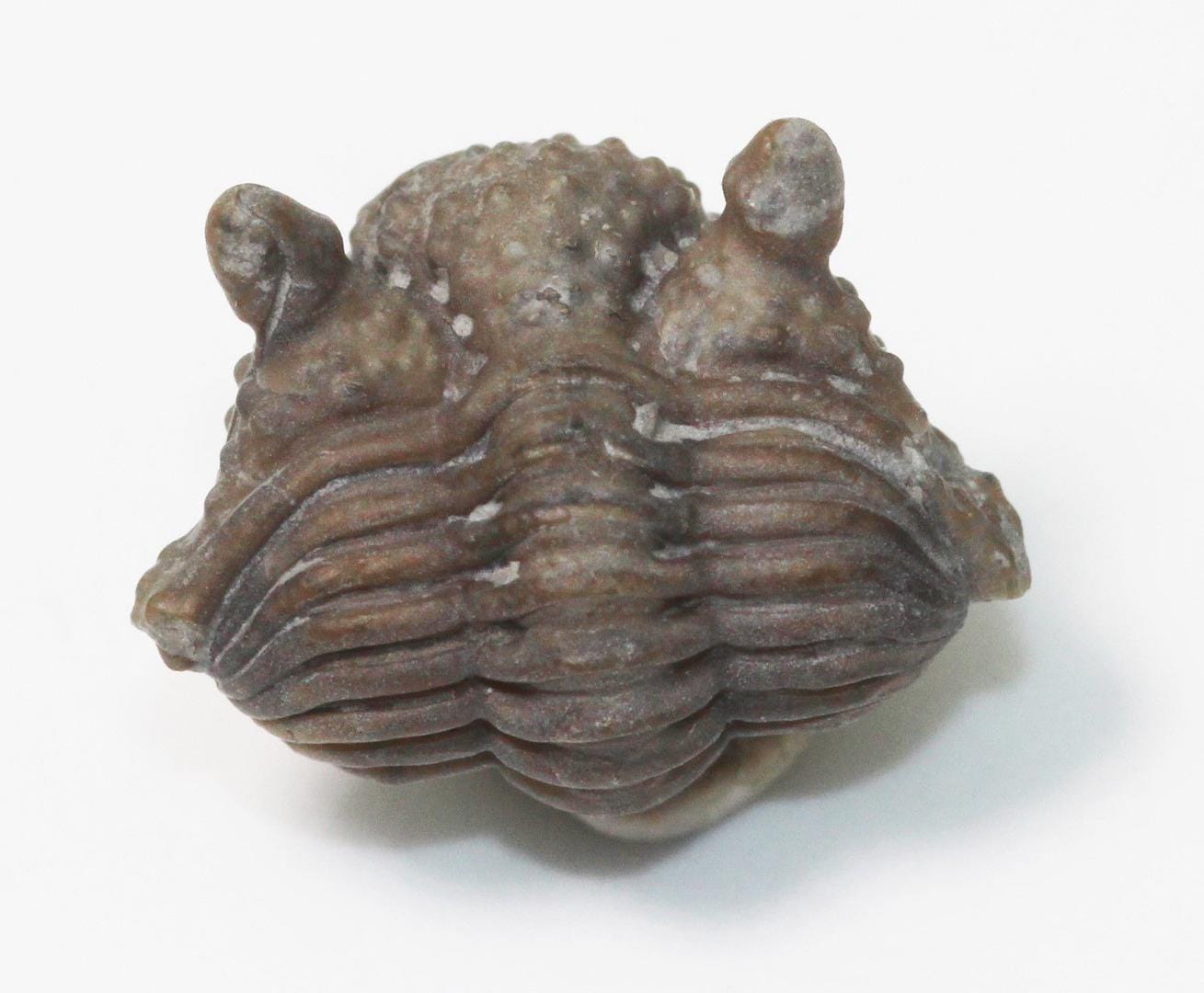
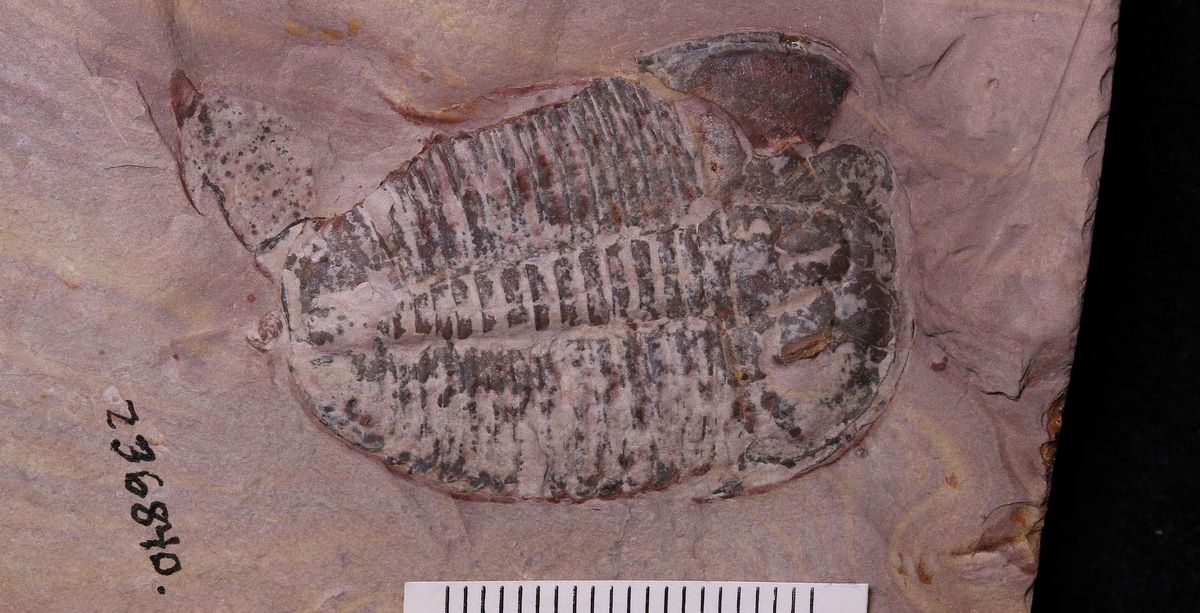
Not one of the cheap ones from the front table — one of the glass case pieces. A Bright Angel Shale specimen, enrolled. The animal had curled into a tight ball — cephalon (the head shield) tucked against pygidium (the tail plate), every thoracic segment locked in sequence, the whole body forming a compact disc the size of a silver dollar. Both compound eyes were visible. The genal spines were intact. Every segment was exactly where it had been when the animal was alive.
Nita turned it in her hands under the work light.
"Mom, this animal is intact."
Clara glanced over from her sorting. "I know. That's why it's in the case. Enrolled specimens are the best sellers after the polished wood."
"No. I mean — look at the posture. It's enrolled. Curled up. That's a defense response. Trilobites did this when threatened — same as a pill bug rolling into a ball. The muscles that hold the segments locked are active muscles. This animal was alive when it curled up. And it was buried while it was still curled."
"How do you know it didn't just die that way?"
"Because dead trilobites don't stay enrolled. The muscles relax. The segments unlock and separate. The cephalon detaches from the thorax. Scavengers pull the pieces apart. Currents scatter them. On an open ocean floor, a dead trilobite disarticulates in days — sometimes hours. This one didn't get the chance."
She set it down on the table and reached for a second specimen from a different shelf. This one was a mess — a scatter of thin plates in a piece of shale. Individual thoracic segments, a detached cephalon, fragments of genal spines. Standard Bright Angel material. Clara had a box of similar pieces priced at eight dollars each for tourists who wanted a real fossil but didn't want to spend real money.
"This one had time," Nita said, holding the two specimens side by side. "It died. The soft tissue decayed. The segments separated. The current moved the pieces around. Then it was buried — after it was already a pile of parts."
She looked at her mother.
"Two animals. Same species. Same formation. Same age. Completely different preservation. The difference isn't what they were. The difference is how fast the sediment arrived."
Clara looked at the enrolled trilobite, then at the scattered plates.
"Same as the wood," she said.
"Same as the wood. Fast burial, good preservation. Slow burial, fragments. Your glass case is full of organisms that were buried before they had time to fall apart. Your bargain bin is full of organisms that weren't."
Clara picked up the enrolled specimen and held it under the light. She'd priced it at a hundred and sixty dollars. She'd priced it that way because the market rewarded completeness and she knew what collectors would pay. She hadn't known she was pricing the speed of burial.
"I've been grading these for twenty years."
"You've been grading taphonomic quality for twenty years. You just called it something else."
Over the next three days, Nita worked through Clara's Bright Angel inventory the way she'd worked through the ledger that first weekend home — not as a customer, not as a collector, but as a reader. Every specimen was a sentence. The preservation state was the verb.
The trilobites told her the most because Clara had the most of them. Enrolled specimens: burial before muscular relaxation, hours at most. Partially disarticulated specimens: burial after initial decay but before complete scattering, days to weeks. Fully disarticulated hash: burial after the organism had been reduced to loose parts by scavengers and current, weeks to months.
Three grades of preservation. Three windows of time between death and burial. Clara had been sorting them into three price categories for two decades.
The brachiopods told the same story in a different language. Both valves intact, still articulated: burial before the muscles that held the shell closed had decayed. A brachiopod's valves open after death the same way a mussel's do — the adductor muscles relax, the shell gapes, and currents and scavengers separate the halves. Finding both valves together, closed, meant the same thing as finding an enrolled trilobite — the animal was sealed in sediment before its body had time to come apart. Clara had been noting this in the oddities book since Story Two. Now Nita could put a number on it. Hours. Maybe a day.
The hyoliths were the sharpest clock. A hyolith was a small conical shell with a lid — an operculum — that covered the opening. In life, the operculum was held in place by soft tissue. After death, the tissue decayed and the operculum fell off. Finding a hyolith with the operculum still seated meant burial before the soft tissue connecting it to the shell had broken down. That window was even shorter than the brachiopods — the operculum was small, light, and loosely attached. Any current, any scavenger, any delay at all, and it was gone.
Clara had four hyoliths with opercula. She'd priced them high because they were unusual. She hadn't known how unusual. Each one was a clock that had stopped within hours of the animal's death — stopped by sediment that arrived fast enough to freeze the moment.
"How many specimens in the shop have this kind of preservation?" Nita asked on the third evening.
Clara thought about it. "The enrolled trilobites — maybe thirty over the years. The articulated brachiopods — a dozen that I noted. The hyoliths with lids — four. Plus whatever's in the boxes I haven't sorted yet."
"And they all come from the Bright Angel."
"They all come from the Bright Angel. Specific beds. The green shale. I've always known those beds produce the best material. The brown beds give me fragments. The green beds give me whole animals."
"Mom, the green beds are the quiet deposits. Low energy. Fine-grained. The sediment settled slowly from suspension. But the animals in them were buried fast — fast enough to preserve enrollment, articulation, opercula. The sediment was fine, but it arrived quickly. That's not a contradiction. That's an event — a pulse of fine material dropping out of the water column all at once, covering everything on the bottom before the organisms had time to decompose."
"Like ash settling after an eruption."
"Exactly like that. Or like the fine mud that settles out of floodwater after the current drops. The quiet beds aren't quiet because nothing was happening. They're quiet because the energy dropped suddenly and everything in suspension fell to the bottom at once."
Clara looked at the green shale specimens on the table — the pristine ones, the glass-case material, the ones she'd been selecting for twenty years because they were the most complete, the most detailed, the most beautiful.
"Every one of these is a snapshot of something falling out of the sky," she said.
"Out of the water column. But yes. Every one."
On the fourth day, Clara brought out something Nita hadn't seen before.
A collector had come through in the fall — not a tourist, a serious field collector who worked the Bright Angel exposures east of the canyon. He'd brought Clara a small lot of shale pieces, greener and more fissile than the usual stock. Clara had looked at them, seen that they were unusual, and put them aside for later examination. Later had arrived.
Nita picked up the first piece and held it under the loupe.
She didn't say anything for a long time.
"Mom, come look at this."
Clara came around the table and looked through the loupe.
What they were seeing was not a shell. Not an exoskeleton. Not a mineralized hard part of any kind. It was the impression of a soft body — an organism with no skeleton, no shell, no armor. A worm-like creature, maybe two inches long, with structures along its front end that looked like filaments. Feeding apparatus. Delicate, branching, impossibly detailed.
"That's not possible," Nita said. Then she corrected herself. "That shouldn't be possible. Soft tissue doesn't fossilize. It decays too fast. Bacteria break it down in hours to days. The only way to preserve soft-tissue anatomy at this level of detail is to seal the organism from microbial activity almost immediately after death. Not days. Not hours. Almost immediately."
She set the piece down carefully.
"The enrolled trilobite was buried in hours. The brachiopod in hours. The hyolith in hours. This — this was probably buried in minutes—a couple hours at most. The feeding structures are intact. The body outline is intact. There's no scavenging damage, no decay, no transport distortion. This animal was sitting on the seafloor and the sediment arrived before the bacteria did."
Clara looked at the piece. It was small. It was not beautiful the way the enrolled trilobites were beautiful. It was extraordinary in a way that had nothing to do with display value.
"What's it worth?" Clara asked. Not because she wanted to sell it. Because that was how Clara processed the significance of a specimen — through the language she knew.
"Scientifically? Researchers just published similar material from the Bright Angel this year. Soft-bodied fossils with feeding structures and gut contents preserved. They're calling them small carbonaceous fossils. The scientific value is enormous. The commercial value — I don't know. But the taphonomic value is the thing that matters for them."
"Why?"
"Because it's the end of the argument. The wood told us burial had to be fast — months to beat the rot. The trilobites told us hours. The brachiopods told us hours. This tells us minutes. The entire formation is full of evidence that things were buried faster than they could decay, at every timescale, in every bed that produces quality specimens. Your twenty years of grading by preservation quality is twenty years of documenting burial speed. The whole shop is a burial-speed archive."
Ruth spoke from the doorway of the back room. She'd come in silently, the way she always did, drawn by the particular quality of silence that meant Nita had found something.
"Everything in this shop is something that died fast," Ruth said. "The wood was buried before it rotted. The shells were buried before they opened. The little worms were buried before they dissolved."
She looked at the shelves. The steel racks Ray had welded. Twenty years of inventory. Thousands of specimens. Each one a moment — a specific, measurable interval between death and burial, frozen in stone.
"Your mother's been keeping a cabinet of last moments," Ruth said. "Twenty-two years of them."
Ray came in that evening smelling like engine grease. He'd been winterizing the outboard motors. Nita was at the kitchen table with the ledger, the oddities book, and a grid she'd drawn on a legal pad — beds down the left side, preservation states across the top, tally marks in each cell.
"You're counting something," Ray said.
"I'm mapping preservation state against bed type. Mom's ledger records where each specimen came from — not just which canyon, but which bed. The green fissile shale versus the brown sandy beds versus the buff siltstone. I'm checking whether the preservation quality tracks the bed type."
"Does it?"
"Every articulated specimen — every enrolled trilobite, every intact brachiopod, every hyolith with an operculum — comes from the green shale beds. Every one. The shell hash, the disarticulated fragments, the broken material — that's all from the sandy event beds."
Ray sat down. "So the quiet beds keep things whole and the rough beds break them up."
"That's the pattern. And it's the same pattern we saw in the wash after the flood. Remember the debris field? Heavy stuff in the high-energy deposits. Delicate stuff in the slack water. The Bright Angel is doing the same thing — the quiet intervals preserve the delicate organisms, the event pulses break and transport the hard-shelled material."
"How many times does it alternate?"
"The Bright Angel is hundreds of feet thick. The alternation repeats through the entire section. Dozens of cycles. Quiet bed, pristine preservation. Event bed, fragments. Back and forth."
Ray was quiet for a moment. "That's not a calm sea with the occasional storm."
"No."
"That's a storm with the occasional calm."
"That's what the beds show."
Ray thought about it the way he thought about water — practically, without theory.
"On the river, when the water's dropping after a flood, you get that. Pulses. The main flood goes through, then the water drops, then another surge comes — a side canyon draining, a debris dam breaking, whatever. The energy doesn't die smooth. It comes in waves, each one weaker than the last, with quiet stretches in between."
"That's exactly what the Bright Angel looks like."
"So the formation isn't recording millions of years of a stable ocean. It's recording the tail end of something — the energy dying in pulses, each pulse weaker than the one before, the quiet getting longer between them."
"That's what the preservation pattern shows. The quiet beds are getting more common upward through the section. The event beds are getting thinner and less frequent. The energy is dying."
Ray looked at the legal pad with its grid of tally marks. His wife's ledger on the table. His daughter's vocabulary applied to his wife's data.
"Dying from what?"
Nita looked at him. She didn't have the full answer yet. She had the Chinle evidence from Stories One and Two — the continent-scale transport, the impossible burial rates, the mixed assemblages. She had the Bright Angel evidence — the preservation states, the bed-by-bed alternation, the declining energy signature. She could see the shape of something enormous, but she couldn't see its edges.
"I don't know," she said. "I don't know what kind of event produces a formation like this — hundreds of feet of alternating pulses, each one burying organisms alive, the energy declining over time but never fully stopping. It's too big for a single storm system. It's too sustained for an earthquake event. It's too organized for random flooding."
"But it's one thing," Ray said. "Not a hundred separate things."
"The pattern is continuous. The energy declines smoothly, with pulses superimposed. That's one driving mechanism winding down, not a hundred independent events."
Ray looked at the canyon through the kitchen window. Dark below, stars above.
"Same as the wash," he said. "One flood. Multiple surges. Declining energy. Quiet between pulses. Same pattern."
"Same pattern. Different scale."
"Always different scale."
On the last evening before Nita drove back to school, the four of them were on the porch. Blankets this time — December was cold on the rim. Ruth had her heavy wool one, the one she'd had since before Ray was born. Clara had the ledger in her lap, closed. Ray had his hands wrapped around a mug. Nita was on the step.
"Something I want to mention," Nita said. "It's not dramatic. It's a quiet observation. But it matters."
They waited.
"All the fossils we've been looking at — every trilobite, every brachiopod, every hyolith, every soft-bodied worm — they're all shallow-marine organisms. Shallow water. Every one. Through the entire Tonto Group — Tapeats, Bright Angel, Muav — the ecology is consistent. Shallow sea. No deep-water organisms mixed in. No terrestrial organisms mixed in."
"That's different from the Chinle," Clara said.
"Completely different. The Chinle mixed everything — marine shells with terrestrial wood, organisms from different environments jumbled together. That's what we saw in the wash after the flood, what Mom's oddities book has been documenting for years. But the Tonto Group doesn't mix. It's one environment — a shallow sea — with declining energy. The organisms change because the energy changes, not because the environment changes."
Ray saw it before she finished.
"The Chinle is the big event. Everything grabbed and thrown together. The Tonto Group is what comes after — the water settling, the energy dying, everything sorting out in place."
"That's what the fossils suggest. Two different chapters. The violent mixing — that's the Chinle. The long settling — that's what we're standing on."
Ruth pulled her blanket tighter. The stars were coming out in the way they did in December — sharp, immediate, closer than they ever seemed in summer.
"First the water moves," Ruth said. "Then the water rests. Then the water leaves. My grandmother told me that. Three parts. You've been reading the middle part."
Nobody spoke for a while. The canyon was dark and silent below them. Everything it held — the layers, the fossils, the last moments of organisms that had been buried alive in a dying sea — was invisible in the darkness. But it was there. It had been there the whole time.
Clara opened the ledger and looked at it in the faint light from the kitchen window.
"I started this to keep track of inventory," she said. "To know what I had and where it came from. Twenty-two years later my daughter tells me I've been mapping the decline of an ancient catastrophe one specimen at a time."
She closed the book.
"I thought I was selling rocks. I was selling time."
The shop owner sorted her fossils by quality and priced them by completeness. She thought she was grading inventory. She was grading burial speed.
An enrolled trilobite — segments locked, eyes intact, defense posture preserved — requires burial before the muscles relax and the exoskeleton disarticulates. A brachiopod with both valves intact requires burial before the soft tissue decays and the shell opens. A soft-bodied worm with feeding structures visible at sub-millimeter resolution requires burial before bacteria erase the only record of its existence. Hours. Not centuries. Hours.
The published record confirms what the ledger mapped: pristine specimens cluster in quiet shale beds, fragments in event beds, alternating through hundreds of feet of section. The same energy that sorted the sediment sorted the dead. The physics does not distinguish between a sand grain and a shell. Density, size, fragility — the current treats them all the same way.
The alternation pattern records a single declining energy source — not a stable ocean disturbed by occasional storms, but a sustained process winding down in pulses, each weaker than the last, with quiet intervals that grow longer toward the top of the section. A flash flood does this in hours. Whatever built the Bright Angel did it at a scale the family could see but not yet measure.
The daughter rearranged the display case. The mother looked at it and saw twenty-two years of data she had collected without knowing what it meant. The grandmother looked at it and saw what she had always seen — things that died fast, kept by a woman who paid attention.
A cabinet of last moments. The formations remember what the organisms cannot — how quickly the water came, and how little time it gave them.
Author's note: The Bright Angel Shale fossil inventory, trilobite taphonomy, hyolith preservation, and brachiopod disarticulation timescales referenced in this story are documented in the published literature: McKee & Resser (1945) for the original Tonto Group faunal descriptions; Brett & Baird (1986) and Speyer & Brett (1986) for trilobite enrollment as a pre-mortem defense response and disarticulation timescales as taphonomic indicators; the 2025 Science Advances publication on small carbonaceous fossils (SCFs) from the Bright Angel Shale, documenting exceptional soft-tissue preservation including priapulid feeding structures in green fissile shale horizons with limited reworking. Bed-by-bed separation of articulated versus transported fossil material within the Bright Angel is documented in the SCF study. The consistent shallow-marine ecological signature across the Tonto Group is established in published stratigraphic and paleontological syntheses. The characters are fiction. The fossils are not.
Previous in the Canyon Series ←
The Wash
Next in the Canyon Series →
The Ledge
© 2026 D. L. White. Licensed under CC BY-ND 4.0. https://creativecommons.org/licenses/by-nd/4.0/