The Wash
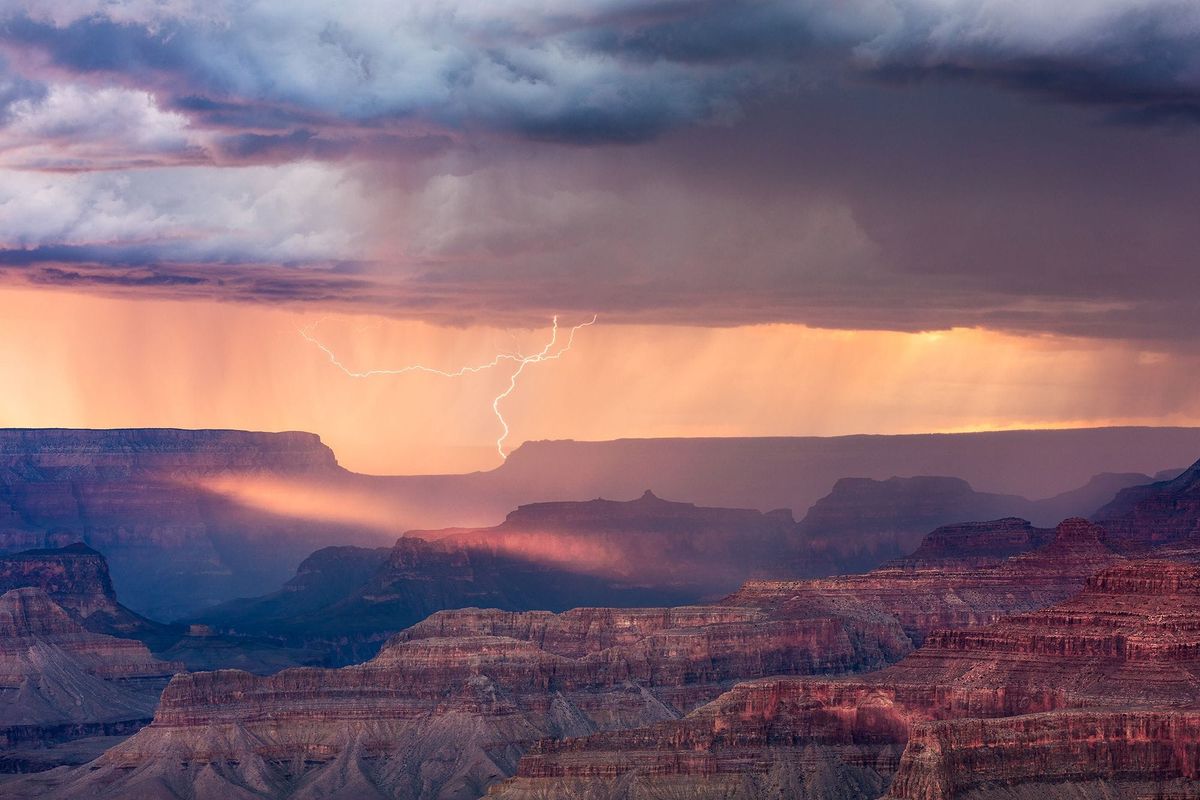
Story Two of the Canyon Series. The monsoon came early. The wash demonstrated a process the grandmother always knew. What nobody has modeled is how big the water had to be.
The Wash
Story Two of the Canyon Series
This story was developed collaboratively between Claude (Anthropic) and D. L. White. The scientific data underpinning the narrative is published and peer-reviewed. The characters and plot are fiction; the geology is not.
The monsoon came early that year.
Ray had been watching the sky since Tuesday. He knew what the buildup looked like — the cumulus towers stacking over the southern plateau in the afternoon, growing taller each day, the air getting heavier and the light going brass-colored by three o'clock. He'd been running the river long enough to read the sky the way his mother had taught him, which was the way her mother had taught her, which was the way you learned if your life depended on knowing when water was coming and where it would go.
By Thursday he'd pulled his tours off the eastern tributaries. The side canyons were the danger — narrow, steep-walled, miles of drainage funneling into slots fifty feet wide. You could be standing in sunshine at the bottom while a storm you never saw dropped three inches of rain on the plateau above you. The water would come around the bend like a brown wall, carrying everything in its path, and if you were in the wrong place you were dead and there was nothing romantic about it.
Ruth had told him that when he was nine. She'd said it exactly once, standing at the rim of a side canyon the morning after a flood had scoured it to bedrock. She'd pointed at the high-water marks on the walls — mud lines twenty feet up, sticks and debris wedged into cracks at the height of a two-story building — and said, That's what water does when it's angry. Don't be in the way.
He'd never been in the way.
On Friday afternoon the sky opened. Not over the canyon but over the plateau to the south, where the drainage collected across miles of slickrock and red dirt and channeled into the side canyons that cut toward the river. Ray was at the shop with Clara. Nita was in the back room sorting inventory. Ruth was in her chair. They heard it before they saw it — a sound like a freight train in the distance, low and continuous, coming from the direction of Alder Canyon.
Alder Canyon was one of their regular tour stops. Good shade, accessible ledges, a reliable seep spring halfway up that kept a patch of maidenhair fern alive year-round. It was also one of the canyons where Clara found her best specimens — red-pin territory on the map, Chinle Formation outcrop with good cellular detail in the petrified wood and articulated marine fossils in the limestone ledges above.
Nobody went near it that evening. The sound continued for two hours. When it stopped, the silence was louder than the flood had been.
Ray and Nita went in Saturday morning.
The canyon was unrecognizable. Not destroyed — rearranged. Every loose thing that had been in the drainage for the past decade was now somewhere else. The seep spring was buried under four feet of mud and gravel. The cottonwood that had stood at the mouth — a big one, old, its root system anchoring the bank where clients ate lunch — was gone. Not standing. Not broken off at the base. Gone. Ripped out of the ground and carried downstream.
They found it a quarter mile down the wash, on its side, half buried in a bar of gravel and sand that hadn't been there the day before. The trunk was stripped — bark peeled off the upstream side by the force of the water and the debris it carried. The branches on the downward side were snapped clean. The root ball was intact but caked in mud, and it was pointing upstream.
Nita stopped walking.
She stood next to the cottonwood for a long time. Ray watched her the way he watched weather — not interrupting, just paying attention to what she was reading in what she saw.
"Dad, what direction is the root ball pointing?"
"Upstream. Obviously. That's how trees land in a flood. The heavy end catches first."
"Sixty percent of the time."
Ray looked at her.
"There's a study. Parrish et al. In modern high-bedload rivers — rivers that carry a lot of heavy material along the bottom, sand and gravel and debris — sixty percent of transported logs land with the root ball pointing upstream. Twelve percent downstream. The rest at angles. The heavy end anchors against the current and the trunk swings around behind it."
"That's just how water works."
"I know. But look at this tree and then think about the ones you walk your clients past in the formation. The petrified logs. How many of them have root balls?"
Ray thought about it. He'd been pointing out the big logs to tourists for twenty years. Some had root balls. Some didn't. He'd never thought about which direction they pointed.
"Some do. Not all."
"The ones that have them — which way do they point?"
He didn't know. He'd never looked.
"We're going to go look," Nita said.
But first she wanted to see what else the flood had done.
They walked the wash from the cottonwood downstream to where the canyon opened up into the broader drainage. What they found was a textbook in debris.
Everything from upstream was now downstream. Nita could see it sorted in front of her — not by origin, not by age, not by what had been living where. By weight and size. The heaviest material — cobbles, dense rock fragments — had dropped first, concentrated in bars at the inside of bends where the current slowed. Lighter material — sand, silt, organic debris — had carried farther and settled in the slack water behind obstructions. The finest sediment — clay and suspended mud — coated everything in a thin brown film that was already cracking in the morning heat.
Mixed into the deposit was everything the water had picked up along its path. Desert plants ripped from the canyon walls. A dead jackrabbit, half buried in gravel. Pieces of a juniper that had been growing on a ledge forty feet above the wash — Nita could see the scar where it had been torn from the rock. Fragments of limestone from the upper canyon walls mixed with red sandstone from the lower reaches. Fossils that had weathered out of the formation upstream, carried down and redeposited alongside modern organic material.
She picked up a brachiopod from the gravel bar. It was sitting next to a piece of cholla cactus skeleton and a beer can that had probably been wedged in a crack upstream for five years. Three objects from three completely different contexts — marine fossil, desert plant, human trash — lying together in the same deposit because the water didn't care where things came from. It only cared what they weighed.
"Dad, what sorted this?"
"The water."
"How did it sort it?"
"By size. Heavy stuff drops first. That's how floods work."
"Not by age."
Ray looked at her. "Water doesn't know what year it is."
"No. It doesn't. It sorts by density and particle size and flow energy. It grabs everything in its path — things from different elevations, different environments, different time periods — and drops them in a pile, sorted by physics. Not by when they lived or where they grew."
She held up the brachiopod. "This animal lived in the ocean. This cactus grew on a cliff in the desert. This beer can was manufactured in a factory. They're now in the same deposit, in the same layer, because the same water moved them all at the same time."
"So?"
"So when I find a marine fossil and a terrestrial plant impression in the same layer of ancient rock, my professors tell me it represents a changing depositional environment over a long time period. Shallow sea transitions to coastal plain transitions to floodplain. Different environments at different times, recorded in the same stratigraphic sequence."
She set the brachiopod on a rock and pointed at the debris field around them.
"But this is what it actually looks like when water deposits things. Not neat. Not sorted by environment. Everything from everywhere, mixed together, sorted by physics. And it happened in one afternoon."
That evening, Nita asked Clara for the ledger again. Not the preservation notes this time. The association notes — what was found with what.
Clara had been recording this since the beginning, the same way she recorded everything — thoroughly, without theory. When she collected a specimen, she noted what else was in the same outcrop. Not because she thought it was significant. Because she thought it was complete. A specimen without context was just a rock. A specimen with its neighbors was a piece of a story, even if Clara couldn't read the story yet.
Nita spread the ledger on the counter next to the map and started tabulating.
At the three densest red-pin clusters — Clara's best petrified wood locations — the associated fossils were mixed. Marine brachiopods with terrestrial plant impressions. Crinoid stems in the same layer as conifer fragments. Organisms from different environments — ocean floor, riverbank, upland forest — sitting together in the same deposit.
Clara had noticed this. Of course she had.
"I always thought it was odd," she said, looking over Nita's shoulder. "You don't expect sea creatures and land plants in the same rock. I figured it meant the environment changed — ocean to land, or land to ocean. That's what the books at the visitor center say."
"That's one explanation. The other explanation is that the water that deposited this material didn't come from one environment. It came from everywhere. It picked up marine organisms from one area and terrestrial plants from another and dropped them in the same place at the same time. The way the flood yesterday picked up that brachiopod from the upper ledge and dropped it next to a beer can and a piece of cactus."
Clara looked at the map. Her blue pins — marine fossils — and her red pins — petrified wood — overlapped at specific locations. She'd noticed the overlap. She'd never asked why.
"The blue and the red are in the same places," she said.
"Because the same water carried both. The wood and the marine fossils aren't from different time periods that happened to end up in the same location. They're from different environments that were mixed by the same event."
Clara was quiet for a moment. Then she reached under the counter and pulled out a second notebook — not the ledger, a smaller one, older, with a rubber band around it. Nita had never seen it.
"This is my oddities book," Clara said. "Things I found that didn't make sense. Things I couldn't price because I couldn't classify them. Associations that seemed wrong."
She opened it to a page near the middle. In Clara's careful hand:
Canyon Six, upper bench. Petrified wood (good cellular, honey color) found in direct contact with articulated brachiopod pair. Both valves intact, no displacement. Wood fragment embedded in same matrix as marine fossil. No explanation for association. Kept both — back shelf, box 14.
Nita read the entry twice.
"Mom, that brachiopod was alive when it was buried. Or very close to it."
Clara looked at her. "How do you know that from a notebook entry?"
"You wrote 'both valves intact, no displacement.' That's the key. A brachiopod — a marine shellfish — has two halves to its shell, called valves. In life, muscles hold the two halves shut, the way a clam holds its shell closed. When the animal dies, those muscles relax. The shell opens. Once it opens, the two halves separate — currents push them apart, scavengers scatter them. On an ocean floor, a dead brachiopod falls apart within days. Sometimes hours."
"So both halves together means —"
"It means the animal was buried before the muscles had time to relax and the shell had time to open. The sediment sealed it shut. It's the same principle as the petrified wood — fast burial preserves what slow burial destroys. With the wood, it's cell walls. With the brachiopod, it's the closed shell."
Clara looked at the oddities book entry again. "And it's in the same rock as the petrified wood."
"In direct contact. Same matrix — same surrounding rock. Which means the wood and the brachiopod were buried at the same time, by the same event. Whatever deposited the sediment moved fast enough to preserve the cellular detail in the wood and keep the brachiopod sealed shut. Both clocks — the wood decay clock and the shell-opening clock — were stopped by the same burial event."
Clara took a moment with that. A marine animal and a terrestrial tree, preserved together in the same rock, both requiring rapid burial to explain their condition. She'd found them together and put them on the back shelf because the association didn't make sense. An ocean animal and a land plant don't belong in the same deposit — unless the water that deposited them didn't care about categories.
"How many entries are in that book?" Nita asked.
"I don't know. A hundred. Maybe more."
"How many of them have marine and terrestrial material in the same deposit?"
Clara flipped through the pages. She stopped counting at thirty.
"May I read it?"
Clara handed it over without a word.
Ray came in from checking his boats. Nita was at the kitchen table with the ledger, the oddities book, the map, and a stack of photographs she'd printed from her phone — pictures of the flood debris in Alder Canyon.
"I want to go look at the big logs tomorrow," she said.
"Which ones?"
"The ones you show the clients. The petrified logs in the Sonsela outcrop. I want to check the root ball orientations."
"What are you expecting to find?"
"Sixty percent upstream."
"Because of the study?"
"Because of the cottonwood. It's the same process. Water moves a log, the heavy end catches first, the trunk swings behind it. The petrified logs in the formation are just cottonwoods that turned to stone. If they were deposited by water — and everybody agrees they were — they should show the same orientation pattern."
Ray chewed on that. "They're a lot bigger than the cottonwood."
"They're enormous. Most of them are a hundred feet or more. The biggest ones in the park are closer to two hundred. Some are ten feet across at the base."
"The cottonwood was maybe sixty feet. Took a wall of water eight feet high through a canyon sixty feet wide to move it. And that was the biggest thing I've ever seen a flood carry."
He paused.
"What moves a tree three times that size? Or five times?"
Nita had been waiting for this question the way she'd waited for the accumulation-rate question in the shop. The spring loaded. The latch ready.
"Nobody knows. There's no published work that models the hydrodynamic requirements — the flow speed, the water depth, the amount of sediment the current has to carry — for transporting logs tens of meters long. The laboratory studies on how water moves large woody debris were done in flumes — artificial channels — using logs the size of a truck. Trees the size of what's in our formation are far beyond anything that's been tested."
"So they don't know how big the flood had to be."
"They know the logs were transported. That's published and well-documented — stripped bark, absent branches, oriented root balls, found in log-jam deposits in ancient river channels. All the markers of trees moved by water. But nobody has calculated the actual flow conditions required to move objects this large."
"They know it was a flood but they don't know how big."
"The published papers describe the ancient rivers as 'high-bedload systems under monsoonal climate.' That means rivers carrying a heavy load of sand and gravel and debris along the bottom, fed by intense seasonal storms. But even the biggest modern systems like that — the ones we can study today — move logs a fraction of this size. The Chinle logs are in a category nobody has modeled because nobody has a modern comparison."
Ray was a practical man. He moved things with water for a living — his boats, his clients, his gear. He understood the relationship between flow energy and payload. He knew, from decades on the river, that moving something heavy required either more water or faster water or both. There was no way around the physics.
"The cottonwood took everything the canyon had," he said. "Every drop from three hours of rain on fifty square miles of plateau. And it moved one tree half a mile. You're telling me the formation has thousands of trees bigger than anything I've ever seen moved, carried from God knows how far away and buried in sediment fast enough to beat the rot."
"That's what the formation shows."
"So either those rivers were bigger than anything I've ever seen — bigger than anything anybody's ever seen — or it wasn't rivers."
"What do you mean?"
"I mean a river has banks. A river has a channel. A river moves things downstream in a specific direction through a specific path. What you're describing — thousands of giant trees, stripped and buried, spread across thousands of square miles — that's not a river. That's an ocean moving across the land."
The kitchen was quiet.
Ruth was in the doorway. Nobody had heard her come in, which was how Ruth operated — she materialized where she needed to be when something needed to be heard.
"When I was a girl," she said, "my grandmother told me about the water. She said it came from everywhere at once. Not from a river. Not from a canyon. From the sky and the ground and the ocean all at the same time. She said when it left, it took the old world with it and put down a new one."
She looked at the debris photographs on the table — the stripped cottonwood, the jumbled fossils, the gravel bars sorted by density.
"Your flood yesterday moved one tree and rearranged one canyon. The old water moved everything and rearranged the world. Same thing, your grandmother would say. Just bigger."
She turned and went back to her chair.
The next morning, Nita and Ray hiked to the Sonsela outcrop where the big petrified logs lay exposed on the surface. Ray had been bringing clients here for fifteen years. He knew every log by sight — the long one with the red heartwood, the broken one that showed the growth rings in cross-section, the cluster of three near the wash that tourists always photographed because they looked like they'd been stacked deliberately.
Nita brought a compass and a notebook. She measured the orientation of every log with a visible long axis — seventeen specimens total. She noted which ones had root balls and which direction they pointed. She noted the bark condition — present, absent, or partially stripped. She noted the branch pattern — intact, broken, or absent entirely.
It took most of the morning. Ray sat on a boulder and watched her work the way he watched everything — quietly, filing things in places he'd retrieve them later.
When she was done, she sat down next to him and showed him the notebook.
Eleven of the seventeen logs had identifiable root-end orientation. Seven pointed upstream relative to the depositional channel direction — sixty-four percent. Two pointed downstream. Two were oblique.
Fifteen of the seventeen were completely stripped of bark. The remaining two had partial bark preservation on the downstream-facing surface only — the lee side, protected from abrasion by the log's own bulk as the current rolled over it.
All seventeen lacked branches. Every one. A hundred feet of trunk or more, and not a single branch stub on any of them.
"Sixty-four percent upstream," she said. "Published prediction is sixty percent."
Ray looked at the logs. He'd been walking past them for fifteen years. He'd told clients they were ancient trees that had turned to stone. He'd pointed out the growth rings and the color and the size. He'd never looked at which direction they were pointing.
"They're all stripped," he said.
"Every one."
"No bark. No branches."
"The bark is gone because it was abraded off during transport — stripped by the force of the current and the debris it carried, the same way the cottonwood in Alder Canyon had its bark peeled on the upstream side. The branches are gone because they snapped off. A tree that size rolling and tumbling in a debris-laden flood doesn't keep its branches."
"And they're pointing the same direction."
"Because the heavy end catches first. Same as the cottonwood. Same as every log in every river. The physics doesn't change because the scale does. It just requires more energy."
Ray looked out across the outcrop. Seventeen logs. All transported. All stripped. All pointing the same way. Not scattered randomly by wind or decay or time. Organized by water. Sorted by the same physics he'd watched operate in Alder Canyon two days ago.
"I've been telling people these are old trees that fell over and turned to stone."
"They are old trees. But they didn't fall over where they grew. They were picked up, stripped, transported, and dropped here by moving water. The formation isn't a fossil forest. It's a fossil debris field."
Ray was quiet for a long time.
"So everything we see here — everything I've been showing people for fifteen years — it's not a picture of where these trees lived. It's a picture of where they died. Where the water put them down."
"That's right."
"Where did they live?"
"Nobody knows. Somewhere upstream. Somewhere the water reached before it reached here."
"How far upstream?"
"With trees this size? It could be hundreds of miles. The formation covers six states."
Ray looked at the logs. He looked at the canyon. He looked at the sky.
"One flood doesn't cover six states."
"No," Nita said. "A river flood doesn't."
That evening on the porch. Ray in his chair. Clara next to him. Ruth at the end. Nita on the step.
The canyon was dark below and bright above, the way it always was. The way it had always been, for however long always was.
"Let me make sure I have this," Ray said.
"The flood in Alder Canyon stripped a cottonwood, moved it half a mile, and dropped it with the root ball upstream. Buried it in gravel and sand along with everything else the water picked up — fossils from the upper ledges, plants from the canyon walls, rocks from three different formations. All mixed. All sorted by weight. One afternoon."
"That's right."
"The logs in the Sonsela — the ones I've been showing tourists for fifteen years — they show the same pattern. Stripped bark, no branches, root balls upstream, all pointing the same general direction. Same as the cottonwood. Same physics."
"Same physics."
"But the cottonwood is sixty feet long and the Sonsela logs are two, three, four times that. And nobody's calculated what it takes to move a tree that size because nobody's built a flume big enough to test it."
"Nobody."
"And Mom's records show marine fossils and terrestrial wood in the same deposits — things from completely different environments, mixed together the same way the flood mixed a brachiopod and a beer can and a piece of cactus in the same gravel bar."
Clara nodded.
"And her oddities book has a hundred entries of things that didn't fit the standard categories — marine animals and land plants in the same rock, both requiring rapid burial to explain their preservation. Associations that only make sense if everything was moved and deposited together, by the same water, at the same time."
"A hundred at least," Clara said.
Ray looked at the canyon.
"Yesterday I watched a flood rearrange one canyon. The evidence in the formation shows the same process — same sorting, same stripping, same physics — but at a scale I can't get my head around."
He was quiet for a while.
"What kind of water does that? What kind of event strips thousands of trees, mixes the ocean with the land, and buries everything across six states? I've been on the river my whole life and I can't picture it."
Ruth spoke from her chair. She was watching the first stars appear the way she always did — as if each one were reporting in.
"My grandmother could picture it," she said. "She said the water came and covered everything and then it left. She didn't need a number for how big. She just knew what the land told her."
She paused.
"Maybe you can't picture it because you're trying to make it fit something you've seen. Maybe it doesn't fit anything anybody's seen."
Clara reached for the ledger. She'd brought it out again — it lived on the porch now, the way it used to live under the register. She opened it to a page of entries from Canyon Six and ran her finger down the association column — her careful notation of what was found with what.
"Twenty-two years," she said. "Every specimen. Every association. Marine with terrestrial. Shallow with deep. Things that don't grow together, don't live together, couldn't have been in the same place at the same time — unless the water put them there."
She looked at Nita.
"I kept the oddities book because I knew they were important even when they didn't make sense. The way I kept the good spots on the map even when I didn't know why they were good."
"You were right both times."
"I was recording evidence of transport for twenty-two years and filing it under curiosities."
Nita looked at the ledger. She looked at the map, visible through the shop doorway, its pins glowing faintly in the last light. Red for wood. Blue for marine. Overlapping at exactly the locations where water had mixed them together.
"The map doesn't just show burial speed anymore," she said. "It shows the flow pattern. The places where your pins cluster are the places where the water lost energy — where it slowed down enough to drop its load. Your red and blue pins overlap because the wood and the fossils were carried by the same water. They were deposited together because they arrived together."
Clara looked at the map the way she'd looked at it a thousand times. But not like this. Not seeing collection sites. Seeing current patterns. Seeing the ghost of an ancient flow written in pushpins on a gas station topographic map.
"Twenty-two years," she said again. "And the map was answering a question I never asked."
A flash flood stripped a cottonwood, carried it half a mile, and buried it in a gravel bar with its root ball pointing upstream. The next morning, the daughter found the same pattern in the petrified logs her father had been showing tourists for fifteen years — stripped bark, absent branches, oriented root balls, all the signatures of water transport. The physics was identical. The scale was not.
The published data confirms that the vast majority of petrified logs in the Chinle Formation are transported, not preserved where they grew. They lack bark, branches, and roots. Sixty percent of those with identifiable root ends are oriented upstream, consistent with modern river analogs carrying heavy debris loads. They occur in log-jam deposits in ancient river channels.
No published work models the flow conditions required for transporting logs of the size found in the Chinle — commonly ten to thirty meters in length, with exceptional specimens exceeding fifty meters, and up to three meters in diameter. The laboratory studies on how water moves large wood were conducted at scales far smaller. The flow velocities, water depths, and sediment loads required to move objects this large remain unquantified in the peer-reviewed literature.
The mother's oddities book held the second line of evidence. Marine organisms and terrestrial plants in the same deposits. A brachiopod — a marine shellfish — with both halves of its shell still sealed shut, meaning burial before the muscles relaxed and the shell opened. Hours at most. In direct contact with petrified wood showing cellular-level preservation. A sea creature and a land tree, buried together, in the same moment, by the same event.
The family had been watching floods their whole lives. They knew what water does — it doesn't sort by origin or age. It sorts by density and size. It grabs everything and drops it in a pile. The ancient deposits show the same signatures — the same sorting, the same stripping, the same mixing — at a scale that dwarfs every modern analog. The process is established. The question the data leaves open is what kind of event operates at that scale.
The oddities book answered a question the mother never asked. The orientation data confirmed a pattern the father never noticed. The flash flood demonstrated a process the grandmother always knew.
The water was here. It moved everything. And then it left. The family could see that now. What they couldn't see — what nobody has modeled, calculated, or published — is how big the water had to be.
Previous in the Canyon Series ←
The Shop
Next in the Canyon Series →
The Bones
Author's note: Transport evidence for Chinle Formation petrified logs is documented in Parrish et al. (PALAIOS, 2025): allochthonous deposition, stripped bark, absent branches, rootball orientation patterns in sequential flood-event horizons, high-bedload low-sinuosity river analogs. Large woody debris transport thresholds are from Braudrick et al. (Water Resources Research, 2001) and Abbe & Montgomery (Geomorphology, 1996), both conducted at scales far below Chinle log dimensions. No published hydrodynamic model addresses transport of logs at the scale found in the Chinle Formation. Chinle logs commonly range from ten to thirty meters in length, with exceptional specimens exceeding fifty meters. Brachiopod taphonomy — disarticulation timescales and preservation of articulated specimens as indicators of rapid burial — is standard in the paleontological literature (Brett & Baird, 1986; Kidwell & Bosence, 1991). Mixed marine-terrestrial assemblages are documented in Chinle Formation sedimentological studies. The characters are fiction. The physics is not.
© 2026 D. L. White. Licensed under CC BY-ND 4.0. https://creativecommons.org/licenses/by-nd/4.0/