Where Did the Dove Find Peace?
Part One of the Diaspora Series. If the event happened, the recovery has to work. Practically. The animals have to eat. The plants have to grow. The ground has to support weight. Not theology — engineering.

Where Did the Dove Find Peace?
A Practical Reconstruction of the Post-Catastrophe Recovery
Part One of the Diaspora Series
What the Wolves Left Behind
The Diversification Series ended with a window and a count. Diversity runs downhill in every family examined, without exception, and the molecular clock — tested against a dog breed with a documented founding date — overestimates elapsed time by hundreds to thousands of times. Against that, a date built from two directly measured quantities: the private mutational load carried in human genomes, divided by the germline mutation rate measured in parent–offspring trios. No assumed population size enters it. The founding point falls between 4,725 and 7,200 years ago. Running the drift equation forward from a single founding pair across that window then gives a figure to test taxonomic families against — and every family with the genetic data to check it comes in under. The kind count that follows, 425 to 550 extant land vertebrates, fits inside a vessel whose dimensions are specified in Genesis.
The series did not name the event. The numbers did that for the reader.
This paper takes the next step. If the event happened — if the air-breathing vertebrates alive today descend from a small number of founding kinds that emerged from a survival vessel onto a post-catastrophe landscape — then the recovery has to work. Practically. The animals have to eat. The plants have to grow. The ground has to support weight. The climate has to cooperate. And every kind that walked off the vessel and now occupies a specific continent has to have a plausible way of having got there.
The specification is narrower than the caricature it is usually argued against. It names creatures "in whose nostrils was the breath of the spirit of life" — mammals, birds and land reptiles, with amphibians debated on textual grounds. Birds are passengers; the specification names them. Insects and the other invertebrates are not passengers. Neither is the marine biosphere, nor the freshwater systems. Their survival is a separate question with a separate answer, taken up in Propositions 8 and 9. What has to be accounted for here is a few hundred kinds coming off a ramp, not the restocking of a planet from a single boat.
The Diversification Series established the when and the how many. The “What Broke the Foundations?” standalone established the how — the cork-popping shell failure, its velocity profile, and its thermal consequences. This paper establishes the what happened next. Not from theology, but from engineering.
The Engineering Specification
The Diversification Series approached Genesis obliquely — through genetics and population biology, without naming the source until the data demanded it. That approach served its purpose: it allowed the reader to evaluate the evidence without prejudice.
By the end of the third paper, the reader who followed the argument knows where it leads. Continuing to avoid the text would be patronizing. The account in Genesis 7–8 provides specific, datable, verifiable claims about the sequence of events. These claims can be evaluated as an engineering specification — a description of what happened, in what order, on what timeline. The question is not whether the reader believes the text. The question is whether the physics affirms it, contradicts it, or is silent.
The Timeline
All dates reference Noah's 600th year. The calendar uses 30-day months, established by the 150-day period spanning exactly five months (Month 2, Day 17 to Month 7, Day 17).
Genesis 7:11 — "In the second month, on the seventeenth day of the month, on that day all the fountains of the great deep burst forth, and the windows of the heavens were opened."
Genesis 7:12 — Rain falls for forty days and forty nights.
Genesis 7:24 — Waters prevail on the earth 150 days.
Genesis 8:1–2 — a strong wind prevails; the fountains of the deep and the windows of the heavens are closed; the rain is restrained.
Genesis 8:4 — Month 7, Day 17: the ark rests on the mountains of Ararat.
Genesis 8:5 — Month 10, Day 1: the tops of the mountains become visible.
Genesis 8:6–7 — Forty days later: Noah sends a raven. It does not return.
Genesis 8:8–9 — Noah sends a dove. It returns — no resting place.
Genesis 8:10–11 — Seven days later: the dove returns with a freshly plucked olive leaf.
Genesis 8:12 — Seven more days: the dove does not return.
Genesis 8:13 — Month 1, Day 1 (Year 601): Noah removes the covering. The surface of the ground is dry.
Genesis 8:14–19 — Month 2, Day 27 (Year 601): the earth has dried out. God commands the exit. Noah, his family, and all the animals leave the ark.
Total duration: approximately 371 days.
Three features of this account are immediately relevant to the physical reconstruction.
First, the text names the tectonic event before the rain. "The fountains of the great deep burst forth" precedes "the windows of the heavens were opened." This is a tectonic narrative with rain as a consequence, not a rain narrative with geological effects.
Second, the Hebrew vocabulary shifts at day 40. The word mabbul — the violent, catastrophic deluge — appears twelve times in Genesis 6–9, but the last occurrence is at 7:17. After that, the text uses only mayim (waters). The character of the event changes.
Third, the account provides a progressive recovery timeline with specific data points: grounding at day 150 accompanied by strong winds, mountaintops visible at day 223, a raven surviving outside at day 263, a dove finding an olive tree with fresh growth at day 272, a dove not returning at day 279, surface dry at day 314, ground firm at day 371. This is a drainage, drying and vegetation timeline, not an evaporation timeline alone.
The Propositions
What follows is a sequence of propositions, each introduced to resolve a specific practical problem. The format mirrors the first paper in the Diversification Series. Each proposition is clearly labeled. The reasoning that connects them is presented separately.
The propositions are not presented as proven facts. They are practical inferences derived from the Genesis account treated as an engineering specification. If the account is substantially true as written, then the event was planned and executed with competence. Physics does not choose the complicated path when a simple one exists; water flows downhill, heat dissipates through available mechanisms, and organisms survive by the means their biology provides. The propositions therefore represent our attempt to reconstruct the most physically sensible sequence that would make the described events workable under standard physics. Each proposition begins with the observed outcome in the text and works backward to the most practical mechanism that would produce it. The companion papers in this series will test these inferences with quantitative modeling.
Proposition 1: The destruction was tectonic, not hydraulic.
The text itself states this. The fountains of the great deep burst forth — crustal fracture, subterranean water expelled under pressure through rift zones, volcanic eruptions along fracture lines. This is the trigger. The rain follows as a consequence: extreme evaporation from the newly opened hot rift basins drives massive atmospheric moisture loading, volcanic aerosols lower the condensation ceiling, and torrential rainfall results. The rain is a product of the tectonic event, not the cause of the flood.
The physical consequence is immediate: plates begin to move. At the velocities established in the “What Broke the Foundations?” standalone (peak velocity approximately 12 km/yr from the three-phase deceleration model), crustal displacement generates continental-scale tsunamis within hours. Every low-lying surface on the landmass is inundated — not by rising rain, but by displaced ocean water moving at hundreds of kilometers per hour.
What this resolves: The mechanism of destruction. Nothing on low ground survives (and all of the ground starts out low before mountains are uplifted) — not because it stays underwater for a year, but because it is hit by a wall of water moving at the speed of a freight train. The distinction matters for everything that follows.
Proposition 2: The ark was positioned in the continental interior.
On a pre-catastrophe supercontinent (Proposition 3 of the companion paper), the fracture zones — future coastlines — are at the edges. The violence originates there: volcanic eruptions, rift formation, explosive water release. Tsunamis propagate inward from these boundaries.
In the deep interior, the water arrives differently. A tsunami crossing hundreds of kilometers of flat terrain loses energy. It does not arrive as a breaking wave. It arrives as a rising flood. The text describes exactly this: "The waters increased and bore up the ark, and it rose high above the earth" (Genesis 7:17). The vessel lifts. It is not struck.
This is not theological reasoning. It is practical planning. If the event is tectonic, and the violence originates at the crustal fracture zones, then the interior of the landmass is the safest place to launch a vessel that must survive the initial hours. A competent engineer would position the ark there. The text describes a competent engineer.
What this resolves: The survival of the vessel during the initial catastrophe. A vessel designed to float, positioned in the continental interior, experiences a rising flood rather than a coastal impact. The engineering is sound.
Proposition 3: Inundation was dynamic and regionally variable, not uniform global submersion.
This proposition follows directly from Proposition 1. The destruction mechanism is tectonic — tsunamis, not rising bathtubs. A tsunami crosses a landscape in hours to days, not months. The water passes over and continues moving. What it leaves behind is wet, battered, and debris-strewn — but not permanently submerged.
The 150 days during which "waters prevailed" does not require 150 days of static submersion at every point on the landscape. It requires 150 days during which the ongoing tectonic event — plates still moving at over 95% of initial velocity, basins still opening, mountains still rising, ocean still violently churning — prevents the water from settling. The surface is not still. The surface is in continuous, violent rearrangement. Any given point of land may be alternately exposed and submerged multiple times as waves, currents, and tectonic displacement reshape the surface hour by hour.
The critical distinction: the highland regions that are being thrust upward by plate convergence are not submerged for months. They are hit by waves, exposed as the water drains into adjacent basins, hit again, exposed again. The total duration of submersion at any given highland location is measured in hours to days per episode, not months of continuous inundation.
What this resolves: The survival of the terrestrial biosphere outside the ark. Under prolonged submersion, every root system, every seed bank, every soil microbe, every insect egg is destroyed. Under dynamic, regionally variable inundation, deep-rooted plants survive. Insect eggs in soil survive — they are waterproof by design. Seeds survive. Soil microbial communities survive in anaerobic pockets. The biosphere is battered but not sterilized. Under the staircase diversification model established in the Diversification Series, local survival of only approximately 10⁻³ to 10⁻⁴ of pre-catastrophe seed banks and insect eggs is sufficient to repopulate observed post-catastrophe diversity — a threshold well within the survival capacity demonstrated by modern tsunami research.
Published research on vegetation survival after the 2004 Indian Ocean tsunami and the 2011 Tohoku tsunami confirms this at every level. Deep-rooted trees — specifically including olive trees — survive brief saltwater inundation with high recovery rates. Root systems resprout within months. Salt is leached from soil by subsequent heavy rainfall. Recovery is fastest in high-rainfall tropical and subtropical environments.
The biosphere did not restart after the catastrophe. It resumed.
Proposition 4: The fossil record is consistent with the event and with the centuries that followed it.
If the destruction mechanism is tectonic — continental-scale tsunamis generated by rapid plate motion — then the fossil record should bear the signature of that event and of the regime that followed it, rather than of slow accumulation. It does, though not in the way a first pass suggests.
The broad pattern is real and is not in dispute. Marine invertebrates dominate the lowest fossiliferous strata. Terrestrial vertebrates appear higher. Birds and mammals are concentrated highest. The standard explanation attributes this to evolutionary succession over hundreds of millions of years. A catastrophist account is commonly assumed to attribute it to hydraulic sorting during the wave itself — heavy and slow settling low, light and mobile caught later and deposited higher. That second explanation does not survive contact with the flow conditions this model requires, and this paper does not use it.
On the low-lying surfaces where most of the column sits, the violent phase does not deposit at all. Flow velocities from interfering, continental-scale wave trains exceed the mobilization threshold for boulders, cobbles, gravel, sand, silt and clay at the same time. Nothing settles; everything moves. What that phase leaves behind is an erosion surface and an unsorted debris pile — raw material, not a graded sequence. Sorting comes afterward and by a different agent: the long regime of wind-driven sheet flow worked in the Deposition Series, which sorts by grain size against a declining thermal contrast rather than by how fast an animal could run.
So the broad marine-to-terrestrial ordering is not the wave's handiwork. It is largely a record of where the organisms already were. Marine communities occupied the seafloor and the low ground; terrestrial communities occupied the surfaces above them; the ordering is habitat and elevation, laid down before the event and, in most places, still where it was laid. The event's own contribution is destruction, displacement and trapping — breaking material up, moving some of it, and dropping loads wherever the flow decelerated.
The record also carries a finer feature, and it points the same way: fine biostratigraphic zonation. Specific assemblages of species appear in the same relative order across multiple continents, with a precision no turbulent flow would generate. As noted in the first paper of the Diversification Series, that precision is better explained by recognizing that organized ecosystems existed before the catastrophe and had already produced stratified fossil deposits through normal processes. What the catastrophe then did to that existing record is the subject of the rest of this proposition.
The critical question is how a record that already existed could come through a global hydraulic catastrophe without being homogenized into undifferentiated rubble. The answer is not that all of it was picked up and reassembled. An event of this kind leaves behind material it did not touch, material it moved without breaking, and material it broke and redeposited. The model requires all three, and all three are observed. The fine ordering is carried mostly by the first two: it survives because it was never lifted, or because whatever moved it moved it as a unit.
Undisturbed ground is the largest part of that. A catastrophe that is regionally variable by construction — Proposition 3 — is also variable in what it excavates. Where the water passed over without cutting, the older record stays where it was laid down, in normal bedding, with in-situ assemblages and no transport contact beneath it. Nothing needs to preserve its order, because nothing moved it.
Where material did move without breaking, coherent transport is the mechanism, and it is well documented. At the surface: chaos. Breaking waves, turbulent mixing, violent destruction. Nothing deposited there preserves structure. At depth, a different physics operates. Density-driven currents and coherent mass flows carry enormous volumes of sediment across long distances while preserving internal layering. The mechanism is analogous to sliding a deck of cards across a table — the deck moves, but the cards stay in order. Geologists call these features olistostromes, megaturbidites, and submarine mass transport deposits. The 1929 Grand Banks earthquake triggered a submarine turbidity current that traveled over 600 km across the ocean floor at speeds up to 100 km/hr and deposited a graded, internally layered sequence that geologists can read as clearly as a book. Its internal structure survived because the deep-water flow was coherent — laminar and density-driven — not turbulent.
What that mechanism is asked to do here is bounded. These are local-to-regional features in the observed record. This paper does not scale them to continents, and does not ask them to carry biostratigraphic correlation between continents. Coherent transport accounts for displaced packages that arrived intact. It does not account for the global ordering, and it does not need to, because the ordering is mostly still where the pre-catastrophe ecosystems put it. Subsea layering that appears to have shifted as a coherent stack is consistent with a regime that included subduction on this scale; the model is compatible with such observations but does not explicitly predict them.
The third condition is the broken fraction, and it is the one the event itself creates. Where the water was moving fastest it carried everything and deposited nothing. Where it decelerated — into a basin, a hollow, any depression — it dropped what it was carrying together, and what accumulates there is a census of the load rather than a graded sequence. The remainder was left as debris for the later regime to sort.
That fraction is not all laid down at once. The tsunami phase is brief against what follows it. Behind it comes a longer regime: the Pacific closing under compression, a remnant ocean still sloshing, and directional winds driving storm surge and sheet flow across the continents for as long as the weather stays violent. Deposits from that phase are sorted at scale by wind-driven water, and they sit above and among what the first hours left. The column is therefore not one instant's product. It is a sequence of conditions inside a single event, and the deposits differ by when in that sequence they were laid and by where the ground was standing at the time.
The fossil record does not refute the catastrophist model. The model produces mixed, reworked deposits where the water was violent, ordered sequences where it was not or where it moved material as a unit, unsorted dumps where it stopped, and sorted sheets from the long weather afterward — at different times and in different places within one event. Destruction, displacement and trapping are the catastrophe's signature. Grain-size sorting against a declining thermal contrast is the later regime's. The ordering, coarse and fine alike, is mostly the pre-existing ecology's — left in place or carried along.
What this resolves: The apparent contradiction between catastrophic deposition and the ordered fossil record. The ordering — the broad marine-to-terrestrial pattern and the fine biostratigraphic zonation alike — belongs to the ecosystems that produced it before the event, and it survives because most of that record was never lifted, or was displaced as a unit. The event contributes destruction, displacement and trapping; the centuries after it contribute the grain-size sorting. Neither requires millions of years.
Proposition 5: The 371 days is a construction schedule.
The catastrophe does not require 371 days to destroy. It requires hours. Continental-scale tsunamis at initial plate velocities reach every point on a supercontinent within a day. Nothing on the low relief supercontinent with the “breath of life in its nostrils” survives the first 24 hours.
Everything after the first hours is recovery. And the recovery is driven by the same tectonic forces that caused the destruction.
Mountains do not wait for water to drain off them. They are being thrust upward by plate convergence. At the plate velocities of the early phase — approximately 12 km/yr at peak — convergence drives rapid uplift at the collision zones, and highlands push up through the water surface. The water does not fall. The land rises. (The additional frictional heat generated by rapid uplift remains thermally negligible relative to the heat budget established in the “What Broke the Foundations?” standalone.)
Simultaneously, ocean basins are being pulled apart by the same plate motion. New volume opens up below the water surface. Water flows into the deepening basins under gravity, lowering the effective sea level. A third term switches on at the same time, but it does not yet carry comparable volume. Massive evaporation from the hot rift basins — the Atlantic and Indian — drives extreme moisture transport into the atmosphere, and at high latitudes and high elevations that precipitation falls as snow and stays. Every meter of ice accumulating on cold highlands is a meter of water removed from the liquid system. The ice budget, though, is built over centuries of elevated accumulation, not over months. In year one the engine is running and the volume is not there yet.
Two mechanisms therefore carry the 371 days: mountains rising and basins deepening. Together they transform a flooded planet into one with substantial exposed land within months. Ice is a third drain on a longer clock, and its contribution shows up later — in the sea-level drop that opens the land bridges.
The grounding of the ark at day 150, at a practical elevation of 2,000–3,000 m in the Armenian Highlands (the text says "the mountains of Ararat" — a region, not a summit), implies that water has dropped below this elevation. But the vessel does not ground on an island. At 2,000–3,000 m water level, every landmass on Earth with terrain above that elevation is already exposed:
The Tibetan Plateau (average 4,500 m) — dry and greening for weeks or months.
The Ethiopian Highlands, the Andes, the Alps, the Rockies — exposed at various points, catching rain, growing things.
Total land area above 2,500 m on the modern Earth: approximately 17 million km² — larger than Russia's habitable land area. That is modern hypsometry, quoted as an analog for scale. The distribution is still being built during the uplift, so it is not a day-150 census.
By day 371, when the ground is firm enough for heavy animals, the ark's passengers do not walk out onto a muddy island. They walk out onto a continent.
The post-catastrophe landscape is not uniformly greening. Some areas remain chaotic — canyons being carved by massive runoff, rivers establishing new channels, sediment still shifting, ground still unstable. But between these zones of active rearrangement are large, well-drained highland patches where conditions favor rapid recovery: volcanic ash soil, warm rainfall, subtropical sun, adequate drainage on sloped terrain. These patches — not the entire surface, but large, connected regions of viable habitat — are where the recovery takes root. The entire planet does not need to be a garden on day 371. It needs enough connected habitable ground for the founding populations to find food, water, and breeding territory. The highland corridor across Eurasia provides this.
The regional character of the recovery is shaped by the three-basin thermal architecture established in the “What Broke the Foundations?” standalone. The Armenian Highlands — the landing site — sit between the hot Atlantic rift to the west and the hot Indian rift to the south. Both furnaces drive extreme evaporation, producing rainfall rates many times modern levels across the entire Near East and Caucasus region. This is the most intensely watered landscape on the post-catastrophe planet: positioned downwind of two furnaces, on high volcanic terrain with ideal drainage and mineral-rich ash soil. The recovery here is not a struggle against scarcity. It is a race to keep up with growth.
Regions farther from the furnaces — the interior of Asia, the Pacific-facing coasts — receive less precipitation. They recover more slowly, with drier conditions and longer timelines to full vegetation. This asymmetry is a direct consequence of the three-basin geometry: the new rift basins are the planet's weather engines, and the landscapes nearest to them green first and fastest.
What this resolves: The practical habitability of the post-catastrophe landscape. The exit is not into a wasteland, nor into a uniformly recovered paradise. It is into a mixed but viable landscape — patchy, with some areas still in active rearrangement and others already well into recovery — with the most favorable conditions concentrated just far enough from the hot rift basins that drive the rainfall. The habitable patches are large enough and connected enough to sustain the founding populations through the critical first seasons. The highland corridor across Eurasia provides this, and it is no accident that the landing site sits in the most favorable position within that corridor.
Proposition 6: The olive leaf is a measurement, not a miracle.
At approximately day 272, the dove returns carrying a freshly plucked olive leaf. This is the most specific biological data point in the entire account.
Olive trees (Olea europaea) are among the most resilient trees on Earth. They survive fire, drought, cutting, and — as documented after the 2004 and 2011 tsunamis — brief saltwater inundation. Their root systems are deep and tenacious. They resprout vigorously from the base even after severe damage. Under favorable conditions — warm temperatures, adequate rainfall, mineral-rich soil — new growth emerges within months.
The post-catastrophe environment at the landing site provides every favorable condition simultaneously. Volcanic ash is loaded with phosphorus, potassium, iron, calcium, and magnesium — everything plants need. Rainfall is running at many times normal rates — driven by the extreme evaporation from the nearby Atlantic and Indian rift basins (Proposition 7). Highland slopes provide the drainage that olive trees require. Subtropical latitude provides the solar input.
An established olive tree on a highland slope, hit by a tsunami (hours of saltwater, not months), subsequently receiving heavy rainfall on volcanic ash soil for several months, would be expected to produce fresh leaf growth by approximately the timeline the text describes.
The olive leaf tells us three things: (1) trees survived the inundation at this location, (2) soil conditions support active growth, and (3) the highland has been effectively dry — with drainage adequate for root recovery — for at least several weeks to months. It is a field measurement taken by a biological instrument.
What this resolves: The condition of the post-catastrophe landscape at the time of exit. The olive leaf confirms that the biosphere resumed rather than restarted, that soil conditions are favorable, and that vegetation is established. These conditions are consistent with brief inundation followed by months of recovery under extreme rainfall on volcanic terrain — exactly the conditions the model predicts for a landing site positioned between two hot rift basins.
Proposition 7: The three-basin thermal architecture is an inevitable consequence of the tectonic event.
The standalone "What Broke the Foundations?" establishes in detail how the cork-popping shell failure creates three thermally distinct ocean basins. The essential physics is summarized here because it governs everything that follows — the ice age, the sea level curve, the land bridges, and the dispersal corridors.
The tear that splits Pangea opens two new ocean basins: the Atlantic and the Indian. These are newly created rifts — their floors are fresh basalt from the rising mantle, initially at approximately 1,200°C. Seawater flooding into these narrow, confined basins contacts the hot rock and flashes to steam. Behind the active rift front, a water column forms, but the surface is capped at the boiling point of water — 100°C at atmospheric pressure. The atmospheric pressure governs what happens next: at 100°C, evaporation runs at roughly 100 to 1,000 millimeters of water per day, an enormous latent heat removal rate that strips energy from the basin as fast as the water surface area allows. The system is self-regulating. As the basin widens and the heat flux density drops, the surface temperature falls below 100°C and evaporation decreases, but continues to regulate the temperature through the same feedback: warmer water evaporates faster, removing more heat, limiting further warming.
The Pacific is fundamentally different. It is the remnant of the pre-event ocean floor — old, cold, dense lithosphere that has not yet been consumed by subduction. No new crust forms in the Pacific. No mantle is exposed at its floor. It receives little direct tectonic heat — leakage at the existing margins rather than emplacement. The Pacific warms only indirectly — through atmospheric heat redistribution (latent heat released when moisture evaporated from the hot basins condenses and precipitates elsewhere) and through circum-Antarctic ocean circulation, where the remnant ocean feeds cold water into the new oceans and differential between basins drives vigorous mixing.
The thermal contrast between these basins is extreme. The Atlantic and Indian basins boil briefly and cool over centuries. The Pacific remains near its pre-event temperature throughout the early recovery. The “What Broke the Foundations?” standalone's heat budget (Appendix F) quantifies the delivery: an active boiling phase of approximately 310 to 478 years, depending on the effective boiling flux, followed by a long conductive tail. The Pacific, which receives little direct tectonic heat — leakage at the existing margins rather than emplacement — stays within several degrees of its pre-event baseline throughout.
This asymmetry resolves the survivability objection that has plagued catastrophic plate tectonics models. If the ocean heated uniformly to the temperatures required to dissipate the total tectonic heat, surface temperatures would exceed the tolerance of marine organisms. But the old remnant ocean does not heat uniformly. The Atlantic and Indian basins are lethally hot during the early event — but they contain no pre-existing ecosystem to destroy. They are newly opened rifts in what was previously dry continental crust. Nothing lives there because nothing lived there before the tear created them. The biology — marine and terrestrial — is in and around the Pacific, which is the remnant of the pre-event ocean. The Pacific stays cool because it is not a contact surface: no new crust forms there and no mantle is exposed at its floor, so it receives no emplacement heat. It warms gradually, through atmospheric and oceanic redistribution, and not by much. The “What Broke the Foundations?” standalone quotes no temperature for it, on the grounds that neither the exchange at the contacts nor the atmospheric return is quantified there and a figure produced without them would be an assertion rather than a result.
The geometry that creates the heat also separates the heat from the biology. This is not a designed feature of the model. It is an intrinsic consequence of the cork-pop mechanism: the new basins are hot because they are new. The old basin is cool because it is old. The life is in the old basin because that is where it was before the event.
The thermal asymmetry also governs the atmosphere. Surface air flows from the cooler Pacific toward the thermal lows over the hot rift basins. At altitude, moisture-laden air rises over the furnaces and spreads outward — carrying evaporated water, volcanic aerosols, and sensible heat to high latitudes. This is a supercharged version of the Hadley circulation, driven not by the modern equator-to-pole gradient but by the far steeper gradient between the boiling rift basins and the cool Pacific.
The consequence is the ice age. Massive evaporation from the hot basins feeds extreme snowfall at the poles. Volcanic aerosols dim polar insolation, keeping the deposited snow from melting. The combination — extreme precipitation and reduced solar input at high latitudes — produces rapid ice accumulation, fast enough to build the sheets well inside the window the Diversification Series established. This is not a separate event requiring a separate explanation. It is an automatic consequence of the three-basin geometry. The warm rift basins produce the ice age for free.
And the ice age, in turn, lowers sea levels — exposing continental shelves and opening land bridges between landmasses now separated by shallow seas. The dispersal highways open automatically as a consequence of the hot rift basins, and close automatically as those basins cool and the ice melts. The opening of these land bridges is calculable from the basin cooling curves — the subject of the companion paper in this series. Their closing is not: it depends on the return of water and sediment off the continents into the deepened basins, which that paper declines to schedule. The corridors are shut today, so closure happened; when is a separate question.
What this resolves: The mechanism for the ice age, the survivability of the biosphere, and the dispersal of terrestrial species to every continent. The three-basin architecture produces all three from a single geometric consequence of the cork-popping tear: the new basins are the furnaces, the old basin is the refuge, and the ice sheets are the bridge-builders.
Proposition 8: Insects and small organisms did not require the ark.
Genesis 7:22 specifies the passengers: creatures "in whose nostrils was the breath of the spirit of life" — air-breathing vertebrates. Insects do not breathe through nostrils. They breathe through spiracles — openings along their abdomens that connect to a network of internal tubes. The text excludes them from the passenger manifest.
The biology confirms the exclusion is practical, not arbitrary. Insect eggs are waterproof. Pupae are sealed and metabolically dormant. Many larvae are aquatic — the flood is their habitat. Flying adults survive on floating debris. Burrowing insects survive in soil air pockets during brief inundation. And critically, insect generation times are measured in weeks, not years. Even if 99% of an insect population is destroyed, the survivors repopulate in a single growing season.
The same logic applies to most small organisms: soil microbes, freshwater invertebrates, amphibians, small reptiles. The catastrophe is devastating but not sterilizing. The survival mechanisms are the same ones these organisms use to survive floods, storms, and volcanic eruptions today — events that occur regularly and have been studied extensively.
What this resolves: The otherwise impossible logistics of preserving the full diversity of terrestrial invertebrate life on a vessel of finite size. They were not on the ark because they did not need to be. Their survival mechanisms are intrinsic to their biology.
Proposition 9: Freshwater ecosystems re-established rapidly from rainfall.
A common objection to any global flood model is the fate of freshwater organisms. If the oceans covered the earth, the entire surface was saltwater. How did freshwater fish, amphibians, mollusks, and aquatic plants survive?
The tsunami model combined with extreme post-catastrophe precipitation resolves this in stages.
First, many freshwater species are more tolerant of salinity variation than commonly assumed. Salmon, eels, and bull sharks routinely move between fresh and salt water. Many cichlids, pike, carp, and tilapia tolerate brackish conditions that would kill marine specialists. The relevant question is not whether freshwater organisms can survive in full-strength seawater indefinitely, but whether they can survive hours to days of elevated salinity during and immediately after tsunami passage. Many can.
Second, fresh water is less dense than salt water. It floats. With precipitation running at many times the modern rate — driven by the extreme evaporation from the hot Atlantic and Indian rift basins (Proposition 7) — freshwater lenses form on the surface of any standing water within days. Highland streams and springs run fresh almost immediately; rain hits exposed rock and flows downhill without ever contacting salt. Lakes refill with fresh water as rainfall overwhelms residual salinity. Rivers carve new channels through soft post-catastrophe sediment, fed entirely by fresh precipitation.
Third, the highlands that emerge first (Proposition 5) create freshwater habitat from their first moments of exposure. Rain falling on newly exposed rock at 3,000–5,000 m runs downhill as pure fresh water, collecting in pools, filling depressions, establishing streams. By the time the ark grounds at day 150, freshwater systems have been operating on higher-elevation terrain for weeks to months. Aquatic organisms that survived the initial salinity pulse in highland pools, upstream reaches, or groundwater-fed springs now have expanding freshwater habitat to recolonize.
Fourth, the extreme rainfall actively flushes salt from the system. Modern post-tsunami research documents that soil salinity returns to tolerable levels within months to a few years under normal precipitation. Under precipitation rates many times higher than modern — driven by the rift-basin furnaces — salt washout occurs in weeks to months. The freshwater system does not need to wait for the flood to end. It begins rebuilding from the top of every mountain the moment rain starts falling on exposed rock.
Finally, many freshwater organisms have drought-resistant life stages specifically designed to survive environmental disruption. Lungfish aestivate in dried mud for months. Killifish eggs survive desiccation and hatch when rewetted. Amphibian eggs and larvae tolerate temporary brackish conditions. Freshwater invertebrate cysts survive extreme conditions and recolonize when conditions improve. These are not hypothetical adaptations — they are observed, documented survival mechanisms that these organisms use routinely in modern environments.
There is a deeper point here that connects to the second paper in the Diversification Series. The genetic staircase — the consistent observation that ancestral populations carry more diversity than any descendant — applies to aquatic organisms as fully as it applies to wolves and horses. Modern obligate freshwater fish that cannot tolerate any salinity variation — the highly specialized cichlids of Lake Malawi, the cave fish of isolated springs — are the reduced versions. They are extractions from a more complete ancestral genome that carried alleles for saltwater tolerance, freshwater specialization, and brackish adaptability simultaneously. The ancestor was a generalist. The descendant is a specialist. The direction is downhill, and the information lost includes the very salinity tolerance that would have permitted survival through the event.
This means the objection "modern freshwater specialists couldn't survive a salinity disruption" is correct about modern fish — and irrelevant to the founding populations. The founding aquatic organisms, like the founding terrestrial organisms, carried undegraded genomes with the full suite of environmental tolerance alleles. They could handle conditions that their modern descendants cannot, for the same reason that the ancestral canid genome could produce both wolves and Chihuahuas while neither wolf nor Chihuahua can reproduce the other. The capacity was there at the start and has been progressively lost through drift and selection in isolated environments. The organisms alive today are the diminished versions. The ones that survived the catastrophe were the complete ones.
What this resolves: The survival of freshwater biodiversity without ark passage. The combination of brief inundation (not prolonged submersion), extreme freshwater rainfall from the rift-basin furnaces rebuilding the hydrological system from the highlands down, the intrinsic salinity tolerance and dormancy mechanisms of many freshwater species, and the broader environmental tolerance of undegraded founding genomes provides a viable pathway. Fresh water returns to the landscape faster than salt can persist in it — and the organisms that needed to survive the transition were better equipped to do so than their modern descendants.
Proposition 10: Reproduction during the voyage changes the starting population.
The ark was occupied for approximately 371 days. During that time, animals breed.
The boarding roster specified in Genesis — two of each unclean kind, seven of each clean kind — is the minimum population. By day 371, the actual population is larger, and the increase is inversely correlated with body size.
Rabbits (30-day gestation, 4–12 per litter): a single pair could produce 40–80 offspring in 371 days, with early offspring breeding as well. Mice and rats: potentially hundreds. Dogs and wolves (63-day gestation): one to two litters of 4–6 pups. Sheep and goats (150-day gestation): one generation born, possibly pregnant again at exit. Cattle (283 days): one calf, possibly pregnant again. Horses (340 days): one foal at most, or pregnant at exit. Elephants (640 days): walked on pregnant, walked off pregnant.
The pattern is significant for two reasons. First, the logistics: the animals consuming the most food and producing the most waste — the large mammals — are the ones that did not multiply. The carrying capacity of the vessel was sized for the boarding roster, and the year of breeding did not significantly increase the burden because reproduction rate is inversely correlated with body mass.
Second, the population genetics: the small, fast-reproducing species walk off the ramp not as pairs but as colonies. The demographic stochasticity that threatens a founding pair — the risk that a few bad seasons or an all-male litter could end the line — is already behind them. By day 371, the rabbits have population-level numbers. The mice are a plague. Fast-reproducing kinds therefore walk off the ramp in tens to low hundreds rather than as pairs, on the breeding arithmetic above. On the third paper's account the modern minimum-viable-population figure of 50 does not apply to undegraded founders at all — the real floor for a pristine pair is a pair — so numbers in that range are comfortable rather than marginal, and stochastic extinction risk drops from a serious concern to a manageable one.
The large mammals exit as small founding groups — pairs plus a few offspring at most. But as established in the third paper of the Diversification Series, the founding genomes are undegraded. The minimum viable population of 50 effective breeders, calibrated against modern populations carrying thousands of generations of accumulated deleterious mutations, does not apply to pristine founders. Inbreeding between maximally heterozygous individuals does not produce the same penalty as inbreeding in modern populations.
What this resolves: Two problems simultaneously. The ark's logistics are not strained by on-board reproduction (the big eaters don't breed fast; the fast breeders don't eat much). And the founding populations that begin the dispersal are larger and more genetically diverse than the boarding roster alone would suggest.
Summary of Addressed Anomalies
The ten propositions, taken together, address the following practical problems from a single coherent framework. Each proposition identifies a mechanism and demonstrates its plausibility; the companion papers in this series will subject these mechanisms to quantitative testing through climate modeling, sea level reconstruction, and dispersal rate analysis.
-
How the catastrophe destroyed terrestrial life without a year-long global submersion (tectonic destruction via tsunamis, measured in hours, not months).
-
How the vessel survived the initial event (interior positioning, rising flood rather than coastal impact).
-
How terrestrial vegetation survived outside the ark (brief inundation; root systems, seeds, and soil microbes persist; confirmed by modern tsunami research).
-
Why the fossil record exhibits both ordered sequences and reworked, unsorted deposits (the ordering is inherited from pre-catastrophe ecosystems, most of which were never lifted or were displaced as coherent units; the reworked fraction is what the event broke up, sorted afterward by wind-driven sheet flow).
-
How the landscape became habitable within 371 days (mountains rising and basins deepening carry it, with ice accumulation a third drain on a longer clock; land emerges from above, not drained from below; regional recovery rates governed by proximity to the hot rift basins).
-
How an olive tree produced fresh growth within the stated timeline (volcanic ash soil, extreme rainfall from the nearby rift-basin furnaces, brief prior inundation; consistent with published recovery rates for olive trees after tsunami events).
-
Why the ice age occurred and how it enabled animal dispersal (three-basin thermal architecture as automatic consequence of the tectonic event; hot rift basins drive extreme evaporation, snowfall, ice accumulation, sea level drop, land bridges — while the cool Pacific preserves the pre-existing marine biosphere).
-
Why insects and small organisms were not on the ark (intrinsic survival mechanisms; text specifies nostril-breathing creatures only; biology and text agree).
-
How freshwater ecosystems survived without ark passage (brief salinity exposure, extreme rainfall from the rift-basin furnaces rebuilding freshwater systems from highlands down, intrinsic salinity tolerance and dormancy mechanisms in many freshwater species).
-
How the founding populations survived the genetic bottleneck (on-board breeding expands fast-reproducing populations; slow reproducers have pristine genomes tolerant of tight founding).
Each proposition invokes only known physics, observed biology, or published empirical research. No proposition requires a suspension of natural law. The miracles in the text are specific and bounded — God commands, God sends, God shuts the door. Everything between those acts is engineering: fluid dynamics, thermodynamics, population biology, and soil science. The physics is not altered. It is applied.
What This Paper Does Not Claim
This paper does not claim to have proven the Genesis account. It claims that the practical requirements of the account — the conditions necessary for the narrative to function as described — are met by known physics applied to the established catastrophist framework from the Diversification Series and the “What Broke the Foundations?” standalone.
This paper does not claim that every parameter in the reconstruction is precisely correct. The uplift rates, drainage timelines, vegetation recovery rates, and basin temperatures are order-of-magnitude estimates based on modern analogs and physical models. The actual values could differ while preserving the overall framework.
This paper does not claim that the biosphere was undamaged. The catastrophe was devastating. The proposition is that it was not sterilizing — that sufficient biological infrastructure survived to support rapid recovery. This is a meaningful distinction. Not every organism's survival mechanism has been fully characterized here. The claim is that no known showstopper prevents survival under the dynamic-inundation model, and that the specific mechanisms identified — root survival, seed persistence, insect dormancy, freshwater re-establishment — are documented in modern post-catastrophe research.
This paper does not address the dispersal itself — the specific routes, rates, and mechanisms by which founding kinds reached their current continental distributions. That is the subject of the companion papers in this series.
The reader may note that the physical model produces a brief period of active destruction — days, not months — followed by an extended recovery period. The structural parallel with the six-day creation account is not lost on the authors, though we make no argument beyond observing it.
The Open Question
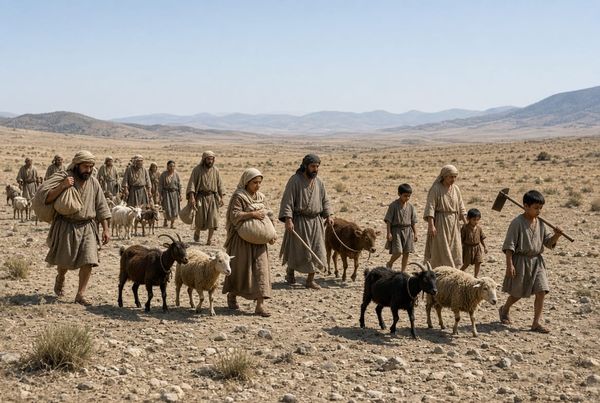
The ark's passengers walked out onto a greening continent. The hot rift basins were already driving the weather engine that would build ice sheets, lower sea levels, and open the land bridges that connect every major landmass. The corridors were opening. The terrain was fertile. The animals scattered.
But how fast? In what directions? And why did marsupials end up in Australia while placental mammals dominate everywhere else? Why does every continent's fauna look exactly like the result of a competitive tournament whose participants were determined by which animals made it through the door before it closed?
The three-basin architecture that produces the ice age is calculable. The sea level curve that opens the land bridges is calculable. The spread rates of populations expanding into empty territory are observable. The competitive dynamics that determine who survives on each isolated landmass are predictable.
The dove found peace on a hillside that never died. The question that follows her is: how far did her descendants fly before the bridges closed?
The olive leaf was not a miracle. It was a measurement. Everything else follows.
← Diversification Series · Series · Next →
© 2026 D. L. White. Licensed under CC BY-ND 4.0. https://creativecommons.org/licenses/by-nd/4.0/
This paper was developed collaboratively using Claude (Anthropic) for technical modeling, calculations, and co-development of the reasoning chain. Grok (xAI) provided independent validation of specific claims regarding plant survival after tsunami events and climate model performance. Neither AI system endorses all conclusions as settled.