How Did the Rhino Cross the Sea?
A catastrophist alternative to the North Atlantic Land Bridge hypothesis. Part One of the Diversification Series
How Did the Rhino Cross the Sea?
A Catastrophist Alternative to the North Atlantic Land Bridge Hypothesis
Meaning Books, March 2026
Part One of the Diversification Series
Abstract
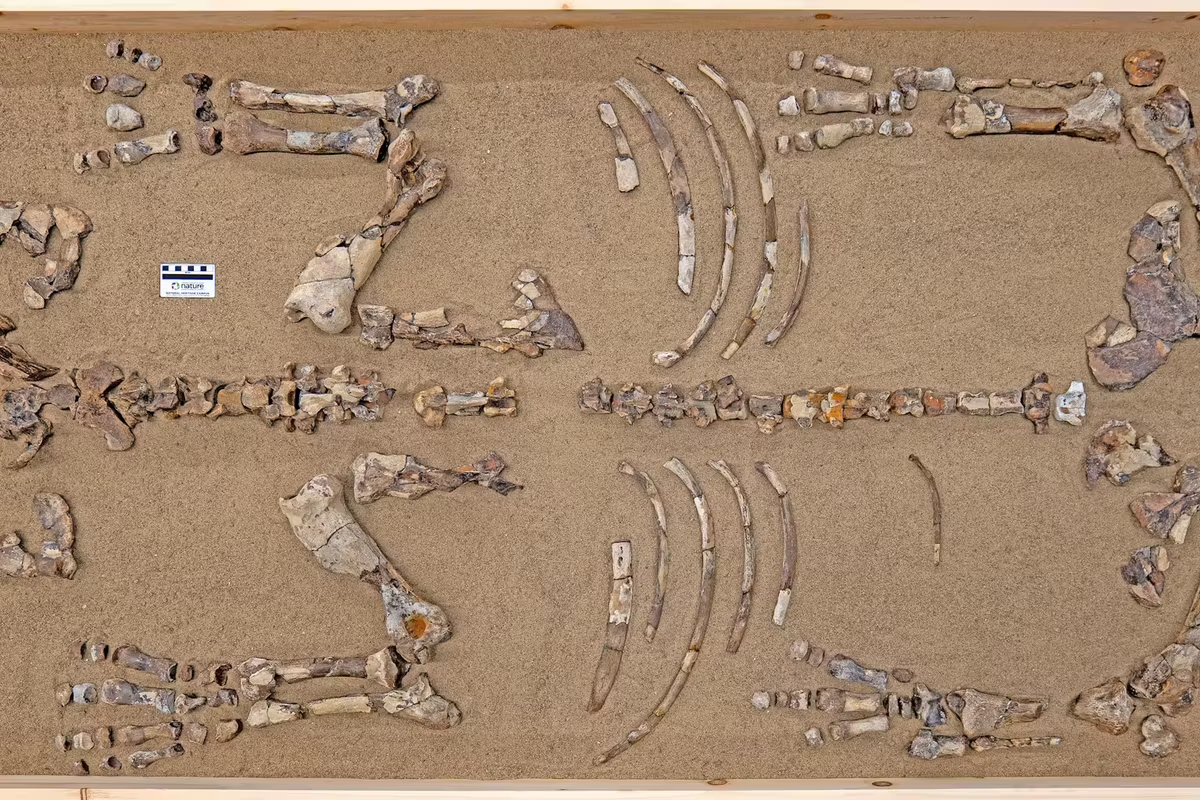
In October 2025, researchers from the Canadian Museum of Nature announced the discovery of Epiaceratherium itjilik, a nearly complete rhinoceros fossil recovered from Haughton Crater on Devon Island, Nunavut (Fraser et al. 2025). The specimen is dated to approximately 23 million years ago and identified as the northernmost rhino ever found. Its closest relatives are European, not Asian, which poses a direct bio-geographic problem: how did a European-lineage animal reach the Canadian High Arctic across an ocean that---by conventional reckoning---had already separated the two continents for over 30 million years?
The researchers proposed that the North Atlantic Land Bridge remained crossable roughly 20 million years longer than previously thought. The revision is inferred rather than observed, and holding it open that late requires the crossing to have worked by means no longer resembling a land bridge---island-hopping over open straits and seasonal sea ice, by populations that left no fossil record along either route.
This paper presents an alternative framework. Beginning from the physical anomalies the fossil presents, and introducing a sequence of clearly identified propositions, it constructs a catastrophist model that resolves multiple independent problems simultaneously---without requiring any change to known physics. An order-of-magnitude energy budget analysis is included to demonstrate that the model falls within the plausible zone. The paper concludes with an open question the model necessarily raises.
1. The Evidence on the Table
Three features of the discovery require explanation:
The animal's lineage. Phylogenetic analysis (the reconstruction of evolutionary family trees from physical and genetic traits) places E. itjilik among European rhino species, with no identified Asian intermediates. A Bering land bridge route from Europe through Asia to North America lacks supporting evidence in the family tree.
The environment. The fossil was found alongside temperate forest species---rabbits, shrews, a proto-seal---at a location currently 1,000 kilometers north of the Arctic Circle. The Arctic at 23 million years ago, per conventional paleoclimate models, was warmer than today but still required substantial climate modeling to support this ecosystem at 75°N latitude.
The proteins. Researchers recovered endogenous protein sequences from the animal's tooth enamel, at a conventional age of approximately 23 million years (Paterson et al. 2025)---roughly ten times older than the oldest recovered ancient DNA. The researchers described this as groundbreaking. Protein degradation is a chemical process governed by temperature, hydration, and time. At a true age of roughly 5,000 to 10,000 years, published hydrolysis kinetics for enamel proteins predict survival well within observed ranges; the 23-million-year conventional age is the anomaly that requires explanation, not the protein itself.
The published explanation---an extended North Atlantic Land Bridge---addresses only the first of these three features. It does not account for the environmental anomaly or the protein preservation. And the extension is inferred rather than observed; the late portion of it depends on a crossing mechanism proposed to accommodate the dispersals the model requires.
2. What Kind of Explanation This Requires
The three features do not share a slow explanation. Each is unusual on its own; taken together they describe a community that was buried intact, in one place, under conditions that preserved the association. A temperate-forest fauna at 75°N, a nearly complete skeleton lying with its neighbors, and enamel proteins in a recoverable state are not what gradual accumulation leaves behind. Explaining them separately requires three unrelated accidents of preservation. Explaining them together requires one event.
That is not evidence. It is a constraint on the class of explanation that can work, and it narrows the field to something rapid. It says nothing about which rapid thing.
The crater is the container, not the cause. Haughton is an impact structure, but the impact is not the burial event and nobody proposes that it is---an impact of that scale vaporises material rather than preserving it. The fossiliferous beds are post-impact lacustrine sediments: a lake that formed in the crater afterward and accumulated pollen, megaflora and vertebrate remains. Two consequences run through the rest of this paper. The conventional age of the fossils is inherited from the dating of the impact structure, and the describing authors treat that age as a maximum, constraining the fossils themselves biostratigraphically. And whatever buried this community did so in a lake basin, long after the event that excavated it.
Why this account, and not another. Traditions describing a catastrophic inundation are common across cultures. Nearly all of them are narrative: water came, the land was covered, some survived. A narrative cannot be tested, because there is nothing in it that constrains anything. The account in Genesis is unusual in what it supplies---a sequence of phases with stated durations, a vessel with stated dimensions, a mechanism naming two distinct sources of water, a landing region, and a chronology running forward from the event. Structure of that kind generates constraints, and constraints are what make a claim capable of failing. The account is selected here on that basis. The reason is methodological, not theological: among available accounts of a global catastrophe, it is the one specified in enough detail to be tested rather than merely asserted.
How it is treated. As the antecedent of a conditional. If what the account states is true, what else must be true? Those consequents---what the physics must permit, what the genetics must show, what the geology must record---are the subject of this paper and the series that follows it. The account is the claim under examination, not a premise the examination rests on.
The constraints are taken as a package. They are not selected, and the inconvenient ones are not set aside. The stated duration, the dimensions, the mechanism, the landing region and the post-event chronology are carried simultaneously. Any single constraint is easy to accommodate; the difficulty, and the substance of the test, is whether all of them can be satisfied at once by the same physical account.
Stated quantities are budgets, not decoration. The vessel's dimensions fix a volume, and that volume has to accommodate whatever the account says it carried. How many distinct populations that means is not decided here. It is a separate question, and the discipline it imposes is that the answer has to come from the genetics rather than from the vessel---two constraints approaching from opposite directions, with neither permitted to be adjusted to accommodate the other.
The reading is structural. The account states that the vessel was lifted, which places it aground when the water arrived and its origin inland rather than at a coast. It states a landing region. Neither of these yields a physical quantity, and none is derived from them. Where the account is descriptive, this work complies with the structure and does not extract numbers from the text that nothing else constrains.
No miracle is admitted into the mechanism. Every physical step is required to work by ordinary means, using published material properties and measured rates. This is the most restrictive rule adopted here, and it is adopted deliberately: permit one suspension of physics and every subsequent difficulty can be absorbed by another, at which point the hypothesis can no longer fail and the exercise stops being a test.
The analysis runs from the event forward. How the vessel came to be specified, and how its occupants came to be aboard, are pre-event questions and are outside the scope of this work---excluded by the same rule that excludes every other pre-event claim, and applied uniformly. Nothing here depends on the reader's view of where the specification came from.
What follows should therefore be read as a test that can come out badly. Where a consequent is checkable and the check fails, that is reported; Section 6 states plainly what this paper does not claim. The first consequent to examine is the one the fossil's age depends on---the timeline itself.
3. Methodological Observation: Radiometric Calibration
The 23-million-year age assignment derives from radiometric dating of the Haughton Crater lake deposits, cross-referenced with biostratigraphic correlation (the fossil's morphology and strata match rhino fossils of similar assigned ages worldwide).
Both methods ultimately depend on radiometric calibration. The stratigraphic column---the worldwide sequence of layered rock and fossil deposits that geologists use as their master timeline---has its absolute dates anchored to radiometric measurements. This means the two lines of evidence are not fully independent; they share a common foundation.
Radiometric dating methods (particularly K-Ar and Ar-Ar) depend on assumptions about initial conditions at the time of rock formation---specifically, that no daughter product (e.g., argon) was present when the rock solidified. When these methods are tested against rocks of historically known age---lava flows from observed volcanic eruptions---the results consistently overestimate the true age, sometimes by orders of magnitude. The documented cause is excess argon: argon trapped in the rock at formation that the model assumes is absent.
Key observation:
The physics of radioactive decay is well-established and not in dispute. Decay constants have been measured with high precision in laboratory settings. The vulnerability is not in the decay rates but in the assumed initial conditions. If initial daughter product concentrations were different from what models assume, every calculated age shifts---without requiring any change to nuclear physics. This is the documented failure mode in known-age samples, and it always errs in the same direction: too old.
Modern Ar-Ar step-heating protocols were developed specifically to address this problem and represent a genuine improvement over earlier K-Ar methods. The protocol heats a sample incrementally and measures the argon released at each temperature step. The rationale is that excess argon---trapped in crystal inclusions, grain boundaries, or loosely bound sites---releases at different temperatures than radiogenic argon locked in the crystal lattice. If several consecutive temperature steps produce the same apparent age, that plateau is interpreted as the true age, with the contamination burned off at the edges.
The protocol works when excess argon is spatially segregated within the crystal---concentrated in specific sites that release at specific temperatures while the radiogenic signal releases at different temperatures. But if excess argon is uniformly distributed throughout the crystal lattice---incorporated into the mineral structure during crystallization rather than trapped in inclusions after the fact---then every temperature step releases a proportional mix of radiogenic and excess argon. The plateau is flat, looks clean, and produces a wrong answer that the method has no internal means to detect. A flat plateau does not prove the absence of excess argon. It proves either its absence or its uniform distribution. The method cannot distinguish between those two cases. This is a recognized limitation in the geochronology literature, not a novel objection.
A deeper problem is structural. Independent validation of any radiometric method requires samples whose true age is known from non-radiometric evidence. The only such samples are rocks from historically observed volcanic eruptions---Vesuvius in 79 AD, Mt. St. Helens in 1980, Hualalai in 1801, Ngauruhoe in the 1950s. But potassium-40 has a half-life of approximately 1.25 billion years. In the centuries since these eruptions, the fraction of K-40 that has decayed is on the order of 10⁻⁷. The radiogenic argon produced in that time is vanishingly small relative to atmospheric contamination and any excess argon trapped during crystallization. The true signal is buried in the noise.
This is why defenders of the method dismiss results on young volcanic samples---the samples are too young for the radiogenic signal to rise above background. That objection has technical merit on its own terms. But it reveals a validation gap that is structural, not incidental. Samples young enough to have historically documented eruption dates are too young for the method to produce a meaningful radiogenic signal. Samples old enough for the radiogenic signal to be measurable do not have independently known ages. There is no sample on Earth that is simultaneously old enough to accumulate measurable radiogenic argon and young enough to have a historically verified formation date. The two requirements are mutually exclusive at current measurement precision---a consequence of the half-life being 1.25 billion years and recorded human history being roughly 5,000 years. The window does not overlap. The method is untestable at the ages where it is actually used, and the ages where it is testable reveal a consistent failure mode whose magnitude at older ages cannot be characterized.
The standard response is that initial argon does not matter at deep time---that for a sample genuinely millions of years old, the accumulated radiogenic argon is so large that any excess trapped at formation is de minimis by comparison. This argument sounds decisive but is circular. The claim that initial argon is negligible relative to the radiogenic signal assumes that the radiogenic signal is large, which assumes that the sample is actually millions of years old---the conclusion being used as a premise. You measure a quantity of Ar-40 in a rock. You need to determine how much is radiogenic versus how much was present at formation. The de minimis argument says the excess is small relative to the radiogenic portion. But the radiogenic portion is not measured independently---it is inferred by assuming the age is old, which makes the excess look small, which validates the age. If the true age is thousands rather than millions of years, the math inverts completely. Essentially all the measured argon is either atmospheric or excess, and the radiogenic contribution is the part that is de minimis. Which component is negligible depends entirely on which timescale is true, and that is the very question at issue. Neither side can use its own assumed timescale to dismiss the other's without begging the question.
The validation gap and the de minimis circularity are two halves of the same problem. The first establishes that independent verification is structurally impossible. The second establishes that the fallback argument---that verification is unnecessary because the initial conditions wash out at deep time---assumes its own conclusion. Together they close the escape route: the method cannot be tested where it can be verified, and the problem cannot be dismissed where it cannot be verified, because the dismissal is circular.
A rigorous recalibration study---characterizing the statistical distribution of errors in known-age samples and applying that error profile to samples of unknown age---has not been conducted. Such a study could only produce one of two outcomes: younger ages or confidence intervals too wide to support precise dating. Either result would challenge foundational assumptions across multiple disciplines simultaneously, which may explain why the study has not been attempted.
4. The Propositions
What follows is a sequence of propositions, each introduced to resolve a specific physical problem. Each is clearly labeled. The reasoning that connects them is presented separately from the propositions themselves.
One pattern is worth noting before they begin. Where these propositions depart from the conventional account, the departure is almost always a single parameter rather than a mechanism---the formation of ocean-floor magnetic stripes is accepted exactly as described and only the rate is questioned; the physics of radioactive decay is accepted and only the assumed initial conditions are questioned; the process that raises mountains is accepted and only its timing is questioned. The machinery is conceded throughout. What is disputed is what was fed into it.
Proposition 1: Radiometric ages are unreliable where the method depends on an assumption about initial conditions.
The vulnerability identified in Section 3 is specific, not general. It applies to methods whose age calculation requires an assumption about how much daughter product was present when the rock formed---principally K-Ar and Ar-Ar. There the failure mode is documented, appears in every known-age test, and runs in one direction only: excess argon can add apparent age, never subtract it. Where a method carries that dependency, its ages are expected to be inflated, and the inflation cannot be corrected without independent knowledge of the initial conditions, which is the one thing unavailable.
Methods that do not carry that dependency are not challenged here. This is a narrower claim than catastrophist treatments have generally made, and the narrowing is deliberate. The model is entitled to what its mechanism implies and nothing further, and the mechanism implies nothing about techniques that do not rest on an initial-condition assumption.
It goes further and predicts that most of those methods read approximately correctly. The organizing question is not what kind of method it is, but whether the event reached the record. Where a record accumulated untouched, its increments are real and it reads its true age.
This holds for present-day process as well. The event's tail is bounded, and what it relaxed into is the world now being measured---so a method calibrated against modern rates is calibrated against a system that has largely settled, which is why it works. The model does not claim a fitted relaxation timescale for that settling. It claims only that the residual motion still detectable is small, is confined to particular observables, and is where any deviation should be looked for.
Records that count annual increments---tree rings, speleothem bands, coral growth layers, varves---are mostly untouched on this account. A coral core read at tens of thousands of years is overwhelmingly pre-event structure that reads true, with only its youngest span able to fall inside the event window at all. Where a portion does fall inside, the one-increment-per-year assumption can fail, because the high-energy regime can lay more than one increment in a year. The model owns that rather than exempting these records from its own principle: it is a bounded correction at the young end of a long record, not a compression of it.
Ice is the exception among the counted records, and the reconciliation following Proposition 6 addresses it. On this account the polar ice is entirely post-event, so the whole layer count sits inside the window rather than a recent cap of it---which is why ice is challenged where the other counted records are not.
Radiocarbon is disturbed differently again. The measurements are taken as sound; it is the calibration the model perturbs, through the injection of ¹⁴C-dead carbon during the event.
The distinction that matters is between a method reading slightly off across a defined window, for a reason the model supplies and can be checked against, and a method reading wrong for a reason it has no internal means of detecting. The first is a correction. The second is the problem described in Section 3.
Relative ordering is not carried by this proposition. Proposition 2 accounts for the preservation of ordering by a separate route, and this one does not need to.
What this resolves:
At younger true ages, the Atlantic Ocean is narrower. Continental positions are closer to their pre-rift configuration. The physical distance between Europe and North America decreases in proportion to the reduction in age.
It also identifies why this particular fossil's age is affected rather than merely asserting that it is. The Haughton assignment derives from ⁴⁰Ar/³⁹Ar dating of the impact structure---squarely inside the vulnerable class, and the reason the age is inherited rather than measured on the fossil itself.
Proposition 2: A global hydraulic catastrophe with simultaneous tectonic and volcanic activity produced the bulk of the sedimentary record rapidly.
Rather than slow accumulation over millions of years, the majority of the stratigraphic column was deposited rapidly under catastrophic hydraulic conditions. Hydraulic sorting produces layered deposits by particle density, size, and hydrodynamic properties---not by time. Organisms sort roughly by habitat elevation and mobility: marine organisms lowest, slow-moving land animals in the middle, mobile animals and birds highest. This general pattern matches the fossil column's broad structure.
An event of this kind also determines what becomes of whatever fossil record already existed. This hydraulic catastrophe leaves behind material it did not touch, material it moved without breaking, and material it broke and redeposited. The model requires all three, and all three are observed.
Where the event did not reach, the old record remains intact and in place. Normal bedding, in-situ assemblages, no transport contact, no hydraulic sorting.
Where it moved material without breaking it, the old record is displaced but coherent. Internal ordering preserved, resting on a contact it did not originate from.
Where it broke material up, the old record is mixed and redeposited. Sorted by hydraulic properties rather than by time.
The second and third cases account for something hydraulic sorting alone does not. The fossil column exhibits specific, repeatable biostratigraphic zones---consistent assemblages of species appearing in the same relative order across multiple continents---with a precision no flood produces. A flood sorts by physical properties. It does not independently reproduce the same species communities in the same order on three continents. It does not need to. Organized ecosystems existed before the catastrophe and produced their own deposits through normal processes, already stratified by location and elevation on the landscape. Moving that record preserves much of its ordering. The broad hydraulic pattern is the catastrophe's signature. The fine biostratigraphic structure is the pre-existing ecology's, carried along for the ride or left in place. How long those ecosystems ran is not addressed here; this series analyzes from the event forward.
The event also creates record. Where water was moving, it deposited by hydraulic sorting, which is the broad pattern already described. Where it was not, it deposited without sorting. Flow entering a depression decelerates and drops its load together, so what accumulates in a basin or a closed hollow is a census of whatever the water was carrying when it arrived---buried where it stopped, rather than graded by density and size. The same event therefore produces sorted deposits across open ground and unsorted ones in the holes, and the difference is a matter of where the material came to rest rather than of what carried it there.
What this resolves:
The rhino, the vegetation it fed on, and the animals it lived among were buried within the event timeline, at the latitude they occupied at the time. The temperate forest community at 75°N is not an ecological puzzle requiring an animal that tolerated months of winter darkness---the ground was somewhere else when they were standing on it, and its present position was acquired afterward. The enamel proteins survive because the burial is recent. And the deposit carries no hydraulic sorting because of where it happened: in a hole, where the water stopped, rather than in the flow, where it was still grading its load.
Proposition 3: Pre-catastrophe Earth had relatively uniform, low-relief topography.
Nothing here disputes how mountains are made. Continental collision thickens crust and raises ranges; subduction opens trenches; the mechanisms are textbook and are not in question. This proposition uses them.
The modern extremes are the products of that process---the great ranges thrown up by collision and crustal deformation, the deep basins torn open as the continents separated. If the catastrophe is when that deformation occurred, then the pre-catastrophe surface follows by subtraction: remove the orogenic relief and what remains is the older collision belts, the sutures marking earlier joins, and very little else. Those belts are low, healed, and already recognized as ancient. The result is not a flat earth. It is an earth without the features the event itself created.
That surface is what this proposition describes, and it is derived rather than assumed---a boundary condition recovered by running the mechanism backwards, not an independent claim about a world nobody observed.
On such a surface, the existing ocean volume redistributes to cover the entire earth to a significant depth. Estimates for a topographically smoothed Earth yield global ocean depths on the order of 8,000--9,000 feet. No additional water source is required. Post-catastrophe, water drained from continental surfaces into the newly formed deep basins, exposing the landmasses we see today.
What this resolves:
The water volume problem for global inundation. Additionally, low-relief pre-catastrophe topography means fewer barriers to terrestrial migration. The rhino's European relatives are not separated by an ocean. They are neighbors on a connected, walkable landmass. This proposition also establishes the conditions for Proposition 4.
Proposition 4: Pre-catastrophe Earth's low topographic relief and unobstructed circulation produced a substantially reduced pole-to-equator temperature gradient, sufficient for temperate ecosystems at high latitudes.
The primary driver of the reduced temperature gradient is the topography established in Proposition 3. Modern Earth's extreme temperature gradients are largely products of its topography---mountain ranges deflect jet streams, create rain shadows, and channel ocean currents into narrow gyres. Deep ocean basins isolate circulation patterns. Remove these features and you remove the primary mechanisms that concentrate equatorial heat and produce polar cold. Broad, unobstructed ocean and atmospheric circulation distributes thermal energy far more evenly from equator to poles---not perfectly uniformly, since the poles still receive less solar energy per unit area than the equator, but sufficiently to support temperate ecosystems at latitudes where they cannot exist today. The claim is not zero gradient. It is a dramatically flattened one.
A supplementary contributor is elevated atmospheric humidity---a natural and physically stable consequence of a warmer planet. The relationship is governed by the Clausius-Clapeyron equation: for every degree Celsius of warming, the atmosphere holds approximately 7% more water vapor before condensation occurs. A planet with significantly reduced topographic relief and warmer average temperatures holds more moisture distributed throughout a deeper atmospheric column, because the condensation ceiling---the tropopause---is higher.
This distributed humidity provides a modest additional greenhouse effect without the fatal thermal consequences of a discrete vapor canopy. It is not a shell or a layer---it is the natural equilibrium state of a warm atmosphere, governed by the same physics that operates today, scaled up. The hydrological cycle is fully preserved: evaporation, convective uplift, condensation, and precipitation all function normally, with higher throughput at every stage.
During the catastrophe, rapid cooling of the upper atmosphere by volcanic aerosols lowers the condensation ceiling. The distributed moisture precipitates out progressively---sustained, global rainfall over an extended period as conditions change. Not a single catastrophic dump, but a continuous wringing-out that contributes precipitation from above while oceanic and subterranean water provide the primary inundation volume.
What this resolves:
The temperate Arctic forest ecosystem associated with the rhino fossil, without requiring exotic paleoclimate models, different continental positions, or a thermally unstable atmospheric structure. The topographic mechanism alone---unobstructed circulation on a low-relief planet---produces the reduced gradient that temperate high-latitude ecosystems require. The elevated humidity provides a modest additional greenhouse contribution but is not the primary driver. The mechanism is freshman-level atmospheric physics applied to a planet with different topography.
Proposition 5: The catastrophe's thermal output was managed by water acting simultaneously as lubricant, buffer, and heat engine.
This proposition is preserved as first written, at the screening stage, and its arithmetic is scoped accordingly: it weighs the ocean against frictional heat at plate boundaries, which was the term under examination at the time. The later mechanistic treatment in the Trigger standalone and its Appendix F changes two things. It finds substantially more heat, because conservation of mass for the emplaced magma is not negotiable once the displacement is fixed. And it finds that the disposal is carried by evaporative self-regulation---the boiling point of water and the Clausius-Clapeyron relation---together with the geometry of the three basins, rather than by the ocean's thermal mass. The distinction matters: a thermal buffer is a fixed capacity, while evaporation is a rate that climbs steeply with temperature, and only the second can absorb an input larger than the one budgeted for. The conclusion below stands. The ranking of mechanisms within it does not, and the reader should take the ordering from Appendix F.
Rapid plate movement generates enormous mechanical heat---a well-known and serious objection to catastrophist models. Previous attempts to address this problem, including the RATE project's accelerated nuclear decay proposal, have acknowledged the heat problem without resolving it. The framework presented here identifies a multi-vector solution intrinsic to the catastrophe's own conditions. A detailed order-of-magnitude energy budget is provided in Appendix A.
Heat reduction at the source:
The single most important variable in the energy budget is fault zone lubrication. Laboratory measurements of rock friction show that water at fault boundaries reduces shear stress by approximately 85%---from roughly 100 MPa for dry rock to roughly 15 MPa for hydrated fault zones. This is measured physics, not speculation. Under conditions of global inundation, water is necessarily present at every active plate boundary. The catastrophe's own conditions prevent the worst-case heat scenario from occurring.
This distinction is critical. Previous analyses of the catastrophist heat problem---including those by sympathetic researchers---calculated frictional heat generation under dry-boundary assumptions while simultaneously proposing that the planet was covered in water. They set up the problem without allowing their own model's conditions to influence the physics.
Heat absorption by the ocean:
The ocean's thermal mass provides an enormous energy buffer. Order-of-magnitude analysis (Appendix A) indicates that the mixed-layer thermal buffer alone---the top 1,000 meters of catastrophically churned ocean---is sufficient to absorb the full tectonic heat output under wet-friction conditions without surface temperatures exceeding 40°C.
Heat transport to space:
Even though the thermal buffer alone appears sufficient, two additional mechanisms operate continuously. First, evaporative cooling: water contacting superheated crust absorbs 2,260 joules per gram via heat of vaporization---the energy required to convert liquid water to steam at the same temperature. The resulting steam rises convectively, carrying thermal energy upward. At altitude, condensation releases this energy as latent heat, which radiates to space. The Stefan-Boltzmann law governs this radiation: output is proportional to the fourth power of absolute temperature. A modest increase in upper atmospheric temperature produces an enormous increase in radiation to space. This creates a self-governing negative feedback loop---the hotter the surface becomes, the more aggressively the system works to cool it.
Second, volcanic ash and particulates block incoming solar radiation during the event, preventing additional radiant energy from being added to the system during the period of maximum heat generation.
The self-consistent system:
Water performs four simultaneous roles in this model: it lubricates fault zones (reducing heat generation by approximately 85%), it absorbs heat via thermal mass (buffering the ocean against temperature spikes), it transports heat from the surface to the upper atmosphere (via the evaporation-condensation cycle), and it radiates that heat to space (via the T⁴ relationship). One substance, four mechanisms, all intrinsic to the conditions of the event itself. The cooling system is not bolted onto the catastrophe---it is an unavoidable consequence of it.
What this resolves:
The heat dissipation problem for rapid plate tectonics. Order-of-magnitude analysis (Appendix A) indicates that the mixed-layer thermal buffer alone---the top 1,000 meters of catastrophically churned ocean---can absorb the full wet-friction tectonic heat output while keeping surface temperatures below 40°C, with a margin of approximately 1.8 times. The evaporative and radiative mechanisms operate simultaneously on top of that buffer, providing additional cooling capacity that the model does not require but benefits from. The claim is not that this definitively works, but that the physics does not rule it out---and that the mechanism is self-consistent rather than ad hoc.
Proposition 6: The post-catastrophe environment inevitably produced an ice age.
This is not a separate proposition so much as an unavoidable physical consequence of the preceding ones. It is included because it constitutes a successful secondary explanation---a result the model generates without being designed to.
Post-catastrophe conditions: warm oceans (heated by absorbed tectonic energy), cold landmasses (ash-darkened skies, reduced solar input, no pre-catastrophe humidity layer), and sharp temperature gradients that did not exist before the event. Warm oceans drive extreme evaporation. Cold continents cause precipitation to fall as snow that does not melt. It accumulates.
This is precisely the combination that conventional ice age theory struggles to produce. Cold climates reduce evaporation, which reduces snowfall, which limits ice sheet growth---a self-limiting cycle. The catastrophist model produces the exact conditions required---massive evaporation from warm oceans plus cold continental deposition surfaces---as an automatic byproduct of the event, not as a separate mechanism requiring its own explanation.
As the oceans gradually cool and the atmosphere clears, the ice age ends naturally and progressively.
Reconciliation with the Ice Core Record
The ice core record is some of the hardest physical data in the geosciences and must be accounted for rather than ignored. The Greenland column (GISP2/GRIP) is roughly 3,000 meters of real ice. It contains visible layering, isotopic variation (δ¹⁸O) that tracks temperature changes, trapped gas bubbles, and volcanic ash horizons. None of that is in dispute. The ice exists and contains what it contains.
The question is whether the timescale assigned to the column---roughly 110,000 years for the full depth---is the only reading consistent with the physical evidence, or whether it depends on assumptions that have degrees of freedom.
The upper portion of the column is well-anchored. Layer counting there is verified against known volcanic eruptions with documented historical dates, and those layers are annual. That is hard data and this framework does not challenge it. What should be said precisely is why they are annual on this reading: not because the recent record falls outside the model's scope, but because it is the relaxed end of it. The entire column is post-catastrophe on this account. Deposition rates decline continuously from the early high-intensity phase toward modern values, so layers approach one per year as the ocean cools. The top of the column is where that relaxation has finished, not a separate regime the framework has set aside.
Below that depth, layers thin, compress, and become increasingly ambiguous to resolve. Two distinct things happen there, and they are worth separating. Layer counting continues for a while, carrying the one-layer-per-year assumption with it---the same method as above, applied where the layers are harder to read. Deeper still, counting is abandoned altogether and the timescale is set instead by ice-flow models and by matching isotopic patterns to orbital forcing cycles (Milankovitch). That is not layer counting at all. It is a model-based method with its own assumptions, and the 110,000-year date at the base of the column rests on it---particularly on the assumption that accumulation rates have been roughly stable or predictably varying across the whole column.
The post-catastrophe mechanism described in Proposition 6 predicts precisely the conditions that would violate that assumption. Warm oceans---heated by absorbed tectonic energy---evaporate aggressively. Cold continents cause that moisture to fall as snow that does not melt. Modern Greenland accumulates roughly 20 to 60 centimeters of ice equivalent per year depending on location. If warm post-catastrophe oceans drove precipitation at 5 to 10 times modern rates for the first several centuries---which is physically reasonable given ocean temperatures elevated by the energy budget described in Proposition 5---that produces 1 to 6 meters per year of ice equivalent. Over several centuries of elevated accumulation tapering toward modern rates, the full 3,000-meter column is within reach. The supply side of this has since been worked in detail: the moisture available from the post-catastrophe ocean exceeds what the column requires by one to two orders of magnitude, and the end-to-end efficiency the model needs---roughly 0.3 to 3 percent of gross basin evaporation retained as ice---brackets the value modern Earth already achieves. Adequacy of supply is not the open question. Converting adequate supply into the observed column in detail would require a coupled atmosphere--ice-sheet model, which is not attempted here.
Under these conditions, the layering in the deep column resolves naturally. In an environment with extreme precipitation and frequent storm cycles, multiple visible layers form per year---each major storm deposits a distinct layer. Where accumulation has relaxed to modern rates and is verified by historical markers, each layer genuinely is annual. Deeper, where accumulation was far more rapid, what appears to be annual layering may be sub-annual storm banding compressed by flow and pressure. The transition is gradual, as the mechanism requires---there is no horizon in the ice where one regime stops and another begins. The layer count overestimates for the same structural reason a molecular clock overestimates when it is calibrated on present-day rates: it applies a constant rate to a period when the actual rate was much higher.
The isotopic variation (δ¹⁸O) through the column shows real climate change. In this framework, it records the rapid cooling from post-catastrophe warm-ocean conditions to modern temperatures, recorded over centuries rather than across 110,000 years. The signal is genuine. The timescale assigned to it is model-dependent.
This reading of the ice core record is consistent with the framework's pre-catastrophe climate model. Proposition 4 describes a warm planet with a substantially reduced pole-to-equator temperature gradient. It precludes perennial ice altogether, and the geography settles that before the climate is consulted. A single assembled continent, not seated on a pole, offers nowhere for a permanent ice sheet to rest, and open ocean cannot hold one. Proposition 3 removes the remaining candidate: highland glaciation requires highlands, and the pre-event surface retains only the old healed sutures. Seasonal snow at latitude or elevation is unremarkable and is not at issue here. What the model excludes is ice that survives the summer, year on year, anywhere on the pre-event earth---and continental-scale sheets, which need both a polar landmass and the steep gradients modern topography produces, have neither available to them. The entire Greenland column is therefore post-catastrophe ice, built by the warm-ocean precipitation mechanism of Proposition 6. This preserves Proposition 3's water budget (no significant ice volume locked up pre-catastrophe), strengthens Proposition 6 (which now predicts not just why an ice age occurred but how much ice and how fast), and accounts for the ice core's physical contents without requiring any of its data to be wrong.
An important constraint remains. Volcanic tephra layers in the deep column---such as the Saksunarvatn ash and the Vedde Ash---appear at depths that are consistent with the layer-counted chronology. If those layers were sub-annual storm bands, the tephra positions would be displaced relative to the layer count. This is the strongest objection to this reading. However, the apparent independence of the tephra dating warrants scrutiny. Most tephra markers in the deep column are dated by radiocarbon dating of associated material or by correlation to the ice core chronology or other radiometrically calibrated reference records---so their apparent independence is model-dependent in the same way the accumulation-rate assumption is. A detailed examination of which tephra markers have genuinely independent age constraints (such as historical eruption records or dendrochronology anchored to living trees) versus which are dated by methods that share calibration ancestry with the ice core chronology would substantially clarify this question. That work is a natural next step and is explicitly invited.
What this resolves:
The apparent conflict between a short timeline and the depth of the Greenland ice column. The ice is real. The layers are real. The chemistry is real. The timescale is an inference from a rate assumption, and that rate assumption is exactly what the framework challenges---from a specific, physically grounded mechanism rather than from hand-waving.
5. Summary of Resolved Anomalies
The six propositions, taken together, resolve the following problems from a single causal framework:
1. How a European-lineage rhino reached the Canadian Arctic (connected landmass, no ocean crossing required).
2. Why temperate forests existed at 75°N latitude (substantially reduced pole-to-equator temperature gradient via unobstructed circulation on a low-relief planet, with a supplementary greenhouse contribution from elevated atmospheric humidity).
3. Why proteins survived to the present in tooth enamel (the specimen is far younger than assigned; preservation is unremarkable at a that age).
4. Why rock forming during the event would carry inflated K-Ar and Ar-Ar ages (mantle degassing, hydrothermal circulation through new crust, and rapid subaqueous quench all raise the initial argon a sample starts with). The overestimation seen in modern known-age flows is not the model's to explain---that is the documented behavior which identifies the vulnerability in the first place.
5. How global inundation is possible without additional water volume (low pre-catastrophe topographic relief).
6. How rapid plate movement avoids sterilizing the surface (water as lubricant at the fault boundaries, as thermal mass, and---carrying most of the load---as an evaporative engine that removes heat faster the warmer the surface gets; all of it intrinsic to the event rather than added to it).
7. What caused the ice age and why conventional models cannot produce sufficient precipitation to build continental ice sheets (warm oceans plus cold continents as automatic byproduct of the catastrophe).
8. Why the fossil record contains both broad hydraulic sorting patterns and fine biostratigraphic zonation (the catastrophe provides the broad sorting; pre-existing ecology, carried through the event, provides the fine structure).
9. Why the Greenland ice core column is 3,000 meters deep despite a short timeline (post-catastrophe warm oceans drove extreme precipitation onto cold continents, building the column in centuries at accumulation rates 5 to 10 times modern values, with storm banding sub-annual in the early column and relaxing toward annual as the ocean cooled).
Nine problems, one framework, and several of them---the ice age, the biostratigraphic fine structure, the depth of the ice column---were not what it was built to address. That is not proof of anything, and it is not offered as proof. It is the reason the investigation continued past this point rather than stopping here.
6. What This Paper Does Not Claim
This paper does not claim to have proven any of its propositions. Each is clearly labeled as a postulate, and the reasoning that follows from each is presented as conditional logic: if this, then that.
This paper does not claim that conventional geology is fraudulent or that its practitioners are dishonest. It observes that the incentive structures of institutional science make certain questions structurally difficult to pursue, and that this is a sociological observation, not an accusation.
This paper does not claim that radiometric physics is wrong, and it does not challenge radiometric dating as a class. Its objection is confined to methods whose age calculation requires an assumption about initial daughter product---principally K-Ar and Ar-Ar. For those, it claims that accuracy cannot be verified on samples with unknown initial conditions, and that the one domain where verification is possible (known-age volcanic flows) shows systematic overestimation. Methods that do not carry that dependency are not disputed here; the model expects them to read approximately correctly, and in the case of radiocarbon it relies on the measurements being sound while disputing only the calibration applied to them. Proposition 1 states the boundary.
This paper does not claim that the fossil column was produced entirely by a single hydraulic event. It claims that the broad sorting patterns are consistent with catastrophic deposition, while the fine biostratigraphic structure reflects pre-existing ecological communities deposited and organized before the catastrophe and largely preserved through it.
This paper does not claim that the ice core data is wrong. The ice is real, the layers are real, and the chemistry is real. It claims that the timescale assigned to the deep column depends on accumulation rate assumptions that are model-dependent---and that the post-catastrophe warm-ocean mechanism predicts accumulation rates far higher than modern values during the first centuries after the event, which would mean fewer years elapsed than the layer count implies, without requiring any of the physical data to be discarded. The reading offered here is preliminary and would benefit from detailed accumulation modeling.
This paper does not claim that every parameter in the energy budget is precisely known. It claims that order-of-magnitude analysis places the model within the plausible zone---that the physics does not rule it out. A full computational model would be required to narrow the ranges, and the authors welcome the attempt.
This paper does not claim that additional water beyond the existing ocean volume is required. The inundation mechanism is topographic, not volumetric. Existing ocean volume (~1.335 × 10⁹ km³) distributed over a topographically smoothed Earth yields a global depth of approximately 2.6 km (8,500 feet).
This paper does not claim to have quantified the protein preservation constraint with precision. Enamel protein survival at an age of 5,000 to 10,000 years is consistent with published degradation kinetics, but formal modeling using measured hydrolysis rates at estimated burial temperatures has not been performed here. Such modeling is straightforward and would strengthen or narrow the constraint. It is explicitly invited.
This paper does not claim to have addressed every proxy record that carries a conventional chronology. Marine sediment cores, speleothems (cave deposits), and lake varve sequences all contain layered records with age models derived from sedimentation rates, growth rates, or radiometric calibration. This framework predicts that these records would show similar rate-assumption vulnerabilities to those identified in the ice core discussion---periods of elevated deposition rate producing more layers per unit time than conventional models assume. A systematic examination of these parallel proxy records against the framework's predictions is a natural extension of this work.
This paper does not claim to have identified an independent observable signature for the catastrophic trigger. The slab-detachment mechanism described in Proposition 5 is physically plausible and consistent with the energy budget, but the paper has not specified a geochemical, stratigraphic, or geophysical marker that would distinguish a catastrophic slab-foundering event from ordinary Holocene geological variability. Identifying such markers---for example, a global pulse of dehydration-derived fluids in mantle-sourced volcanic products, or a contemporaneous worldwide spike in seismicity indicators---would provide independent support for the model and is a priority for further investigation.
7. The Open Question
The model presented here, if taken seriously, describes an event that eliminates every terrestrial habitat on Earth simultaneously. Global inundation, tectonic upheaval, volcanism, and atmospheric disruption leave no viable land surface for an extended period.
Yet here we are. And so are the wolves, the horses, the cattle, and everything else that breathes air and walks on land. If such a catastrophe ended the world the rhino lived in, then every land-dwelling, air-breathing animal alive at the time suffered the same fate. The post-catastrophe world requires a survival mechanism. The physical constraints on such a mechanism are narrow: it must be buoyant, enclosed, provisioned for the duration of the event, and sufficient to reestablish terrestrial biodiversity afterward.
The warm post-catastrophe ocean means the thermal environment on the water's surface would have been far more hospitable than the land for an extended period. Survival on the water is not the difficulty. The difficulty is getting there with the right cargo.
And if the animals survived --- if they came through the event and started over on a newly exposed, post-catastrophe landscape --- then every species alive today descends from whatever walked off that vessel and into a changed world. The pressing question is not whether it happened. The question is: when did the wolves start howling? How fast did a handful of founding populations diversify into the tens of thousands of species we see today? And how many founding kinds of animals does it take to account for all of them?
The author leaves the implications to the reader. But the questions do not leave the reader alone.
The rhino did not cross the sea. The sea, in anything like its present width and depth, was not yet there to cross. Everything else follows.
Appendix A: Order-of-Magnitude Energy Budget
What follows is a rough order-of-magnitude budget, developed at the outset of this investigation to answer a single screening question: can the heat of rapid plate motion be carried away without sterilizing the planet? It was written before any mechanism for initiating the event had been derived, and it was the gate on the work that followed---had the budget failed here, the investigation would have stopped at this paper. It did not fail. The margins were judged sufficient to justify deriving an actual mechanism, which is the subject of the Trigger standalone, where the computed heat budget for the proposed mechanism is developed in full in Appendix F. That treatment supersedes this one in precision and in scope. This appendix is retained because it is the calculation the rest of the work rests on having passed, and because a screening estimate that could have closed the door is worth showing to the reader who wants to know whether the door was ever open.
The following analysis estimates whether the heat generated by rapid plate tectonics can be managed by the cooling mechanisms described in Proposition 5. All values are order-of-magnitude estimates with stated assumptions. The goal is to determine plausibility, not precision.
A.1 Tectonic Heat Generation
Parameter Value
Frictional boundary length 40,000 km
Effective shear depth (brittle 30 km zone)
Contact area 1.20 × 10¹² m²
Total plate displacement 5,000 km
Simultaneous engagement factor 30%
Frictional heat at plate boundaries is the primary energy source. The calculation depends on four parameters: boundary length, shear depth, shear stress, and total plate displacement.
Shear stress is the critical variable. Laboratory measurements of rock friction yield the following:
Condition Shear Stress Total Heat
Dry rock friction ~100 MPa 1.80 × 10²⁶ J
Water-lubricated faults ~15 MPa 2.70 × 10²⁵ J
Water at fault zones reduces frictional heat generation by approximately 85%. Under conditions of global inundation, water is necessarily present at all active boundaries. Additionally, subducting slabs release gravitational potential energy as they sink, partially driving plate motion and further reducing the net frictional energy budget. The wet-friction estimate of 2.70 × 10²⁵ joules is used as the working figure.
Boundary friction is not the only heat source. New oceanic crust formation during rapid plate separation releases substantial additional energy. The total thermal inventory of new crust---latent heat of solidification plus sensible heat from magma cooling---is approximately 6.5 × 10²⁷ J. However, the rate at which this heat enters the ocean is limited by thermal conduction through solid basalt. Using basalt's thermal diffusivity of ~10⁻⁶ m²/s, the thermal penetration depth in one year is approximately √(10⁻⁶ × 3.15 × 10⁷) ≈ 5.6 meters, so the ocean sees approximately 0.08% of the total crust inventory during the event year---roughly 5.2 × 10²⁴ J. Hydrothermal convection---water circulating through fractured crust---delivers additional heat as pressurized hot water directly into the ocean buffer, not as atmospheric steam. The remaining 99.92% enters the ocean over centuries, providing the warm post-catastrophe ocean that drives the ice age described in Proposition 6.
A.2 Ocean Thermal Buffer
Parameter Value
Total ocean mass 1.40 × 10²¹ kg
Specific heat capacity 4,180 J/kg·K
Ocean surface area 3.60 × 10¹⁴ m²
Catastrophic mixing depth 1,000 m
Mixed layer mass 3.69 × 10²⁰ kg
Allowable temperature rise 20°C (from 20°C to 40°C)
Absorption capacity of the mixed layer at 20°C rise: 3.08 × 10²⁵ joules. This exceeds the wet-friction tectonic heat estimate of 2.70 × 10²⁵ joules. The ocean's thermal buffer alone is sufficient to absorb the full tectonic heat output without surface temperatures exceeding 40°C.
If the full ocean depth participates in mixing, the buffer capacity rises to 1.17 × 10²⁶ joules---more than four times the tectonic heat under wet-friction conditions, and sufficient to manage even the dry-friction worst case.
A.3 Evaporative Heat Removal
Evaporative cooling provides an additional heat removal pathway. The heat of vaporization of water is 2,260 J/g (2.26 × 10⁶ J/kg). Each gram of water that vaporizes on contact with heated surfaces removes 2,260 joules of thermal energy.
Evaporation Rate (mm/day) Energy Removed/Year Scenario
Normal tropical 8 2.38 × 10²⁴ J
Elevated (warm, no 15 4.45 × 10²⁴ J ice caps)
Storm-like 30 8.91 × 10²⁴ J sustained
Catastrophic 50 1.48 × 10²⁵ J average
Extreme (near plate 150 4.45 × 10²⁵ J boundaries)
At catastrophic average evaporation rates (50 mm/day over the full ocean surface), evaporative cooling alone could remove the total wet-friction tectonic heat in approximately 22 months. This mechanism operates simultaneously with---not instead of---the ocean's thermal buffer.
Under the volcanic aerosol blanket and cold upper atmosphere described in Proposition 5, the lower-atmosphere vapor-pressure gradient is reduced by rapid low-altitude condensation and continuous precipitation. This regime likely suppresses peak evaporation rates relative to a clear-sky warm-ocean case. The 50 mm/day global average therefore represents an upper-bound estimate; actual rates may be lower, but the mechanism still operates simultaneously with the ocean buffer and contributes meaningful margin.
A.4 Radiative Cooling to Space
Eff. Radiating Temp Output (W/m²) Energy/Year (global)
255 K (current) 240 3.86 × 10²⁴ J
270 K 302 4.86 × 10²⁴ J
290 K 401 6.45 × 10²⁴ J
310 K 524 8.43 × 10²⁴ J
The Stefan-Boltzmann law governs thermal radiation: power output is proportional to T⁴. The Earth currently radiates at an effective temperature of approximately 255 K (~240 W/m²). Latent heat released at altitude by condensing steam increases the effective radiating temperature.
An increase in effective radiating temperature from 255 K to 290 K produces approximately 2.60 × 10²⁴ additional joules of radiation to space per year. This is a supplementary mechanism, not the primary one, but it scales aggressively with temperature due to the T⁴ relationship.
A.5 Combined Budget
Component Energy
HEAT IN: Tectonic friction 2.70 × 10²⁵ J total (wet)
HEAT IN: Conduction-limited crust ~5.2 × 10²⁴ J heat
HEAT OUT: Ocean buffer (one-time, 3.08 × 10²⁵ J 20°C rise)
HEAT OUT: Evaporation (50 mm/day, 1.48 × 10²⁵ J/yr per year)
HEAT OUT: Excess radiation (per 2.60 × 10²⁴ J/yr year)
TOTAL OUT, Year 1 4.83 × 10²⁵ J
Year 1 combined cooling capacity (4.83 × 10²⁵ J) exceeds total heat input (3.22 × 10²⁵ J, including conduction-limited crust heat) by a factor of approximately 1.5. The ocean buffer alone (3.08 × 10²⁵ J) is within ~4% of total heat input, so the supplementary evaporative and radiative terms provide the necessary margin. The 40°C volume-weighted average surface temperature is therefore maintained with modest but real dependence on these additional mechanisms.
A.6 Sensitivity
The single most consequential variable in this analysis is the presence of water at plate boundaries. The difference between dry-friction and wet-friction heat generation is a factor of approximately 7. Under dry conditions (1.80 × 10²⁶ J), the ocean's mixed-layer buffer is insufficient and the model requires full-ocean mixing to remain viable. Under wet conditions, the mixed layer alone suffices with margin.
The model's self-consistency is worth noting: the same global inundation that defines the catastrophe guarantees the presence of water at plate boundaries, which simultaneously reduces heat generation and increases heat removal capacity. The cooling mechanism is not an independent assumption---it is a necessary consequence of the catastrophe's own conditions.
Local temperatures near active plate boundaries would far exceed 40°C, with explosive steam generation and localized boiling. The 40°C figure represents the volume-weighted average of the 1,000-meter mixed layer, not a local maximum. The ark does not need the global average---it needs one survivable region of ocean away from the 0.3% of ocean surface that overlies active plate boundaries.
Hydrothermal convection at mid-ocean ridges delivers the majority of crust heat as pressurized hot water directly into the ocean buffer via liquid-phase mixing. This is the observed mechanism at modern ridges and bypasses the atmosphere entirely, reducing the atmospheric steam load relative to a naive surface-contact model. At the extreme spreading rates required by the model, fracture permeability and turbulent mixing would be far more vigorous than at modern ridges; however, the dominant heat transfer mechanism remains liquid-phase hydrothermal circulation rather than direct steam release to the atmosphere.
The volcanic aerosol blanket described in Proposition 5 creates a fundamentally different atmospheric regime from a clear-sky warm ocean. Cold upper atmosphere over warm ocean drives violent convection, rapid low-altitude condensation, and continuous heavy precipitation that clears water vapor from the lower atmosphere faster than it can accumulate. Vapor residence time drops from the current ~9 days to ~1--2 days under these conditions. The survivability concern shifts from heat stroke to hypothermia and violent seas---conditions that are dangerous but not thermodynamically lethal.
A.7 Limitations
Every parameter in this analysis carries substantial uncertainty. Plate displacement, boundary engagement, shear stress at depth, mixing depth, and evaporation rates are all estimated rather than measured. The analysis establishes that the model occupies the plausible zone---that the relevant quantities are of the same order of magnitude---not that the budget balances precisely. A full computational fluid dynamics and thermodynamic model would be required to narrow these ranges. The authors welcome the attempt.
The energy budget presented is a lower bound. New crust formation, latent heat of solidification, and lithospheric cooling contribute additional heat beyond boundary friction. The conduction-rate analysis and hydrothermal observations indicate this additional heat enters the ocean on a timescale much longer than the event year, but a full accounting would require computational modeling beyond the scope of this order-of-magnitude analysis.
In particular, a full three-dimensional coupled ocean--atmosphere--aerosol model under catastrophic plate-tectonic conditions would be required to confirm the wet-bulb temperatures, precipitation rates, and local habitability zones in the volcanic-aerosol regime.
© 2026 D. L. White. Licensed under CC BY-ND 4.0. https://creativecommons.org/licenses/by-nd/4.0/
AI collaboration: this paper was developed collaboratively between D. L. White and Claude (Anthropic). White directed the inquiry, posed the core questions, and introduced the propositions. Claude provided technical data, identified physical mechanisms, performed calculations, and co-developed the reasoning chain. Neither party endorses all conclusions as settled — the intent is to demonstrate that the logic holds, not that the case is closed.