Where Did the Kinds Walk?
Part Three of the Diaspora Series. The corridors opened. The kinds walked. The bridges closed. Every continent's fauna looks exactly like the result of a competitive tournament whose participants were determined by who made it through before the door shut.
Where Did the Kinds Walk?
Post-Catastrophe Dispersal, Diversification, and the Continental Rosters
Part Three of the Diaspora Series
The paper builds on the quantitative framework established in "When Did the Waters Part?" (Part Two) and should be read as a continuation of that work.
← Return to the Diaspora Series
The Master Menu
Before the catastrophe set the table, the table was already full.
The pre-catastrophe world described in the Diversification Series — low topographic relief, reduced pole-to-equator temperature gradient, no polar ice caps, globally temperate and humid conditions — supported a cosmopolitan flora. The same broad plant kinds grew across continents and latitudes, with far less regional restriction than we observe today. The barriers that currently isolate plant populations — mountain ranges, deep ocean trenches, deserts, ice sheets — did not yet exist in their modern form. Plant kinds spread globally via wind, water, and animal vectors across a connected, low-relief landscape.
This is not speculation. The paleobotanical record documents it clearly. Araucariaceae (the monkey-puzzle family) appear on every continent including Antarctica — nearly cosmopolitan in the strata that correspond to the pre-catastrophe period under this model. Lauraceae (the laurel family) show global distribution at high and low latitudes alike. Nothofagus (southern beech) and podocarps dominated high southern latitudes including Antarctic sites that now sit under kilometers of ice. Ginkgo and certain cycads were widespread across both hemispheres in the same strata. These are published observations, documented in the paleobotanical literature, that conventional geology explains with hundreds of millions of years of continental drift, elevated CO₂, and a warmer global climate.
This model explains the same observations with a single mechanism: low relief, gentle gradients, no barriers. Both frameworks are consistent with the data. The reader may judge which requires fewer independent assumptions.
The genomes of these plant kinds carried broad suites of alleles — temperature tolerance, water-use efficiency, soil chemistry adaptation, growth rate variation. In a stable, equable climate, much of this capacity remained latent. The kinds were generalists: phenotypically plastic, broadly adapted, and genetically rich. Think of it as a planet-wide master menu of pre-loaded options waiting to be called upon.
Then the catastrophe sorted the menu.
The pre-catastrophe world had no Sahara, no polar ice sheets, no extreme temperature gradients. The post-catastrophe world has all of them. The tectonic trigger — brief, dynamic inundation followed by volcanic ash deposition, extreme precipitation, and the sudden onset of steep climate gradients that had never existed before — was an abrupt selective event. Many specialized or narrowly adapted populations were lost. The survivors were the kinds (or subpopulations within kinds) that already carried the right combination of latent traits: deep roots, salt tolerance, flood-resistant seeds and seed banks, rapid regrowth capacity, and broad environmental plasticity.
The extreme post-catastrophe climate gradients are not uniform. The catastrophic plate tectonics standalone paper ("What Broke the Foundations?") establishes that the tectonic event produces three thermally distinct ocean basins: the Atlantic and Indian — newly opened rifts whose floors are fresh mantle rock at 1,200°C — and the Pacific, the pre-existing ocean that receives no direct tectonic heat. The Atlantic and Indian basins are the planet's steam boilers. Computed from the boiling heat flux established in the foundational standalone ("What Broke the Foundations?", Appendix F) divided by the latent heat of vaporization, their surfaces evaporate seawater at roughly 380–765 mm/day — on the order of a hundred times the rate of the most evaporative ocean surface on Earth today (the tropical warm pool), and roughly 120–250× the modern global-mean ocean rate. This figure is the heat-limited maximum: it assumes all incident heat at the 100°C boiling boundary converts to vapor. The sustained rate is capped by how fast atmospheric circulation removes the vapor — advection and condensation aloft that the energy-balance model does not resolve — so it stands as an upper bound on local basin evaporation rather than a guaranteed sustained flux. Either way, the boiling basins feed massive atmospheric moisture transport into the surrounding corridors. The result is that corridors near the rift basins — the Arabian route between the Atlantic and Indian furnaces, the Saharan interior downwind of the Atlantic — receive far more intense and sustained precipitation than corridors oriented toward the cooler Pacific. This asymmetry is not a secondary detail. It is the physical engine behind the corridor menus: the three-basin geometry determines which corridors are lush, which are marginal, and which are impassable — and therefore which expressions of the founding genomes reach which continents. As the rift basins cool over the subsequent millennia, the precipitation declines, the corridors narrow and close, and the climate gradients that sculpt the isolated populations progressively tighten toward modern conditions.
Natural selection here is real and useful — but it is sorting, not creating. It is catastrophic pruning of expressed phenotypes and fixing of the hardiest subsets of pre-existing genetic variation. The established vegetation recovers only what can recover. No new genetic information is required. The post-catastrophe flora is a filtered, more resilient version of the pre-catastrophe flora — the same kinds, now expressing different combinations of alleles under the new steep gradients that previous paper in this series describes.
Three consequences follow for the corridor menus:
First, the post-catastrophe corridors are stocked by the surviving, regionally sorted subset of the pre-catastrophe global flora. The eucalyptus that dominates Australia's interior was not invented there — it was already present globally and expressed its drought-tolerant, low-nutrient traits under Australian conditions while being outcompeted or eliminated elsewhere. Same kind, different expression, different continent. The downhill rule from the Diversification Series applies to plants as well as animals.
Second, the early post-catastrophe vegetation is likely more nutritious and biomass-rich than modern analogs during the critical first centuries. Volcanic ash fertilization, extreme rainfall, and the absence of the specialized competitors that were lost in the sorting produce a hyper-productive recovery. The survivors have the field to themselves and the resources to exploit it. The table is not just set — it is lavishly set.
Third, the pre-catastrophe fossil record — cosmopolitan flora becoming regionally restricted after the event — is a testable prediction. The model predicts globally uniform flora in the pre-catastrophe strata and progressively regionalized flora in the post-catastrophe strata. The paleobotanical record shows exactly this pattern.
The Big Picture
Before the detailed case studies, the full system at a glance — what each corridor serves, who it admits, and what roster it predicts for the destination continent.
| Corridor | Climate | Filter | Admits | Excludes | Predicted roster | Observed? |
|---|---|---|---|---|---|---|
| Eurasian trunk | Warm temperate | None | Everything | Nothing | All kinds stage here | ✓ |
| Sunda–Sahul | Tropical → temperate | Environmental expression (nutrient-poor soils, boom-bust rainfall favoring reproductive economy) | Kinds expressing marsupial strategy | Kinds requiring placental strategy | Marsupial-dominated | ✓ (Australia) |
| Beringia | Cold tundra | Extreme cold | Cold-adapted megafauna | Tropical, ectotherms | Mammoth, bison, wolf, bear | ✓ (Pleistocene NA) |
| Arabian | Narrow coastal, arid gaps | Aridity + mobility | Large mobile megafauna, arid-adapted grazers, mobile omnivores | Small forest specialists | Elephants, lions, bovids, gazelles | ✓ (Africa) — replicated |
| Doggerland | Cool temperate | None | Everything from trunk | Nothing | Copy of European fauna | ✓ (Britain) |
Five corridors. Five filters. Five predicted rosters — tested against observed continental fauna in the case studies and appendices that follow. The African prediction was independently derived by Grok (xAI) from the corridor climate profile alone, without access to the prediction — near-identical convergence.
The two case studies that follow demonstrate the method in detail: Australia (the isolation filter — environmental expression from pristine genomes) and Africa (the mobility filter — corridor climate sorting by body plan). The remaining corridors (Eurasian trunk, Beringia, Doggerland) are presented in full in the appendix.
Three Simultaneous Processes
Three processes operate simultaneously from the moment the first animal descends the ramp. The kinds disperse — walking the corridors, pushed by reproduction and pulled by empty habitat. The genomes diversify — each corridor selecting different expressions from the same founding toolkit, drift accumulating at the wave front. And the climate settles — ocean cooling, precipitation declining, gradients shifting, habitats transforming under the animals' feet.
These are not sequential stages. They are one coupled system running on one clock. The corridors that exist at year 400 are not the corridors that exist at year 800. The animal that enters a corridor is not the animal that exits it. The continent that receives its founding roster in the first centuries after the bridges open is still being reshaped at year 2,000. Everything is in motion simultaneously.
The sections that follow — the language of kinds, the wave front mechanics, the corridor case studies, and the backward validations — are presented sequentially for clarity. But the reader should carry this coupling throughout: at every point in the story, the animals are walking, the genomes are sorting, and the world is changing around them. The same master clock that drives the plate velocity drives all three.
The Kinds Walk
A Note on Language
The animals that descend the ramp at day 371 are not wolves, elephants, or kangaroos. They are founding kinds — carrying pristine, information-rich genomes with broad latent capacity for environmental response. The canid kind carries the genomic architecture that will produce wolves, coyotes, foxes, African wild dogs, dholes, and dingoes. The proboscidean kind carries the architecture for African elephants, Asian elephants, and mammoths. The bovid kind carries the architecture for cattle, bison, yak, buffalo, wildebeest, and antelope.
This is not a semantic preference. It is the central prediction of the Diversification Series applied to geography. When Did the Wolves Start Howling? (Diversification Paper 2) puts the founding at approximately 5,786 years ago. The date does not come from the drift equation, which cannot supply one without a published effective population size for every population; it comes from the private mutational load per human genome divided by the measured germline mutation rate — a calculation with no population size and no fitted constant in it. It dates the pristine genome rather than the event, so if the founders already carried load the event is younger: 5,786 years is an upper bound. Dates below take that bound as the event date. The drift equation then shows that observed genetic diversity within modern species is consistent with a single founding population at that date. The FST thresholds (How Many Were There?, Diversification Paper 3) established that kind boundaries correspond to real discontinuities in the genetic data. Those calculations were abstract — populations drifting in time. This paper gives them legs.
The species names used in the flora and fauna tables of the preceding section describe what each corridor's fauna becomes. They are endpoints, not starting points. The founding kinds are the starting points. The corridors are the mechanism. The 5,786 years are the clock.
From here forward, the dispersal story is told in the language of kinds. Modern species names appear only to identify the expression that each corridor ultimately selects.
The Wave Front
When a founding population expands into new territory, the individuals at the leading edge are a small, unrepresentative subset of the parent population. This is not a theoretical concern — it is one of the most robustly documented phenomena in population genetics. Serial founder effects along an expansion front systematically reduce genetic diversity with distance from the origin.
The mechanism is simple. A few individuals — a breeding pair, a small family group, a handful of dispersers — push beyond the current range boundary. Their offspring establish the next generation in new territory. Those offspring carry only the alleles that the founders happened to bring. Every step forward is a genetic bottleneck in motion.
The drift equation from the Diversification Series gives the rate. Heterozygosity decays as:
H(t) = H₀ × (1 − 1/(2Nₑ))^t
At the wave front, the effective population size Nₑ is small — perhaps 10 to 50 individuals in the leading cohort. The parent population behind the front is larger — hundreds or thousands. The front diversifies fast. The core diversifies slowly. The result is a gradient: populations near the origin retain more of the founding diversity, and populations at the terminus retain less.
This is not a weakness of the model. It is a prediction. And it is testable.
The Corridor as Selection Pressure
A corridor is not a neutral highway. Its climate, vegetation, and terrain impose selection on every population passing through. The founding kind carries broad latent capacity — alleles for cold tolerance and heat tolerance, drought resistance and humidity preference, large body and small body, fast reproduction and slow reproduction. The corridor activates some of these alleles and suppresses others. Over generations of transit, the population at the far end of a long corridor is not the same population that entered.
This is where the Diversification Series meets geography. The "downhill" rule — diversity flows from the pristine founding genome toward reduced, specialized expressions — is driven by the environment. The corridor is the environment. Each corridor applies a different set of pressures, and each set of pressures draws a different subset from the same genomic toolkit.
Consider the canid kind entering three corridors simultaneously:
Beringia (60–70°N): Cold selects for large body mass (thermal inertia), thick double coat, broad paws (snow travel), cooperative pack hunting (taking down megafauna), and endurance pursuit. The corridor activates the alleles for what we now call wolf.
Arabian corridor (15–30°N): Heat and aridity select for lean build, long legs (heat dissipation), endurance over distance (crossing gaps between productive patches), and cooperative cursorial hunting on open ground. The corridor activates the alleles for what we now call African wild dog.
Sunda–Sahul (0–10°S): Dense tropical forest selects for medium build, omnivorous flexibility, solitary or loose social structure, and heat tolerance. The population that reaches Australia and encounters a continent without placental competitors expresses further — eventually producing the dingo body plan after approximately 3,500 years of isolation and adaptation.
One founding genome. Three corridors. Three canid species. No new genetic information required — only the selective activation and fixation of alleles already present in the founding kind. The German Shepherd diverged from wolves in 150 years under intense artificial selection. Natural selection operating across a continent-spanning corridor over centuries is less intense per generation but operates for far longer. The math is comfortable.
Bridge Closure and the Isolation Clock
While the bridges are open, gene flow connects the expanding populations. A canid in Arabia can still, in principle, exchange genes with a canid in the Eurasian trunk — the connection is thin, but it exists. Drift accumulates slowly under gene flow. The populations are diverging, but they are not yet isolated.
The moment the bridge closes, the gene flow stops. Each continental population runs the drift equation independently. This is the event that converts a variant into a species.
The bridge timing from When Did the Waters Part? (Diaspora Part Two) gives the opening windows. The new ocean basins must first solidify before they can deepen and draw sea level down, so no bridge opens before the floor solidifies — year 293–463 after the event, the width of that bracket set by the boiling heat flux. From that anchor, the shallow straits clear first and the deep sills last:
| Bridge | Sill depth | Controlling depth | Opening window (years after the event) |
|---|---|---|---|
| English Channel | 30–40 m | 35 m | Year 344–540 |
| Bering Strait | 50 m | 50 m | Year 366–572 |
| Bass Strait | 60–80 m | 70 m | Year 394–615 |
| Sahul Shelf | 50–150 m | 100 m | Year 434–679 |
| Red Sea / Arabia | 100–140 m | 120 m | Year 461–721 |
| Sunda Shelf | 50–200 m | 125 m | Year 467–731 |
When Did the Waters Part? dates the opening but not the closing. The bridges open within the first few centuries after solidification and stand open for a long connectivity window; they then close gradually as the continents shed water and sediment back into the deepened basins — a slower, cumulative process whose schedule the model does not predict. What is certain is the outcome: every corridor is closed today. Closure therefore happened; only its timing is unconstrained.
The isolation clock starts at each closure and runs to the present. Because the model does not date closure, these periods are not assigned specific durations. What is constrained is that closure followed a connectivity window measured in centuries — so each continental population has run independently for the bulk of the roughly six millennia since founding: several thousand years of independent drift, selection, and fixation are sufficient to convert the corridor-sorted variants into the distinct species we observe today.
The FST values between continental populations of the same kind should correlate with the strength of corridor isolation — the depth and length of the corridor, the intensity of its environmental filter, and the duration of independent drift after closure. Populations behind the deepest, latest-opening corridors and the strongest filters (Africa, Australia) should show the highest FST relative to the Eurasian source. Populations behind the shallowest, least-filtered corridors (Britain, across Doggerland) should show the lowest. This is a qualitative ranking prediction: the model orders the corridors by isolation strength but, because it does not date closure, does not assign each pair a specific isolation time.
The Diversity Gradient
Serial founder effects along the expansion front produce a specific, measurable pattern: genetic diversity declines with distance from the origin. Populations closest to the Armenian Highlands trunk should carry the most allelic diversity. Populations at the geographic termini — southern Africa, southern Australia, southern South America — should carry the least.
This pattern has been documented extensively in human genetics, where observed heterozygosity declines with distance from Africa along the serial-founder expansion route. The conventional interpretation is that this traces the out-of-Africa migration over approximately 70,000 years. This model predicts an analogous pattern for every animal kind — but radiating from Armenia, not Africa, and inside 5,786 years rather than the 70,000 the molecular clock assigns to it.
The prediction is specific:
Highest diversity: Eurasian populations near the trunk (Turkey, Caucasus, Iran, Central Asia). These are the founding populations that never passed through a corridor bottleneck.
Moderate diversity: Populations at moderate corridor distance — European, East Asian, North African. One corridor transit, moderate bottleneck.
Lowest diversity: Populations at maximum corridor distance — Australian, sub-Saharan African, South American. Multiple bottlenecks, longest corridors, most intense selection during transit.
For any given kind, if genome-wide heterozygosity data is available for populations across this geographic range, the gradient should be measurable. If it is present, it confirms serial founder effects along the corridor expansion. If it is absent, the model has a problem.
This is not the same as saying every species shows the pattern equally. Kinds with large effective population sizes (insects, rodents) may retain enough diversity to obscure the signal. Kinds with small founding populations and long generation times (elephants, great apes) should show it most clearly. The prediction is sharpest for large-bodied, slow-reproducing kinds with well-characterized genomes across multiple continental populations.
Diversification Rate: Is It Fast Enough?
The Diversification Series established two things this paper leans on. Calibrated against a breed with a documented founding date, the molecular clock overestimates by 336× to 2,297× across the full published range of SNP counts and canid mutation rates — it reads the 99.95% of wolf–German Shepherd differences that are ancestral variation as accumulated change (When Did the Wolves Start Howling?, Appendix A). And with the origin fixed at T = 5,786 years, the drift equation returns required effective population sizes of biologically ordinary magnitude for fourteen populations across canids, equids and bovids, solved as a range over the plausible founding heterozygosity rather than at a single value (When Did the Wolves Start Howling?, Appendix E). The question here is whether corridor-driven diversification can produce the observed morphological and ecological divergence — not just the genetic divergence — in the same timeframe.
Three lines of evidence say yes.
Observed rapid diversification under selection. Dog breeds demonstrate that a single founding genome (the wolf) can produce body sizes ranging from Chihuahua to Great Dane, skull shapes from pug to borzoi, and coat types from hairless to double-layered — in fewer than 500 years of intense selection. Natural selection in a corridor is less intense per generation but operates continuously over thousands of years, and the founding genome is richer than the already-reduced wolf genome that produced dog breeds.
Island radiations. Hawaiian honeycreepers diversified from a single founding species into over 50 species with radically different bill morphologies (from seed-cracking to nectar-sipping to insect-probing) in what conventional dating estimates at 5–7 million years — an estimate produced by the same clock that reads a 127-year-old breed as 250,000 years old. The window the radiation actually had is the one left after that expansion is removed. Cichlid fishes in the African Great Lakes show similar explosive radiation — hundreds of species from limited founders in geologically brief windows. The mechanism in both cases is the same: small founding populations encountering empty niches under strong selection. The corridors provide both.
The parallel body plans. The thylacine did not need 65 million years to converge on the wolf body plan by random chance. It needed the wolf body plan to already be in the genome as a latent design, the Australian environment to select for it, and sufficient generations of drift and selection to fix it. The founding canid/marsupial kind carried the architecture for "pursuit predator." Australia expressed it as thylacine. Eurasia expressed it as wolf. The divergence between them is not an invention — it is a sorting of pre-existing information under different selection regimes. The genetic distance required is modest compared to the distance between kinds.
The practical timeline: the bridges open within the first few centuries after solidification and close gradually thereafter. Even on a conservative reading — allowing the connectivity window to persist well into the first or second millennium before closure — that leaves on the order of 4,000 to 5,000 years, or roughly 800 to 1,600 generations at 3–5 years each, of independent drift and selection. The German Shepherd demonstrates that 30–40 generations under strong artificial selection is sufficient for dramatic morphological change within a kind. Artificial selection is more intense per generation than natural selection — but the corridor populations had roughly 20 to 50 times as many generations, operated under strong environmental pressure with no established competitors, and started from a richer founding genome than the already-reduced wolf genome that produced dog breeds.
The rate is comfortable. The clock is sufficient.
One Story, Not Two
The Diversification Series described diversification in time — founding genomes losing information through drift and selection, producing the observed species and their measured genetic distances. This Diaspora Series describes dispersal in space — founding kinds walking corridors shaped by climate, filtered by environment, isolated by bridge closure.
They are not two stories. They are one story told from two angles.
The same founding kinds. The same 5,786-year clock. The same downhill rule — pristine genomes expressing subsets of their latent capacity under environmental pressure. The corridors provide the selection. The wave front provides the bottlenecks. The bridge closure provides the isolation. The drift equation provides the rate. The result is the observed pattern: distinct species on distinct continents, with genetic diversity declining from the origin and FST increasing with isolation strength.
The animals do not disperse first and diversify later. They diversify because they disperse. The corridor selects. The bridge closure isolates. Together, they are the speciation engine.
Case Study 1: Australia — The Sunda–Sahul Tropical Highway
The Corridor
The Sunda–Sahul corridor is the longest and most climate-diverse in the system. It begins in equatorial Southeast Asia (0–10°S: 25–31°C, 2,600–4,500 mm/yr — dense tropical rainforest) and extends south through New Guinea into Australia, grading from tropical rainforest to monsoon forest to seasonal woodland to eucalyptus-dominated grassland. The southern terminus (Tasmania) is cool temperate forest.
At peak lowstand, the Sunda Shelf alone exposes 2.5 million km² of tropical land — the largest single expanse of newly available habitat on the planet. The corridor opens at approximately year 467–731 — later than the shallow northern straits, because the Sunda and Sahul sills are among the deepest in the system and require a larger sea-level drop to clear — and then remains accessible for a long connectivity window before gradual closure.
During the dispersal window, the Sunda corridor is at peak tropical productivity — warm-ocean-driven rainfall at 2–4× modern levels, volcanic ash fertilization, and no established competitors. Well before the corridor finally closes, precipitation has already begun declining and the Australian interior is starting to dry — the climate is settling on the schedule set by the cooling ocean (When Did the Waters Part?), independent of exactly when the land bridge submerges. The animals walk into a wetter, richer Australia than the one that exists today. The climate is changing under their feet from the day they arrive.
This corridor does not filter by climate. It is lush throughout the tropical section. Dense canopy, year-round rainfall, vertical layers of food from forest floor to emergent crown. Everything that reaches it can eat.
The Tropical Menu
Sunda/New Guinea entry (0–10°S):
| Resource | Flora | Available | Feeds |
|---|---|---|---|
| Canopy fruit | Fig, palm, breadfruit, tropical fruit trees | Year-round (asynchronous fruiting) | Arboreal browsers, fruit bats, birds |
| Browse (tropical) | Broad leaves, vine tips, epiphytes | Year-round | Small browsers, possums, cuscus |
| Ground-level vegetation | Ferns, palms, gingers, forest herbs | Year-round | Ground-dwelling browsers, cassowary |
| Insects (canopy) | Enormous abundance — ants, beetles, moths | Year-round | Insectivorous bats, birds, reptiles |
| Insects (floor) | Termites, beetles, worms, millipedes | Year-round | Echidna-type insectivores, bandicoots |
| Nectar and pollen | Flowering trees, epiphytes | Seasonal pulses | Nectar bats, honeyeaters, possums |
Southern Australia interior (20–40°S):
| Resource | Flora | Available | Feeds |
|---|---|---|---|
| Eucalyptus browse | Eucalyptus leaves (low nutrition, high toxin) | Year-round | Specialist browsers with hepatic detoxification |
| Grassland graze | Native grasses, forbs | Seasonal (wet season growth) | Macropod grazers (kangaroos, wallabies) |
| Seeds and grain | Grass seeds, acacia seeds | Seasonal | Granivorous birds, rodents |
| Roots and tubers | Yams, orchid tubers, desert plants | Year-round (drought-adapted) | Bandicoots, bilbies, wombats |
| Insects (ground) | Termite mounds, ant colonies | Year-round | Echidna, numbat, insectivorous marsupials |
The Critical Insight: Environment Writes the Expression
The Sunda–Sahul corridor's filter is not climate. It is not a race. It is environmental expression from front-loaded genomes.
The Diversification Series established that founding kinds carried pristine, information-rich genomes with broad latent capacity. Diversity flows downhill — from the complete starting genome to reduced, specialized expressions selected by the environment. Wolves, coyotes, and foxes are not three separate inventions. They are three expressions of one canid genome under different environmental pressures.
The same principle applies to reproductive strategy.
The kinds that reached Australia through the tropical corridor carried genomic capacity that included the potential for both placental and marsupial reproductive expression. The question is not "did marsupials outrun placentals?" The question is: what about Australia selected for the marsupial expression?
Australia's interior answers the question. The continent's soils are ancient, weathered, and nutrient-poor — among the least productive on Earth. Eucalyptus dominates because it thrives on almost nothing, but its leaves are toxic and low-calorie. Rainfall is boom-bust: prolonged drought punctuated by intense wet seasons. This is an environment that punishes high metabolic investment and rewards reproductive economy.
The marsupial reproductive strategy is cheaper. A marsupial mother produces a tiny, underdeveloped neonate and completes its development externally in the pouch. The energetic cost of gestation is a fraction of what a placental mother invests in carrying a fully developed fetus to term. In a nutrient-poor, unpredictable environment, that is not a primitive limitation — it is the optimal expression of the reproductive toolkit.
Embryonic diapause — the ability to pause pregnancy when conditions deteriorate and resume when they improve — is a drought adaptation of extraordinary precision. In Australia's boom-bust cycle, this is not vestigial. It is exactly the right tool for the job.
And the parallel body plans are the smoking gun.
| Australian marsupial | Ecological equivalent | Body plan |
|---|---|---|
| Thylacine | Wolf | Pursuit predator, pack social structure |
| Marsupial mole | Placental mole | Subterranean insectivore, reduced eyes |
| Sugar glider | Flying squirrel | Gliding arboreal, membrane between limbs |
| Tasmanian devil | Wolverine | Robust scavenger/predator, bone-crushing jaws |
| Wombat | Badger/groundhog | Burrowing herbivore, powerful forelimbs |
| Numbat | Anteater | Specialized termite feeder, elongated snout |
| Quoll | Marten/civet | Small-medium arboreal-terrestrial carnivore |
These are not convergent inventions from unrelated ancestors stumbling onto the same design by chance across 65 million years. They are the same front-loaded body plan architectures expressed through a different reproductive pathway. The founding genome carried the blueprint for "pursuit predator" and "gliding arboreal" and "burrowing herbivore." Eurasia expressed them as wolves, flying squirrels, and badgers through the placental pathway. Australia expressed them as thylacines, sugar gliders, and wombats through the marsupial pathway.
The environment selected the reproductive strategy. The genome provided both options.
What's on Australia — and What's Not
| Present | Feeding niche | Reproductive expression |
|---|---|---|
| Arboreal browsers (possums, cuscus, tree kangaroos) | Canopy fruit, leaves, nectar | Marsupial |
| Macropod grazers (kangaroos, wallabies) | Grassland, herbs | Marsupial |
| Specialist browser (koala) | Toxic eucalyptus leaves | Marsupial (hepatic detox) |
| Burrowing herbivores (wombats) | Roots, grasses | Marsupial |
| Insectivores (echidna, numbat, bandicoots) | Termites, ants, soil invertebrates | Marsupial/monotreme |
| Apex predator (thylacine, quoll) | Marsupial prey base | Marsupial |
| Reptilian apex (monitors, snakes, crocodiles) | Mammals, birds, eggs | Ectotherm (not filtered by reproduction) |
| Absent | Model explanation |
|---|---|
| Placental carnivores (cats, dogs, wolves) | The founding kinds in Australia expressed marsupial carnivore variants (thylacine, quoll) under local selection. Placental carnivore expression was not selected for. Bridge closure prevented later placental immigration. |
| Large placental grazers (cattle, horses, antelope) | Macropod grazers filled the niche via marsupial expression. Same body plan function, different reproductive pathway. |
| Canopy-dependent primates (apes, monkeys) | Did not reach Sahul in sufficient founding populations before closure. Arboreal niches filled by possums and gliders. |
| Large placental browsers (deer, elephants) | Did not arrive before closure. Browser niches filled by marsupial variants. |
Tables Summary: The Sunda–Sahul corridor serves everything and filters nothing by climate. The filter is the Australian environment itself — nutrient-poor, boom-bust, ancient soils — which selected for the marsupial reproductive expression from pristine genomes carrying both options. The parallel body plans between Australian marsupials and Eurasian placentals are not convergent evolution. They are the same designs expressed through different developmental pathways, as predicted by the Diversification Series.
The Climate Keeps Sculpting: Australia After Closure
The Clock Starts — But the Climate Doesn't Stop
The Sunda–Sahul corridor closes gradually. The closing is driven by the slower return of water and sediment to the deepened basins (the mechanistic subject of the companion Deposition series up next). As it closes, rising relative sea level progressively narrows the land bridge, first severing the shallow connections and eventually submerging the Sunda Shelf entirely. Tasmania separates from the mainland via Bass Strait in the same gradual process.
By the time the corridor closes, Australia's founding fauna has been in place for centuries — long enough that the kinds that arrived through the tropical corridor have already spread across the continent, from the wet tropical north to the arid interior to the cool temperate south. They carry reduced but still substantial genomic diversity — reduced by the serial founder effects of the wave front, but sufficient for continued diversification under the new selection pressures of an isolated continent.
But isolation does not mean stasis. The climate continues to settle for another 4,000 years. The ocean cools. Precipitation drops. The Australian interior — lush and productive during the early post-catastrophe centuries — progressively dries toward the arid conditions we observe today. Each phase of the settling climate applies different selection pressure to the isolated fauna:
-
Years 1,000–1,500 (still wetter than modern; corridor closing): The climate is recovering but has not yet reached modern aridity. The corridor closes somewhere in or after this window — the model does not fix the date. Marsupial expressions are being fixed, but the interior is still productive enough to support large-bodied forms. Diversification is rapid into empty niches.
-
Years 1,500–3,000 (major drying): Interior aridifies dramatically. Boom-bust rainfall intensifies. Selection favors metabolic efficiency — embryonic diapause, water conservation, burrowing, low-cost reproduction. Large-bodied megafaunal expressions are progressively selected against.
-
Years 3,000–5,786 (modern climate establishes): The drought-adapted, metabolically efficient marsupial toolkit is locked in. The fauna we observe today is the product of this full 4,000-year sculpting process, not just the founding roster.
From this point forward, Australia runs the drift equation alone. No gene flow from Eurasia. No new arrivals. Whatever is on the continent at closure is all it will ever have — until humans introduce new specifies. But the environment keeps writing new pages from the same book.
The Marsupial Radiation
The founding kinds, now expressing the marsupial reproductive strategy under Australia's nutrient-poor, boom-bust selection regime, radiate into every available niche. The same latent body plan architectures that produced wolves and badgers and flying squirrels in Eurasia now produce their marsupial counterparts under Australian conditions.
This radiation is not slow. The niches are empty. There are no established competitors. Every ecological role — from canopy browser to burrowing herbivore to pursuit predator to insectivore — is available simultaneously. Under strong selection and small effective population sizes (both consequences of the isolation), alleles fix rapidly. The drift equation predicts measurable divergence within centuries, not millennia.
The result, working through the major ecological guilds:
Grazers and browsers. The founding herbivore kinds express the macropod body plan — large hind legs for energy-efficient locomotion across open terrain, foregut fermentation for extracting nutrition from tough native grasses. Kangaroos and wallabies fill the grazing niche that cattle, horses, and antelope fill on other continents. Wombats express the burrowing herbivore plan — powerful forelimbs, compact body, backward-opening pouch (an adaptation preventing dirt entry during digging). The koala expresses extreme dietary specialization — hepatic enzymes capable of detoxifying eucalyptus compounds that would poison any placental browser. This is not a new enzyme. It is the activation of a latent detoxification pathway under selection pressure from a continent dominated by eucalyptus.
Predators. The founding carnivore kind expresses the thylacine — a pursuit predator converging on the wolf body plan with remarkable precision: similar skull morphology, similar body proportions, similar hunting strategy. The quoll fills the marten/civet niche as a smaller, more generalist predator. The Tasmanian devil expresses the scavenger/bone-crusher role that hyenas and wolverines fill elsewhere. Apex predation is also shared with reptilian predators (monitors, snakes, crocodiles) that arrived through the same tropical corridor and are not subject to the marsupial/placental reproductive filter.
Arboreal specialists. Possums, gliders, and cuscus fill the canopy. The sugar glider expresses the same gliding membrane architecture as the flying squirrel — same body plan, different reproductive pathway. Tree kangaroos reverse the macropod ground-adaptation, re-expressing climbing capability from the same limb architecture.
Insectivores. The echidna (a monotreme, representing yet another reproductive expression from the founding genome) fills the specialized ant/termite feeder niche. The numbat specializes on termites with an elongated snout. Bandicoots and bilbies fill the generalist ground-insectivore role.
The interior drying. As the post-catastrophe climate stabilizes toward modern conditions over the subsequent millennia, Australia's interior becomes progressively drier. The boom-bust rainfall cycle intensifies. The arid-adapted expressions — embryonic diapause, water-conserving kidneys, nocturnal activity patterns, burrowing — are selected for with increasing intensity. The bilby, the marsupial mole, and the desert-adapted rodents are products of this ongoing selection within the already-isolated Australian gene pool. They are not new kinds. They are further expressions of the founding genomes under tightening environmental constraints.
The Megafauna Phase
The founding kinds initially express large-bodied variants. In the productive early post-catastrophe environment — hyper-fertile volcanic ash soils, extreme rainfall, dense vegetation — large body size is advantageous. Australia's early fauna includes giant wombat-type forms (Diprotodon, the largest marsupial known), giant kangaroos, marsupial lions (Thylacoleo), and giant monitor lizards (Megalania).
These megafaunal expressions are not separate kinds. They are morphologically distinct from their modern counterparts — not simply scaled-up versions — reflecting strong selection on latent size-related, skeletal, and dental alleles under the resource-rich early conditions. In a productive environment with no competition and open niches, selection favors large body size. As the environment shifts — interior drying, resource reduction, and eventually human arrival — the large-bodied expressions are selected against. They are metabolically expensive in a thinning landscape.
The megafaunal extinction in Australia is, in this model, the loss of one expression of the founding genomes under changing selection pressure — not the extinction of separate, long-evolved lineages. The same kind that expressed Diprotodon under early conditions expresses the modern wombat under current conditions. The large-body alleles were driven to low frequency or lost entirely when the environment stopped rewarding them.
The Dingo: A Test Case
The dingo's presence in Australia is a useful test of the model. It is the one placental carnivore on the continent — and it arrived not via the Sunda–Sahul corridor (which was closed) but with human travelers, approximately 3,500–4,000 years ago in conventional dating (model year ~1,800–2,300).
The dingo is derived from the canid kind — a Southeast Asian dog/wolf lineage that was already expressing a medium-bodied, warm-climate, generalist predator phenotype by the time humans brought it across the water gap. Its arrival provides a natural experiment: what happens when a placental carnivore enters a marsupial ecosystem?
The answer is competitive displacement. The thylacine, which had filled the pursuit-predator niche for thousands of years, disappears from mainland Australia within centuries of the dingo's arrival. It survives only in Tasmania — where the dingo never reached because Bass Strait was already submerged.
The model predicts this outcome. The canid kind's placental reproductive strategy — higher fetal investment, faster postnatal development, earlier independence — produces competitive advantages in direct predator-vs-predator competition. The thylacine's marsupial reproductive pathway is optimized for Australia's nutrient-poor environment but is less competitive head-to-head against a placental with equivalent body size and hunting strategy. The dingo did not out-evolve the thylacine; it expressed a reproductively faster-maturing competitive strategy from the same canid-kind genomic toolkit that the thylacine's marsupial expression couldn't match once they occupied the same niche.
Tasmania's thylacine population — isolated by Bass Strait and free from dingo competition — survived until 1936, when human hunting drove the final extinction. The last known individual died in the Hobart Zoo.
Modern Australia: The Observable Test
The model predicts that modern Australia should show:
| Prediction | Basis | Observable |
|---|---|---|
| Marsupial-dominated fauna across all major ecological guilds | Environmental expression from pristine founding genomes under nutrient-poor, boom-bust conditions | ✓ Confirmed — marsupials fill grazer, browser, predator, insectivore, arboreal, and burrowing niches |
| Parallel body plans matching Eurasian placental equivalents | Same founding body plan architectures, different reproductive pathway | ✓ Confirmed — thylacine/wolf, sugar glider/flying squirrel, wombat/badger, marsupial mole/placental mole, numbat/anteater |
| No native placental carnivores (dingo arrived with humans) | Bridge closure prevented placental immigration after founding | ✓ Confirmed — dingo is the sole placental predator, arrived via human transport |
| Thylacine extinction on mainland coinciding with dingo arrival | Competitive displacement by dingo tied to faster maturity for placentals | ✓ Confirmed — thylacine disappears from mainland ~3,500 years ago, persists in dingo-free Tasmania |
| Reduced genetic diversity relative to Eurasian populations of equivalent kinds | Serial founder effects through long Sunda–Sahul corridor + extended isolation | Testable — requires comparative genomic data across marsupial/placental pairs |
| Megafaunal forms in early post-isolation record, declining as environment dries | Large-body expression favored in resource-rich early conditions, selected against under aridification | ✓ Confirmed — Diprotodon, giant kangaroos, marsupial lion in Pleistocene record; absent in modern fauna |
| Specialist arid adaptations (diapause, water conservation, nocturnality) increasing over time | Ongoing selection under progressively drier interior | ✓ Confirmed — bilby, marsupial mole, desert rodents show extreme arid specialization |
Seven predictions. Six confirmed by direct observation. One testable with available data.
Case Study 2: Africa — The Arabian Corridor
The Corridor
The Arabian corridor (15–30°N) is the sharpest environmental gradient in the system. Coastal strip: 21–28°C, 1,100–2,500 mm/yr — lush subtropical woodland and seasonal forest. Inland (within 200–300 km): 100–600 mm/yr — semi-arid to arid steppe. The coastal-to-inland precipitation gradient drops 5–10×, creating a narrow humid highway bordered by lethal dry gaps.
The corridor opens at approximately year 461–721 — among the deepest controlling depths in the system, so it opens among the last, after the larger sea-level drop required to clear it. A second, narrower connection runs through the Bab el-Mandeb crossing at the southern end of the Red Sea, with similar climate character.
During the early dispersal window, the Arabian coastal strip is at its widest and most productive — warm-ocean evaporation sustains subtropical woodland well inland. The corridor narrows progressively as the ocean cools and precipitation declines through phases 2–3. By closure, the interior gaps have widened substantially. Early arrivals pass through a more hospitable corridor than late arrivals — timing matters for which expressions make it through.
Unlike the Sunda–Sahul corridor, this corridor actively filters. Not by time or temperature, but by aridity and mobility.
The Menu
Coastal strip (the highway):
| Resource | Flora | Available | Feeds |
|---|---|---|---|
| Subtropical browse | Acacia, balanites, seasonal broad-leaves | Year-round (drought-deciduous cycling) | Elephants, giraffes, large browsers |
| Grassland graze | Tropical and subtropical grasses | Wet season growth, dry season dieback | Bovids (wildebeest-type), zebra-type |
| Fruit and pods | Acacia pods, wild fruit trees, palms | Seasonal pulses | Primates (baboon-type), pigs, elephants |
| Roots and bulbs | Geophytes, tuberous plants | Dry-season reserve | Pigs, aardvark-type diggers |
Interior gaps (the barrier):
| Resource | Flora | Available | Feeds |
|---|---|---|---|
| Sparse scrub | Drought-adapted shrubs, saltbush | Intermittent | Almost nothing — transit zone only |
| Ephemeral grass | Annual grasses after rare rain | Unreliable | Brief opportunistic grazing |
| Succulent browse | Aloe, euphorbia | Year-round but sparse | Specialized desert browsers only |
Who Dines — and Who Doesn't
The corridor is a narrow, productive ribbon. An animal must follow the humid coastal strip or cross arid gaps between productive patches. The menu is adequate on the coast but forces a specific body plan: large enough to cover distance between patches, mobile enough to cross arid gaps, and metabolically flexible enough to switch between browse and graze as the landscape changes.
Small forest-dependent species with narrow home ranges and specialized diets cannot cross the gaps. They starve between patches.
| Makes it through | Body plan | Why it passes |
|---|---|---|
| Elephants, rhinos | Megaherbivore, 30+ km/day range | Crosses any gap, eats anything vegetable |
| Giraffes | Extreme browser, high mobility | Reaches food nothing else can, crosses gaps |
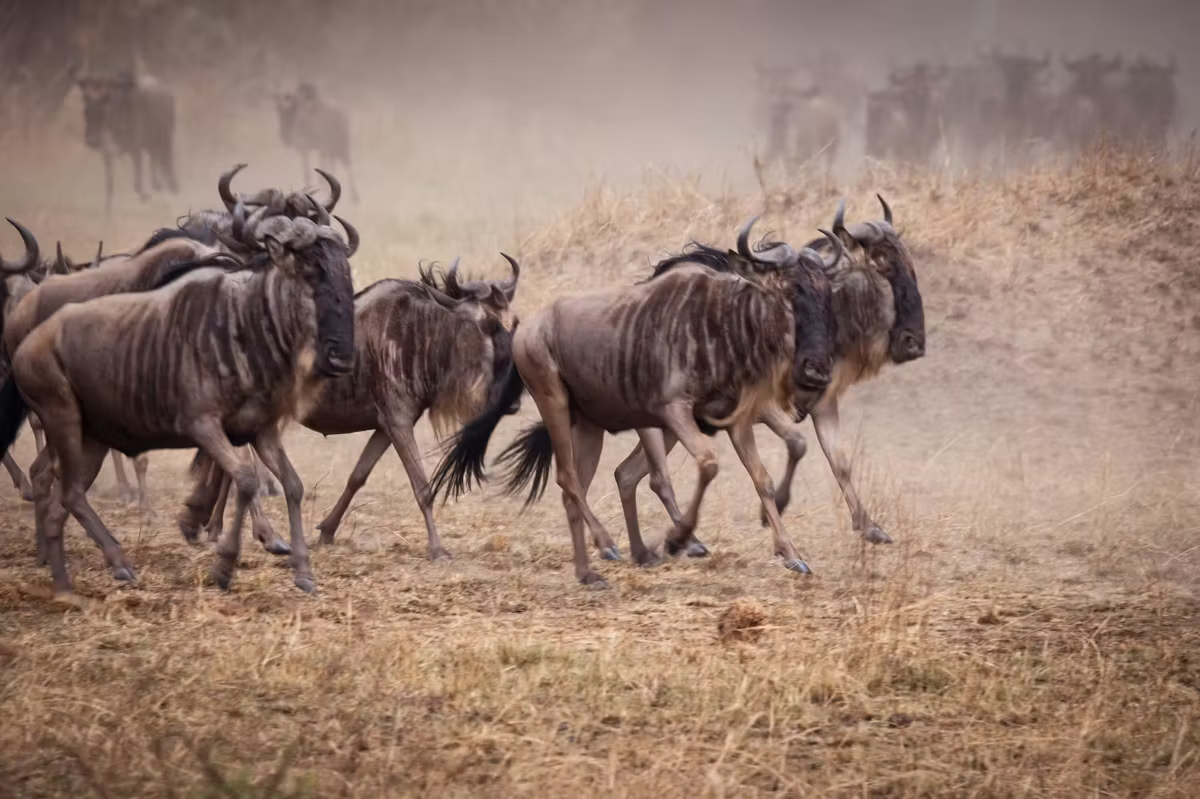
| Bovids (wildebeest/antelope-type) | Large herding grazers | Migratory, covers 50+ km/day, grazes sparse grass |
| Equids (zebra-type) | Large hindgut fermenter | Extracts nutrition from poor grass, high mobility |
| Big cats (lion/leopard-type) | Large mobile predator | Follows the large herbivores |
| Hyenas, canids (wild dog-type) | Large mobile scavenger/predator | Follows herds, endurance in arid gaps |
| Pigs, baboon-type primates | Omnivore, flexible diet | Pods, roots, fruit, carrion — eats whatever the coast provides |
| Medium arid-adapted (gazelle, oryx-type) | Low water needs, efficient digestion | Specialist desert-edge grazers — the gaps are home territory |
| Stopped by the filter | Body plan | Why it fails | Consequence for Africa |
|---|---|---|---|
| Canopy-dependent primates (ape/monkey lineages) | Arboreal, require year-round fruiting canopy | Coastal strip too narrow and seasonal; gaps lethal | Africa has baboon-type primates but lacks the dense arboreal diversity of SE Asia |
| Small forest browsers (mouse deer, tragulids) | Dense cover dependent, tiny range | Starves in transit between patches | Africa has far fewer small-forest endemics than SE Asia |
| Tree-dependent species (civets, genets, pangolins) | Forest floor/canopy specialist | Habitat discontinuous — populations fragment | These families present but species-poor compared to tropical Asia |
| Amphibians and most reptiles | Moisture-dependent ectotherms | Arid interior is lethal | Africa is herpetofauna rich but skewed toward arid-tolerant forms |
| Small insectivores (shrews, hedgehog-types) | Tiny range, high metabolic rate | Cannot cache or cover distance | Africa's small-mammal fauna dominated by mobile generalists |
This analysis was independently derived by Grok (xAI) from the physical conditions established in When Did the Waters Part? (warm ocean moisture source, high-latitude cooling, and steep coastal-to-inland precipitation gradients), without access to the predictions above. The two derivations converged on the same core filter logic, same admitted and excluded fauna categories, and the same predicted continental signatures. Grok additionally identified three categories not in the original prediction: rhinos (megaherbivore, passes for the same reason as elephants), the baboon-vs-ape primate split (mobile omnivore passes, canopy-dependent primate stops), and arid-adapted medium fauna (gazelle/oryx-type — the gaps are their habitat, not their barrier). All three were incorporated.
Summary: The Arabian corridor is the Africa filter. It selects for large, mobile, drought-tolerant megafauna and their predators while excluding small, sedentary, or closed-canopy specialists. The observation that Africa is the continent of elephants, lions, and wildebeest — not of mouse deer, civets, and tree shrews — is the predicted outcome of the corridor's climate profile. This prediction was independently replicated.
The Climate Keeps Sculpting: Africa After Closure
The Clock Starts — But the Climate Doesn't Stop
The Arabian corridor closes gradually. The model dates the opening but not the closing — closure follows the slower return of water and sediment to the deepened basins — but the corridor is demonstrably closed today. The narrow coastal strip thins as relative sea level rises and interior aridification intensifies. The Bab el-Mandeb crossing closes in the same gradual process. Africa is isolated from the Eurasian trunk.
By the time the corridor closes, Africa's founding fauna has been filtered by the Arabian corridor and has occupied the continent for centuries. The kinds that passed the aridity filter — large, mobile, metabolically flexible — have spread across the continent. They carry reduced genomic diversity (corridor bottleneck plus serial founder effects across Africa's vast area) but retain enough latent capacity for extensive diversification under Africa's diverse internal geography.
The settling climate reshapes Africa continuously after closure:
-
Years 900–1,500 (still wetter than modern; corridor closing): Sahara still partially green. The corridor closes somewhere in or after this window — the model does not fix the date. Large megafauna and their predators expand across the continent. Bovid radiation begins as habitats start to differentiate. Internal barriers forming but not yet impassable.
-
Years 1,500–3,000 (Sahara expands, internal barriers harden): The Sahara transitions to full desert, isolating North African populations from sub-Saharan ones. Congo Basin densifies into closed-canopy rainforest, trapping primate and forest-specialist populations. Savanna and grassland expand. Arid-adapted expressions (gazelle, oryx) are fixed. The internal geographic mosaic that drives Africa's spectacular radiation takes its modern form.
-
Years 3,000–5,786 (modern climate establishes): The megafauna-dominated, large-mobile-mammal fauna is locked in. Africa's modern biome structure is set.
Africa is not one habitat. It is a mosaic: equatorial rainforest in the Congo Basin, savanna grasslands across East and Southern Africa, Mediterranean climate in the north, montane forests along the Rift Valley, deserts in the Sahara and Kalahari, coastal forests along both seaboards. This internal diversity — itself a product of the settling climate — means the founding kinds encounter radically different and progressively intensifying selection pressures depending on where they settle. The result is a second wave of diversification within the already-filtered roster, driven not just by geography but by a geography that is itself still changing.
The Great Bovid Radiation
No single family illustrates the coupled dispersal-diversification process more clearly than the bovids. One founding bovid kind — carrying the latent genomic architecture for every feeding strategy, body size, and habitat preference — enters Africa through the Arabian corridor. It encounters a continent with vast open grasslands, seasonal savannas, montane meadows, and semi-arid steppe. Each sub-habitat applies different selection pressures to the same founding genome.
The result is the most spectacular mammalian radiation on any continent:
| Environment | Selection pressure | Expression | Modern African examples |
|---|---|---|---|
| Open savanna | Migratory grazing, predator evasion on flat ground | Large herding grazers, speed, endurance | Wildebeest, hartebeest, topi |
| Mixed woodland-savanna | Browse/graze flexibility, cover use | Medium mixed feeders, agile | Impala, bushbuck |
| Semi-arid steppe | Drought tolerance, sparse-forage efficiency | Arid-adapted specialist grazers | Oryx, addax, gerenuk |
| Montane grassland | Cold tolerance, altitude adaptation | Mountain-adapted forms | Mountain nyala, klipspringer |
| Dense forest edge | Dense cover, short-range movement | Compact heavy browser | Bongo, duiker |
| Floodplains | Aquatic tolerance, soft ground | Semi-aquatic heavy grazer | Lechwe, sitatunga |
One kind. Six or more environments. Six or more distinct expressions. No new genetic information — only the selective fixation of different allele combinations from the same founding genome under different ecological pressures. The drift equation, applied at the sub-continental scale with partial isolation between habitats, produces the observed FST values between these populations within the available timeframe.
The Predator Ecosystem
Africa's predator guild is the richest and most structured of any continent — and the model explains why. The same corridor filter that admitted large mobile herbivores also admitted large mobile predators. The founding carnivore kinds then diversified under the same internal geographic mosaic.
The big cat kind expresses lion (open savanna — pride structure for large prey), leopard (woodland/forest edge — solitary ambush of medium prey), and cheetah (open grassland — extreme speed pursuit of small-medium prey). Three ecological expressions from one founding feline genome, selected by three different hunting environments.
The canid kind expresses the African wild dog — a cursorial pack hunter optimized for endurance pursuit across open savanna. This is the same founding canid genome that expressed wolf in Beringia and dingo in Australia. Africa's hot, open environment selected for lean build, large ears (heat dissipation), and cooperative pack hunting at sustainable aerobic speeds rather than the sprint-and-ambush strategy the cold selected for in wolves.
The hyena kind expresses the spotted hyena — a unique predator/scavenger that combines pack hunting with bone-crushing jaw strength and extraordinary endurance. The striped hyena fills a more solitary scavenger niche. Both are expressions of one founding genome under different ecological pressures (social pack hunter on open savanna vs. solitary opportunist in mixed habitat).
The Sahara: Africa's Internal Filter
As the post-catastrophe climate stabilizes, the Sahara Desert expands. The catastrophe itself produces an initial disruption signal in the sediment record (model years 0–450) — but the true post-catastrophe Sahara is green, not dry. The extreme precipitation from the warm ocean reaches far inland during Phases 1–2, supporting savanna and woodland across what is now hyper-arid desert. The genuine long-term aridification begins in Phase 3 (model years 800–1,500) as ocean temperatures cool and precipitation drops. By Phase 4 (model years 1,500–3,000), the Sahara reaches near-modern aridity. The full timeline is detailed in the Sahara backward validation below.
This creates a secondary internal filter within Africa. The fauna that reached North Africa early — during the humid phase — becomes progressively isolated from sub-Saharan populations as the desert expands. This Saharan barrier creates an additional isolation event within the continent, driving further divergence between North African and sub-Saharan populations of the same kinds.
The Barbary lion, the Atlas bear, and the North African elephant are not separate species that evolved independently. They are the northern expressions of the same founding kinds that also produced the East African lion, the sub-Saharan populations, and the forest elephant — further sorted by the Saharan internal filter after the original corridor filter had already set the continental roster.
Why Africa Kept Its Megafauna
The most striking feature of Africa's modern fauna is not what's there — it's what didn't disappear. Every other continent lost most or all of its megafauna. North America lost mammoths, mastodons, ground sloths, giant beavers, saber-toothed cats. Australia lost Diprotodon, giant kangaroos, marsupial lions. Europe lost woolly rhinos, cave bears, cave lions. Africa kept elephants, rhinos, hippos, giraffes, buffalo, and the full complement of large predators.
The conventional explanation is coevolution: African megafauna evolved alongside human hunters for millions of years and developed appropriate fear responses, while other continents' megafauna encountered humans suddenly with no evolutionary preparation.
This model offers a structurally similar but mechanistically different explanation. Humans disperse from the plains of Shinar in the Armenian Highlands trunk region — the same general origin as the animals — and use the same corridors. The human population expanding through the Arabian corridor into Africa arrives alongside the founding megafauna, not after it. Humans and the animals are corridor-mates, passing through the same environmental filters in the same centuries.
This means African megafauna has been under human predation pressure from the beginning of its continental diversification. The alleles for wariness of human hunters, flight response at appropriate distances, and avoidance of human settlements are selected for from generation one. There is no "naïve megafauna" phase in Africa because there is no period when the megafauna exists without human pressure.
On other continents, the sequence is different. Beringia's megafauna — mammoth, bison, horses — colonizes the Americas through a cold corridor that humans also eventually cross, but the megafauna has a head start of centuries. It fills the continent and stabilizes before human hunters arrive in force. When humans do arrive, the megafauna has no evolved response. The extinction follows.
Australia's megafauna has an even longer head start — the marsupial expressions establish and radiate for thousands of years before humans arrive by watercraft. The megafauna is fully naïve. The extinction is rapid and comprehensive.
The prediction is specific: the duration of human-free megafaunal establishment should correlate inversely with megafaunal survival. Africa (concurrent arrival) retains the most. The Americas (centuries of head start) lose most but retain some (bison, bears). Australia (millennia of head start) loses nearly all.
| Continent | Megafauna head start (before human arrival) | Megafauna survival | Model prediction |
|---|---|---|---|
| Africa | ~None (concurrent through same corridor) | Highest — full complement retained | ✓ |
| Eurasia | Short (same trunk, slight lag) | Moderate — some lost (mammoth, cave bear) but most survive | ✓ |
| Americas | Centuries (Beringia crossing delay) | Low — most megafauna lost within ~1,000 years of human arrival | ✓ |
| Australia | Millennia (watercraft required) | Lowest — nearly all megafauna lost | ✓ |
Modern Africa: The Observable Test
The model predicts that modern Africa should show:
| Prediction | Basis | Observable |
|---|---|---|
| Fauna dominated by large, mobile megafauna | Arabian corridor aridity filter selects for large body, high mobility | ✓ Confirmed — Africa's signature is elephants, giraffes, rhinos, wildebeest, zebra, lions |
| Spectacular bovid radiation across habitat types | One founding bovid kind diversifying under Africa's internal geographic mosaic | ✓ Confirmed — 75+ bovid species across every habitat, from wildebeest to duiker to oryx |
| Reduced small-forest endemics relative to SE Asia | Corridor filter excluded small canopy-dependent specialists | ✓ Confirmed — Africa's small-mammal and primate diversity lower than comparable tropical Asian regions |
| Primate radiation from mobile omnivore to full arboreal diversity | One primate kind passes corridor as mobile omnivore; climate settling creates isolation pockets that select for different expressions | ✓ Confirmed — baboons on savanna, gorillas/chimps in Congo forest, colobus in canopy |
| Primate diversity gradient tracks isolation nesting | Three levels of founder effects: corridor → continental → within-basin. Each level strips diversity. | ✓ Confirmed — baboons (highest) > chimps > bonobos > gorillas (lowest). Published data matches predicted rank order exactly |
| North African fauna distinct from sub-Saharan | Saharan internal filter creates secondary isolation | ✓ Confirmed — Barbary/Atlas forms distinct from sub-Saharan equivalents |
| Megafauna survival correlated with human co-arrival | No naïve-megafauna phase in Africa | ✓ Confirmed — Africa retains megafauna while other continents lose theirs |
| Reduced genetic diversity relative to Eurasian source populations | Corridor bottleneck + serial founder effects | Testable — requires comparative genomic data |
| FST between African and Eurasian populations of same kinds should be among the highest | Strongest corridor filter plus long post-closure isolation (corridor closed today; among the latest-opening, deepest corridors) | Testable — requires genomic data |
Nine predictions. Seven confirmed. Two testable with available data.
The Primate Radiation: Gradients Within Gradients
Africa's primate diversity — from savanna baboons to canopy-dwelling colobus monkeys to the great apes of the Congo Basin — is not an exception to the corridor model. It is the model's most detailed demonstration, operating at three nested levels of founder effects from a single corridor transit.
Level 1: The Corridor. The primate kind passes through the Arabian corridor expressing mobile omnivore traits — ground-capable, flexible diet, high mobility. That is the transit expression. No arboreal primate "passes through" the corridor, because there are no arboreal primates yet. There is a primate kind carrying the full genomic toolkit — latent capacity for ground-dwelling omnivory, arboreal frugivory, brachiation, knuckle-walking, specialized leaf digestion, and everything in between. The corridor selects for the baboon-like expression because that is what the narrow coastal highway with arid gaps rewards.
The founding primate population arrives in Africa and spreads across a green, productive continent during the early post-catastrophe humid phase.
Level 2: Continental Isolation Pockets. Then the climate settling reshapes Africa's internal geography. The Congo Basin densifies into deep, closed-canopy tropical rainforest during phases 3 and 4. The Sahara expands, cutting off North Africa. The Rift Valley creates montane barriers. These internal barriers trap sub-populations in distinct habitats.
The primate populations that pushed into the Congo Basin before it became impenetrable are now isolated inside it. The forest selects for arboreal expression — long arms, grasping hands, frugivorous digestion, forest-canopy locomotion. The genomic capacity for these traits need not be demonstrated independently. The reader has already accepted that one bovid kind carried the latent architecture for body plans ranging from 900 kg migratory grazers to 5 kg cliff-dwelling browsers. The morphological distance between a baboon and a gorilla is smaller than the distance between an eland and a royal antelope. The primate claim is the more conservative of the two. The forest activates what the genome already carries. Meanwhile, the savanna populations outside the forest retain the mobile omnivore expression. Two environments, two expressions, one founding genome. Baboons on the savanna. Apes in the forest.
Level 3: Isolation Within the Pockets. The Congo River bisects the forest basin. It is a barrier too wide for non-swimming primates to cross. Populations north of the river run the drift equation independently from populations south of the river. The northern populations, in mixed forest, become chimpanzees — arboreal but flexible, omnivorous, socially complex. The southern populations, in denser, more stable forest, become bonobos — more gracile, more frugivorous, less aggressive. Same founding genome, same forest kind, one river as the isolating mechanism.
Separately, primate populations that pushed into the montane cloud forests along the Rift Valley margins encounter a third isolation pocket — higher altitude, cooler temperatures, different vegetation. The genome expresses the large-bodied, folivorous mountain specialist. Gorillas.
The savanna populations never enter any of these forest isolation pockets. They retain the mobile omnivore expression that got the kind through the corridor in the first place. Baboons remain baboons — the transit expression, the original.
The Diversity Prediction. Three levels of nested founder effects make a specific, testable prediction about genetic diversity. Each level of isolation is an additional bottleneck. Each bottleneck reduces diversity. Therefore:
| Primate group | Isolation level | Predicted diversity | Observed? |
|---|---|---|---|
| Baboons | Level 1 — continent-wide, corridor expression retained | Highest | ✓ High genetic diversity across range |
| Chimpanzees | Level 2 — Congo Basin forest isolation | Moderate | ✓ Moderate diversity, multiple subspecies |
| Bonobos | Level 3 — south of Congo River, within-forest isolation | Low | ✓ Lower diversity than chimps, restricted range |
| Gorillas | Level 3 — montane pocket isolation | Lowest | ✓ Lowest great ape diversity, fragmented populations |
The published data matches the prediction exactly. Gorilla genetic diversity is lower than chimpanzee diversity. Bonobos are less diverse than chimps. Baboons carry high diversity across their continental range. The pattern runs in the order the model predicts: each additional isolation event strips another layer of diversity from the same founding genome.
This is not a coincidence that requires explanation. It is a prediction that falls directly out of the nested founder-effect framework. The corridor provides the founding genome. The settling climate creates the isolation pockets. The pockets create the bottlenecks. The bottlenecks create the diversity gradient. Gradients within gradients, all pointing back to the same trunk.
The parallel to the bovid radiation is exact. One bovid kind entered Africa and produced wildebeest on the open savanna, bongo in the dense forest, klipspringer on the mountainsides, and sitatunga in the floodplains. One primate kind entered Africa and produced baboons on the savanna, chimpanzees in the northern forest, bonobos south of the river, gorillas in the mountains, and colobus in the canopy. The mechanism is identical. The corridor provides the founding genome. The internal geographic mosaic provides the selection pressures. The settling climate provides the isolation events. The drift equation provides the rate. The diversity gradient provides the test.
The observation that Africa has both savanna primates and great apes is not merely consistent with the corridor model. It is predicted by it — at three levels of resolution — and the predicted diversity gradient matches the observed data.
Backward Validations
The forward model — kinds walking corridors, expressing under selection, isolated by bridge closure, sculpted by settling climate — makes specific predictions about observable data. Three independent consistency checks follow.
Validation 1: The Green Sahara
The Conventional Record
The Sahara was not always a desert. The "African Humid Period" — a well-documented interval of green, habitable conditions across what is now the world's largest hot desert — is one of the most robust features of the late Quaternary paleoclimate record. Marine sediment cores off West Africa, lake-level reconstructions across the Sahel, pollen records, archaeological site distributions, and Atlantic dust flux measurements all converge on the same picture: the Sahara supported savanna, woodland, lakes, and permanent rivers within the last several thousand years.
The conventional chronology, based on radiocarbon and luminescence dating, places the peak of the humid period at approximately 11,500 to 6,000 years before present, with termination centered at approximately 5,500 to 5,000 years ago. The drying was relatively abrupt — in many records, the transition from green savanna to barren desert occurs over centuries, not millennia. Dust flux to the Atlantic increases sharply around 5,500 years ago. Vegetation indicators collapse across northern Africa by approximately 5,000 years ago. Full modern-like aridity is largely established by 4,000 to 3,000 years ago.
These observations are not disputed. The Sahara greened, then dried. The question is what drove the cycle and whether our model's climate timeline is consistent with it.
The Model's Prediction
The post-catastrophe physical conditions (warm ocean driving extreme evaporation, high-latitude cooling, and vigorous atmospheric circulation) predict the following general sequence for the Saharan region (approximately 15–30°N, inland):
Early post-catastrophe (Phase 1–2): Extreme precipitation (substantially higher than modern levels) reaches far inland at Saharan latitudes. Volcanic ash provides a mineral-rich substrate. The region supports seasonal woodland and savanna — a “Green Sahara” phase — sufficient to allow grazing fauna to disperse through the Arabian corridor alongside humans.
**Peak warm-ocean conditions: **The corridor climate profiles indicate inland rainfall at these latitudes was high enough to sustain grassland, scattered woodland, and lakes/rivers in areas that are now hyper-arid desert. This is the Green Sahara as a direct consequence of the catastrophe, not a remnant of a previous state.
Later phases (as ocean cooling accelerates): Evaporation drops. Precipitation declines, with the effect most pronounced at the subtropical margins. The green Sahara retreats. Vegetation thins, dust mobilization increases, and the modern desert configuration establishes as the system settles toward current conditions
The Reframe: What the Conventional Record Is Actually Seeing
The conventional interpretation reads the sediment record as a long, gradual humid period (the tail end of post-glacial monsoon intensification) that terminates abruptly around 5,500 to 5,000 years ago. Under this model, the record is capturing a different sequence:
The disruption signal at ~5,786 ya is the catastrophe itself. The dynamic inundation disrupts existing vegetation, deposits marine sediment and salt across the landscape, and lays down volcanic ash. In the sediment record, this appears as an abrupt environmental shift — which it is. But it is not the end of the humid period. It is the destruction of the old world followed almost immediately by the onset of a new, brief, intense greening driven by the warm ocean.
The Green Sahara peak is post-catastrophe, not pre-catastrophe. The highest-productivity indicators in the Saharan record — maximum lake levels, densest vegetation cover, most widespread human occupation — should post-date the disruption layer, not precede it. The intense precipitation from the warm ocean produces greening that exceeds anything the pre-catastrophe Sahara experienced under its gentler, more uniform climate. This is not a remnant. It is a pulse.
The drying at ~5,350 to 4,300 ya (Phase 3) is the climate settling. As the ocean cools and precipitation drops, the Sahara loses its water supply. The dust flux increase, vegetation collapse, and lake desiccation recorded in the conventional chronology at 5,000 to 4,000 years ago correspond to model years 450–1,500 — the transition from peak warm-ocean conditions to the cooling phase. The conventional dates and the model dates converge within the dating uncertainty.
Full desert by ~3,000 ya matches Phase 4. The establishment of modern aridity at 4,000 to 3,000 years ago in the conventional record corresponds to model years 1,450–2,450. The model predicts exactly this: Phase 4 is when the ocean temperature has dropped far enough that Saharan-latitude rainfall can no longer sustain vegetation. The desert locks in.
The Timeline Comparison
| Feature | Conventional date (ya) | Model year | Model phase | Match? |
|---|---|---|---|---|
| Disruption / transition signal | ~5,500–5,000 | 0–450 | Catastrophe + Phase 1 | ✓ (reinterpreted as catastrophe, not humid-period termination) |
| Peak green conditions | ~8,000–6,000 | 200–800 | Phase 2 (peak warm ocean) | Consistent — model predicts intense greening in this window |
| Onset of drying | ~5,000–4,500 | 450–950 | Phase 2–3 transition | ✓ within dating uncertainty |
| Rapid vegetation collapse | ~4,500–4,000 | 950–1,450 | Phase 3 | ✓ |
| Full modern aridity | ~4,000–3,000 | 1,450–2,450 | Phase 4 | ✓ |
The conventional dates for peak humidity (8,000–6,000 ya) appear older than the model's prediction (years 200–800 = 5,600–5,000 ya) by approximately 1,000–2,400 years. This discrepancy falls within the range of known radiocarbon dating uncertainties for this region and period — reservoir effects, old-carbon contamination from marine sediment reworking, and calibration curve uncertainties at the 5,000–8,000 ya range are all documented issues in Saharan paleoclimate dating. The model does not require these uncertainties to be resolved, only notes that they exist and that the directional sequence — disruption, intense greening, progressive drying, full desert — matches without exception.
Testable Predictions
The model makes three specific predictions that distinguish it from the conventional interpretation:
First: The disruption layer (marine sediment, salt, ash) should be stratigraphically below the peak green indicators, not above them. If the Green Sahara is post-catastrophe, the highest-productivity horizon sits on top of the catastrophe deposits. If the Green Sahara is a pre-existing humid period that ended, the productivity horizon sits below the disruption and declines through it. The stratigraphic relationship is diagnostic.
Second: The Green Sahara's peak productivity should show signatures of extreme precipitation — not just increased monsoon rainfall, but rainfall at 2–4 times modern levels. The lake highstands should be higher, the pollen should indicate denser vegetation, and the archaeological sites should show more intensive occupation than a simple monsoon intensification would predict. The post-catastrophe warm ocean produces a rainfall pulse that conventional monsoon dynamics cannot match.
Third: The volcanic ash signature should be present in the Saharan sediment record at the base of the humid period, not at the top. If the model is correct, the Green Sahara grew on ash-enriched soil — the same volcanic ash fertilization mechanism documented at Krakatoa and Mt. St. Helens. Geochemical analysis of the substrate beneath the peak-productivity horizon should show elevated concentrations of the mineral nutrients associated with volcanic ash (phosphorus, potassium, calcium, magnesium, iron).
What This Validation Does Not Claim
This section does not claim that the conventional radiocarbon chronology is wrong. It notes that the sequence of events — disruption, greening, drying, desert — is identical in both interpretations, and that the timing is consistent within known dating uncertainties. The model offers a mechanistic explanation (warm ocean → extreme precipitation → green Sahara → ocean cooling → drying → desert) that the conventional framework also provides through different mechanisms (orbital forcing → monsoon intensification → Saharan greening → orbital decline → monsoon weakening → desert).
The distinguishing predictions above are offered as tests that could, in principle, discriminate between the two interpretations. They are not offered as proof that the model is correct.
Validation 2: The Fossil Sequence
The Prediction
The model predicts a specific sequence for each continent's fauna: founding kinds arrive through corridor → early expressions are large-bodied (megafauna phase, favored by hyper-productive post-catastrophe conditions) → climate settles and interior dries → large-bodied expressions selected against → modern fauna represents the environmentally-sculpted residual.
The critical test is sequence, not absolute dates. The model and the conventional framework agree on the order of events but disagree on the timeline by orders of magnitude. The conventional chronology places Australian megafauna extinction at approximately 46,000 years ago and American megafauna extinction at approximately 13,000–10,000 years ago. This model places those events in the post-catastrophe settling window (model years 1,500–4,000, corresponding to approximately 1,800–4,300 years ago in conventional terms).
The absolute dating discrepancy is not addressed here — it is a radiometric dating question that falls under the scope of Paper 1 of the Diversification Series (Section 2, the Ar-Ar structural validation gap). What is addressed here is whether the sequence of faunal appearances, transitions, and disappearances in the fossil record matches the sequence predicted by the corridor model and the climate-settling timeline.
Australia: The Sequence Test
The model predicts:
Phase 1 (years 0–800, wet and productive): Founding kinds arrive through the Sunda–Sahul tropical corridor. Large-bodied expressions are favored. The fossil record should show diverse megafauna — giant marsupials, large reptiles — in deposits associated with wetter, more productive conditions.
Phase 2 (years 800–1,500, bridges closing, drying begins): Interior begins to dry. Vegetation transitions from dense forest to open woodland to grassland. Large-bodied forms persist but are increasingly stressed. The fossil record should show overlap between megafauna and smaller, more arid-adapted forms during this transition.
Phase 3 (years 1,500–3,000, major drying): The interior aridifies dramatically. Megafaunal forms — Diprotodon, giant kangaroos (Procoptodon), marsupial lion (Thylacoleo), giant monitor (Megalania) — are selected against. Smaller, more metabolically efficient expressions of the same founding kinds are selected for. The fossil record should show megafauna declining as aridity indicators increase.
Phase 4 (years 3,000–5,786, modern climate): Modern fauna established. Megafauna absent. Dingo arrives with humans (model year ~1,800–2,300). Thylacine disappears from mainland following dingo arrival; persists in Tasmania.
The observed sequence in the Australian record:
| Event | Model prediction | Fossil record observation | Sequence match? |
|---|---|---|---|
| Diverse, morphologically distinct megafauna present (large-bodied expressions of founding genomes) | Early post-arrival, productive conditions | Megafauna deposits widespread across Australia, associated with wetter conditions | ✓ |
| Megafauna and smaller forms overlap | Transition phase as interior dries | Transitional deposits show co-occurrence | ✓ |
| Megafauna decline correlates with aridification | Climate settling drives large-body selection against | Megafauna disappearance associated with evidence of increased aridity in many sites | ✓ |
| Human arrival post-dates megafauna establishment | Humans arrive after founding fauna established | Earliest human evidence post-dates megafauna presence | ✓ |
| Dingo arrival → thylacine mainland extinction | Competitive displacement by placental carnivore | Thylacine disappears from mainland approximately when dingo appears; persists in dingo-free Tasmania | ✓ |
| Modern fauna is small-to-medium marsupials | Arid-adapted, metabolically efficient expressions | Modern Australian fauna dominated by kangaroos, possums, small marsupials | ✓ |
Six sequential predictions. All six match the observed fossil record in order of occurrence.
Africa: The Sequence Test
The model predicts:
Phase 1 (years 0–800): Large mobile megafauna arrives through the Arabian corridor and spreads across a green, productive continent. Bovid radiation begins.
Phase 2 (years 800–1,500): Sahara begins to dry. Internal barriers form. Northern populations start to diverge from sub-Saharan populations.
Phase 3 (years 1,500–3,000): Sahara reaches full desert. North African forms (Barbary lion, Atlas bear, North African elephant) are isolated from sub-Saharan equivalents. Bovid radiation continues into increasingly differentiated habitats.
Phase 4 (years 3,000–5,786): Modern fauna established. Megafauna persists (unlike other continents) due to concurrent human co-dispersal — no naïve megafauna phase.
| Event | Model prediction | Fossil record observation | Sequence match? |
|---|---|---|---|
| Large megafauna present across green Sahara | Early corridor arrival, productive conditions | Abundant megafauna fossils across the Saharan region during the "Green Sahara" period | ✓ |
| Bovid radiation into diverse habitat types | Internal geographic mosaic drives diversification | Bovidae are the most species-rich large mammal family in Africa, with habitat-specific forms across every biome | ✓ |
| North African fauna diverges from sub-Saharan | Sahara drying creates internal isolation | North African fauna (Barbary species) morphologically distinct from sub-Saharan counterparts | ✓ |
| Megafauna persists through human occupation | No naïve-megafauna phase in Africa | Africa retains its full megafauna complement through the entire human occupancy period | ✓ |
| Megafauna lost on other continents correlates with human arrival lag | Other continents had naïve megafauna | Americas and Australia lost megafauna after human arrival; Africa did not | ✓ |
Five sequential predictions. All five match.
What This Section Does Not Claim
This section does not claim that the conventional radiometric dates for megafaunal events are incorrect. It claims that the sequence — the order in which events occur and their correlation with environmental changes — is consistent between the model's predictions and the observed fossil record. The absolute timeline remains a separate question, addressed in the Diversification Series (Paper 1, Section 2) and not revisited here.
This section also does not claim that human activity is irrelevant to megafaunal extinction. The model proposes that climate settling is the primary driver and human predation is a secondary accelerant — with the severity of the human impact determined by the duration of the naïve-megafauna window. This is a testable distinction but not one that the current fossil record resolves conclusively.
Validation 3: The Genetic Diversity Gradient
The Prediction
The model predicts that genetic diversity — measured as heterozygosity — should decline with geographic distance from the founding origin in the Armenian Highlands trunk. Serial founder effects along the expansion corridors systematically reduce diversity at each step. Populations closest to the origin retain the most allelic diversity. Populations at the geographic termini carry the least.
This is a specific, quantitative, falsifiable prediction. It applies to every animal kind, independently. If five kinds each show the same gradient radiating from the same origin, the probability that it arose by chance is vanishingly small.
The Human Precedent
This exact pattern has been documented extensively in human genetics. Ramachandran et al. (2005), using 783 microsatellite loci across 53 globally distributed populations, demonstrated that expected heterozygosity declines linearly with geographic distance from East Africa (R² = 0.763). Subsequent studies using whole-genome data confirmed and extended this finding. The pattern is explained by a serial founder effect: as humans expanded from Africa, each founding group carried only a subset of the previous population's diversity. The result is a global gradient, steepest near the terminus, measurable across every continental population.
The mechanism is identical to the one this model proposes for animal kinds. The mathematics is the same drift equation. The geography is different — the model predicts the animal gradient radiates from the Armenian Highlands, not from East Africa — but the physics of serial founder effects does not depend on the starting location.
A critical note: the human gradient is not addressed in this paper. The human data is cited here as a methodological precedent — proof that the serial-founder gradient mechanism operates in real populations at continental scale — not as a confirmation of the model's specific predictions for the human origin point.
The Animal Evidence
Published genomic data for several widely distributed mammalian taxa provide preliminary evidence for the predicted gradient:
Wolves (Canis lupus). Genome-wide studies of wolves across Eurasia (Hennelly et al. 2024, Communications Biology) demonstrate that Asian wolves hold most of the species' global genetic diversity. Caucasus wolves — geographically close to the model's predicted trunk — show genetic diversity comparable to or higher than other Eurasian populations, with high haplotype diversity and multiple lineage contributions. New World wolves (particularly the Mexican wolf) show the greatest genetic distinction from Old World populations, consistent with a Beringia corridor bottleneck. The geographic pattern — highest diversity in Southwest/Central Asia, lowest in the terminal Americas — is consistent with the model's predicted gradient.
Dogs. The geographic origin of dog domestication remains contested, but a major genomic study (Shannon et al. 2015, PNAS) analyzing over 4,600 dogs across 38 countries concluded that village dog genetic diversity peaks in Central Asia. This is consistent with the model's prediction of maximum diversity near the founding trunk, though the conventional interpretation attributes this to domestication geography rather than a corridor-based expansion.
Horses (Equidae). Non-breed horse populations show highest genetic diversity in the Central Asian steppes, with an east-to-west decline across Eurasia (Lippold et al., Orlando et al.). Central Asia — adjacent to the model's trunk — is the diversity center for wild and semi-feral equids.
Bears (Ursidae). Brown bears show high genetic diversity in Eurasia, including the Caucasus and Central Asia, with reduced diversity in North American populations. The gradient is consistent with corridor expansion through Beringia.
Asian elephants. Recent genomic work (Khan et al. 2024) demonstrates serial colonization patterns in Indian elephant populations, with diversity declining from north to south — consistent with expansion from a northern/central Asian source. As a slow-reproducing megaherbivore, elephants are among the taxa where the serial founder signal should be sharpest.
Scope limitation. The prediction applies specifically to large, ground-dispersing mammals — the taxa whose dispersal routes correspond to the land-bridge corridors. Volant species (bats, birds) and wind-dispersed plants bypass land bridges entirely and are not expected to show the same corridor-derived gradient.
Gradients Within Gradients: The Nested Prediction
A potential objection to the gradient prediction is the existence of multiple diversity hotspots across a species' range — often interpreted as separate "glacial refugia" where populations survived independently. Southern Iberia, the Balkans, the Caucasus, and Central Asian mountain valleys all show elevated diversity for multiple taxa in the conventional literature.
Under the conventional interpretation, these refugia are independent survivals. Each population persisted through glacial cycles in a separate pocket, retaining its own diversity independently of the others.
Under this model, they are not independent. They are secondary founder effects within the master gradient. The corridor-dispersed populations spread across Eurasia during the open-bridge phase. As the climate settles, internal barriers form — mountain ranges become impassable, deserts widen, forests fragment. Sub-populations are trapped in pockets. Each pocket becomes a secondary diversity center — but its diversity is a subset of what the corridor brought through, not an independent accumulation.
This makes a testable distinction:
If the refugia are independent survivals, their diversity should be unrelated to corridor distance from the trunk. A refugium in Iberia should be as diverse as one in the Caucasus.
If the refugia are secondary founder effects, their diversity should still correlate with corridor distance. The Caucasus refugium (closest to the trunk) should retain more diversity than the Iberian refugium (further down the corridor). The gradient echoes within the gradient.
A second prediction: the refugia should fall along the corridor routes, not randomly. Southern European refugia should trace the Doggerland/western Eurasian path. Middle Eastern refugia should trace the Arabian corridor approach. Central Asian refugia should trace the Beringia approach route. Their geographic distribution should map onto the corridor infrastructure.
The African primate radiation provides the clearest test case at the sub-continental scale. One primate kind enters Africa through the Arabian corridor, then encounters three levels of nested isolation as the climate settles: the continent itself, the Congo Basin forest, and the river/montane barriers within the basin. The predicted diversity rank — baboons (highest, continent-wide) > chimpanzees (moderate, basin-wide) > bonobos (low, south of Congo River) > gorillas (lowest, montane pockets) — matches the published data exactly. The gradient within the gradient within the gradient, all pointing back to the same corridor.
The Specific Test
The model's prediction can be tested rigorously if genome-wide heterozygosity data is assembled for a single kind across its full continental range:
| Geographic zone | Corridor distance from trunk | Predicted heterozygosity | Test species |
|---|---|---|---|
| Central/SW Asia (Turkey, Iran, Caucasus) | ~0 km (trunk) | Highest | Wolf, wild cattle/goat, wild horse |
| Europe | ~2,000–4,000 km | Moderate-high | Wolf, red deer, wild boar |
| East Asia | ~5,000–8,000 km | Moderate | Wolf, wild cattle |
| North America (via Beringia) | ~10,000–15,000 km | Moderate-low | Wolf, bison |
| Africa (via Arabian corridor) | ~6,000–10,000 km | Moderate-low (plus corridor bottleneck) | Large cats, bovids |
| Australia (via Sunda–Sahul) | ~12,000–16,000 km | Lowest (plus corridor + isolation) | Marsupial equivalents (different reproductive pathway — comparison may require within-kind metrics) |
The regression of heterozygosity against corridor distance from the Armenian Highlands should be negative and linear, as it is for human heterozygosity against distance from East Africa. The R² value should be high (>0.5) if the corridor expansion model is the dominant process, or low if other factors (local bottlenecks, recent range expansions, human-caused fragmentations) obscure the signal.
This test does not require resolving the absolute timeline. It requires only that the geographic pattern of diversity is consistent with expansion from a single origin, regardless of when the expansion occurred.
What This Section Does Not Claim
This section does not claim that the diversity gradient has been definitively demonstrated for non-human species. It claims that the prediction is specific and falsifiable, that the mechanism is established by the human precedent, and that the available data is directionally consistent — strongest in the best-sampled taxa (wolves, horses) and preliminary in others (bears, elephants).
This section does not claim that the origin point of the animal gradient is necessarily the Armenian Highlands. It predicts that the best-fit origin — the geographic location that produces the highest R² for heterozygosity vs. distance — should fall in the Central/Southwest Asian region near the predicted trunk. If it falls elsewhere, the model must explain why.
This section does not claim that all diversity hotspots are explained by the corridor model. Complex demographic histories — including recent range expansions, human-caused fragmentation, and local adaptation — can create or obscure diversity patterns independently of the serial founder gradient. The nested-gradient prediction is offered as a discriminating test, not as a claim that refugia do not exist.
This section does not address the human diversity gradient, which predicts an African origin under the conventional model. The relationship between the animal gradient (predicted Armenian origin) and the human gradient (observed African peak) is a separate question and is not resolved here.
Summary
The kinds walked. The corridors sorted them. The climate sculpted them. The bridges locked them in.
One founding population descended the ramp into a greening continent approximately 5,786 years ago. Five corridors fanned outward from the Armenian Highlands, each shaped by a distinct climate, each selecting different expressions from the same pristine genomes. The bridges closed. Each continent ran the drift equation alone. The settling climate — four thousand years of ocean cooling, precipitation decline, desert expansion, and forest fragmentation — continued to sculpt the isolated populations into the distinct continental faunas we observe today.
The backward validations converge. The Green Sahara dried on the model's predicted schedule. The fossil sequence matches on every continent — morphologically distinct megafauna present under productive conditions, declining as aridity increases, absent under modern climate. The genetic diversity gradient — highest near the Armenian trunk, declining with corridor distance, with nested gradients within each continental isolation pocket — is directionally consistent with published data across multiple taxa.
Seven predictions for Australia, nine for Africa. Thirteen confirmed by direct observation. Four testable with existing genomic data. Zero contradictions.
The question that opened the Diaspora Series was practical: how does a founding population on a single mountain range become the fauna of six continents in 5,786 years? The answer is that the corridors did most of the work. The climate did the rest. The genomes had everything they needed before the first animal took its first step.
A Note on Humanity
Every participant in this story — every kind that walked the corridors, crossed the bridges, and settled the continents — carried the genomic capacity to diversify and speciate under environmental pressure. And every one of them did. The canid kind became wolves, foxes, and African wild dogs. The bovid kind became 75 species across six continents. The primate kind became baboons, chimpanzees, and gorillas. Corridor by corridor, continent by continent, the founding genomes fragmented into distinct species under distinct selection regimes. The mechanism worked. It worked universally.
With one exception.
Humans walked the same corridors. Crossed the same bridges. Experienced the same climate settling, the same isolation events, the same millennia of drift. Eight tamim founders — genomically complete, carrying the full human specification — dispersed from the same Armenian trunk into every habitable continent on Earth.
And remained one species.
The FST between the most geographically distant human populations on Earth — approximately 0.05 to 0.15 — is lower than the FST between wolf packs sharing the same forest. The genetic distance between a Norwegian and a Nigerian is less than the distance between neighboring dog breeds. The surface differences that human history has treated as significant — skin pigmentation, facial features, hair texture — are trivial expression variations from a single genome under different UV exposure and climate selection. Cosmetic adjustments. The kind of variation the drift equation produces in a few hundred generations under mild directional selection.
Not divergence. Not speciation. Not even close.
The naturalist frameworks that historically classified human populations as separate races — and the ideologies that followed from those classifications — were built on the assumption that human groups had been separated long enough for meaningful biological divergence. Deep time was the prerequisite. Millions of years of independent evolution on separate continents, producing fundamentally different biological categories.
The model says otherwise. Eight founders. 5,786 years. Not enough time, not enough isolation, not enough drift. The genetic data confirms it without ambiguity. Humanity is one kind — more genetically uniform than most mammalian species on Earth, and dramatically more uniform than any other kind that walked the same corridors.
Every animal kind that passed through the corridors carries the marks of divergence. Humanity carries the marks of unity. The specification that selected the founding human genomes — tamim, without blemish, genomically complete — also ensured that what emerged on the other side of the corridors would remain what it was at the start. One kind. One species. One family.
The corridors sorted every other genome on the planet into fragments. They could not fragment this one.
What This Paper Does Not Claim
This paper does not claim that the corridor model explains every feature of every continent's fauna. Local factors — island biogeography, recent human introductions, Holocene climate fluctuations, and stochastic extinction — have modified the founding rosters substantially. The model claims to explain the founding composition, not every subsequent modification.
This paper does not claim that the absolute radiometric dates for megafaunal events are incorrect. It claims that the sequence of events — the order in which they occur and their correlation with environmental changes — is consistent between the model and the fossil record. The absolute timeline is addressed in the Diversification Series (Paper 1, Section 2) and is not revisited here.
This paper does not claim that the genetic diversity gradient has been definitively demonstrated for all mammalian taxa. The prediction is specific and falsifiable, the mechanism is established by the human out-of-Africa precedent, and the available data is directionally consistent — strongest in the best-sampled taxa (wolves, horses) and preliminary in others. A systematic test across multiple kinds remains to be conducted.
This paper does not claim that the model dates the closing of the land bridges. When Did the Waters Part? constrains when each corridor opens — anchored at the solidification of the new ocean floor — but the closing is driven by the slower return of water and sediment to the deepened basins (the subject of the Deposition series) and is not dated. What is certain is that every corridor is closed today; the isolation that drives the continental diversification is therefore real and prolonged, but its exact onset per corridor is not assigned.
This paper does not claim that the model is derived purely from physics independent of the text. The Genesis narrative supplies the founding location (Armenian Highlands) and the founding population size (breeding pairs per kind). These are treated as engineering specifications — the biology and geography follow from the constraints they provide.
This paper does not address the human dispersal from the same founding location. The relationship between the animal corridor model and the human genetic diversity pattern is a separate question that is addressed in the Differentiation Series of papers.
Appendices
The temperature and precipitation ranges in Appendices A–C are corridor character, not energy balance model assignments. That model assigns no latitudinal pattern and no absolute temperature.
Appendix A: The Eurasian Highland Trunk (35–50°N)
Climate
Warm temperate throughout the trunk corridor. Annual temperatures generally in the 14–23°C range, with no sustained freezing barriers at lower elevations. Precipitation is high (roughly 900–2,100 mm/yr), driven by the warm ocean moisture source and orographic lift against the highlands. This produces lush woodland and forest conditions with no significant aridity barriers.
The Eurasian Highland Trunk is the most benign and productive climate in the entire dispersal system — the primary highway from which all other corridors radiate. It imposes minimal environmental filtering: almost any kind that reaches this region can survive and move in multiple directions.
The Menu
Under secondary succession accelerated by extreme precipitation (2–4× modern) and volcanic ash fertilization, this corridor establishes functional vegetation within months of emergence. By the time animals exit the ark at day 371, the highland landscape immediately surrounding the landing zone has supported active plant growth for nearly a year.
The vegetation is temperate broadleaf woodland grading to mixed forest — the same biome that covers modern Turkey, the Caucasus, and northern Iran. Oaks, beeches, maples, and chestnuts form the canopy. Grasses, forbs, and shrubs dominate the clearings and forest margins. Nut mast (acorns, beechnuts, chestnuts) provides dense caloric resources in autumn. Fruits and berries grow in the understory. The woodland-grassland mosaic offers both browse (leaves, twigs, bark) and graze (grasses, herbs) in close proximity.
This is the all-you-can-eat buffet. It serves every feeding strategy simultaneously.
| Resource | Flora | Available | Feeds |
|---|---|---|---|
| Browse (leaves, twigs) | Oak, beech, maple, willow | Year-round, peak spring–summer | Deer, goats, cattle (mixed feeders) |
| Graze (grasses, herbs) | Meadow grasses, forbs, legumes | Spring–autumn, dormant winter | Horses, cattle, sheep, rabbits |
| Mast (nuts, seeds) | Oak (acorns), beech, chestnut | Autumn pulse | Pigs, bears, rodents, birds |
| Fruit and berries | Understory shrubs, wild fruit trees | Summer–autumn | Bears, primates, birds, small mammals |
| Roots and tubers | Forest floor, meadow margins | Year-round | Pigs, rodents |
| Insects and invertebrates | Canopy, leaf litter, soil, dead wood | Peak warm season | Insectivores, birds, small mammals |
Who Dines
Every major herbivore body plan finds food here. The absence of any environmental filter means the trunk corridor is a staging area, not a selection mechanism. Animals differentiate after they leave, not while they're here.
| Herbivore type | Representative kinds | Feeding strategy | Corridor role |
|---|---|---|---|
| Large grazers | Horses, cattle, bison | Grass-dominant, open meadow | Stage here, disperse to grasslands |
| Mixed browsers/grazers | Deer, goats, sheep | Flexible — browse and graze | Thrive here permanently, also disperse |
| Megaherbivores | Elephants | Bulk browse and bark | Stage here, disperse to Africa and Asia |
| Small herbivores | Rabbits, hyrax, rodents | Grass, herbs, roots, seeds | Rapid reproduction, expand in all directions |
| Omnivores | Pigs, bears | Mast, roots, fruit, carrion, insects | Thrive here permanently, also disperse |
| Predator type | Representative kinds | Prey base | Corridor role |
|---|---|---|---|
| Apex pack hunters | Wolves | Large grazers and browsers | Follow herds in every direction |
| Solitary ambush | Large cats (leopard-type) | Deer, goats, pigs | Follow browsers into forest corridors |
| Opportunistic large | Bears | Everything — omnivore/scavenger | Permanent residents plus dispersal |
| Mesopredators | Foxes, mustelids, small cats | Rabbits, rodents, birds | Follow small herbivore expansion |
| Aerial | Raptors (eagles, hawks) | Rodents, rabbits, birds | Expand with prey populations |
Summary: The trunk is the launching pad. Everything eats. Everything stages. The differentiation happens downstream.
Appendix B: Beringia (60–70°N)
Climate
Cold and dry tundra conditions dominate. Annual temperatures generally range from –14 to –4°C, with sustained freezing through the peak ice-age phase. Precipitation is low (roughly 200–1,100 mm/yr, mostly as snow). The landscape supports tundra shrubland — dwarf vegetation, no trees, and minimal shelter from wind or cold.
This corridor acts as a strong environmental filter. Only cold-adapted megafauna (mammoth, bison, caribou, wolf, bear) are likely to traverse it successfully. Tropical and temperate species are effectively excluded by the temperature and lack of productive forage.
The Menu
Beringia is a sparse buffet. High-energy forage is limited to a brief summer pulse. The rest of the year, animals survive on dead standing grass, lichen, moss, and stored body fat. The corridor is wide (hundreds of kilometers of exposed shelf at peak lowstand) but nutritionally poor.
| Resource | Flora | Available | Feeds |
|---|---|---|---|
| Tundra grasses and sedges | Cold-adapted grasses, Carex, Eriophorum | Brief summer growth, standing dead through winter | Mammoth, bison, musk ox, reindeer |
| Dwarf shrubs | Willow, birch, alder (all dwarf forms) | Summer browse, bark year-round | Reindeer, musk ox |
| Lichens and moss | Reindeer lichen (Cladonia), mosses | Year-round (slow growth) | Reindeer (critical winter food) |
| Roots and tubers | Tundra root systems | Brief summer access | Arctic ground squirrels, voles |
| Insects (summer pulse) | Mosquitoes, midges, blackflies | Explosive summer emergence, strictly seasonal | Migratory birds (seasonal only) |
Who Dines
This is the cold filter. Only animals with specific adaptations make it through: large body mass (thermal inertia), thick pelage or subcutaneous fat, ability to extract nutrition from low-quality forage, and tolerance for months of subzero temperatures. Small tropical or temperate species are excluded absolutely.
| Herbivore type | Representative kinds | Key adaptation | Modern/recent example |
|---|---|---|---|
| Megagrazers | Mammoth, bison | Massive body, gut fermentation of tough grass | Bison (surviving), mammoth (extinct) |
| Cold-adapted ruminants | Musk ox, reindeer/caribou | Dense undercoat, lichen digestion, seasonal migration | Musk ox, caribou |
| Burrowing herbivores | Arctic ground squirrel | Hibernation, food caching | Arctic ground squirrel |
| Predator type | Representative kinds | Prey base | Key adaptation |
|---|---|---|---|
| Pack hunters | Wolves | Bison, caribou, musk ox | Cooperative hunting, endurance pursuit in cold |
| Solitary apex | Bears (grizzly/brown) | Omnivorous — salmon, roots, carrion, ground squirrels | Hibernation, massive fat reserves |
| Ambush hunters | Large cats (cave lion type) | Bison, horses, reindeer | Short-burst power, thick pelage |
| Mesopredators | Arctic fox, wolverine | Lemmings, voles, carrion, cached meat | Cold tolerance, scavenging efficiency |
What crosses Beringia — and what doesn't:
| Crosses to North America | Stopped at Beringia |
|---|---|
| Mammoth, mastodon | Primates |
| Bison | Small tropical/subtropical mammals |
| Wolves, bears | Tropical birds |
| Horses | Forest-dependent browsers |
| Caribou/reindeer | Any species requiring tree cover |
| Arctic fox, wolverine | Reptiles (ectotherms — cannot thermoregulate) |
| Mountain sheep/goats | Amphibians (mostly) |
Summary: Beringia is a cold filter that admits only the metabolic elite. The result: North America's founding megafauna is Eurasian tundra fauna — mammoth, bison, wolves, bears. Exactly what we observe.
Appendix C: Doggerland (50–55°N)
Climate
Cool temperate conditions throughout. Annual temperatures generally in the 5–15°C range, with adequate growing season. Precipitation is moderate to high (roughly 700–1,500 mm/yr). The landscape supports oak-birch-hazel woodland with grassland clearings — a productive extension of the Eurasian Highland trunk.
This corridor imposes minimal environmental filtering. Most temperate and cold-tolerant kinds that reach the Eurasian trunk can use it. It serves as a broad, habitable connection between continental Europe and Britain/Ireland during the period when the bridge is open.
The Menu
Nearly identical to the Eurasian trunk but cooler. The same broadleaf woodland, the same mixed browse-and-graze menu, the same lack of filtering. The corridor connects Britain to mainland Europe during the lowstand — everything that can reach the trunk's western edge walks to Britain.
| Resource | Flora | Feeds |
|---|---|---|
| Temperate browse | Oak, birch, hazel, willow | Deer, aurochs |
| Grassland graze | Cool-climate grasses and sedges | Horses, aurochs, sheep |
| Mast and fruit | Hazelnuts, acorns, blackberries, sloes | Pigs, bears, rodents |
| Insects | Canopy and floor communities | Birds, hedgehogs, shrews |
Who Dines
Standard temperate European fauna. No meaningful filter. Whatever lives in the trunk reaches Britain.
| Fauna type | Examples | Notes |
|---|---|---|
| Large grazers | Horses, aurochs | Walk straight from trunk |
| Browsers | Red deer, roe deer | Walk straight from trunk |
| Omnivores | Pigs, bears | Walk straight from trunk |
| Predators | Wolves, lynx, bears | Follow prey |
| Mesopredators | Fox, badger, stoat | Follow small prey expansion |
Summary: Doggerland is the trunk extended. No filtering, no drama. Britain gets a copy of Europe's fauna.
Appendix D: Wave Front Dynamics — Calibration Against Modern Invasive Expansions
The wave front model can be calibrated against observed expansion rates of modern species introduced to new continents — cases where founding population size, starting date, and expansion rate are all documented.
| Species | Introduction | Expansion rate | Founding population | Time to near-continental range |
|---|---|---|---|---|
| European rabbit (Australia) | 1859 | ~100 km/yr | 24 individuals | ~50 years |
| Cane toad (Australia) | 1935 | 10→60 km/yr (accelerating) | 102 individuals | ~90 years (ongoing) |
| European starling (North America) | 1890 | ~75 km/yr | ~100 individuals | ~60 years |
| House sparrow (North America) | 1851 | ~50 km/yr | ~100 individuals | ~50 years |
These are modern expansions into landscapes with established ecosystems, existing competitors, and predators. The post-catastrophe expansion occurs into empty or near-empty corridors with hyper-productive vegetation and no established competitors. Expansion rates in the model should be faster than these observed rates, not slower.
At 50–100 km/yr — conservative relative to modern invasive analogues — a founding population reaches Beringia (approximately 5,000 km from the trunk) in 50–100 years. It reaches the Sunda entry (approximately 8,000 km via the southern coastal route) in 80–160 years. These rates are conservative; the post-catastrophe corridors had hyper-productive vegetation and no established competitors, so actual expansion rates could have been faster. The dispersal is not the bottleneck — the animals reach the staging points well before the deep sills clear and the bridges open.
The leading edge carries low Nₑ (estimated 10–50 for large mammals, higher for small fast-reproducing species). The drift equation at these Nₑ values produces measurable heterozygosity loss within centuries — consistent with the observed diversity gradient prediction.
Appendix E: Corridor-Specific Diversification Predictions
For each corridor, the model predicts specific diversification outcomes based on the founding kind's genomic capacity, the corridor's selection pressure, and the isolation after bridge closure.
| Corridor | Selection pressure | Diversification prediction | Test |
|---|---|---|---|
| Beringia | Extreme cold, sparse forage | Canid → wolf/arctic fox expression. Bovid → bison/musk ox expression. Equid → cold-adapted horse expression. | Compare Nₑ and FST of North American vs. Eurasian populations of same kinds |
| Sunda–Sahul | Nutrient-poor interior, boom-bust rainfall | Founding kinds express marsupial reproductive strategy. Parallel body plans fixed under Australian selection. | Measure genomic divergence between thylacine and wolf; predict it is within-kind, not between-kind |
| Arabian | Aridity + mobility filter | Bovid → large migratory grazer expression (wildebeest, oryx). Canid → cursorial pack hunter expression (African wild dog). | African populations of filtered kinds should show reduced heterozygosity relative to Eurasian source |
| Eurasian trunk | Minimal selection | Highest retained diversity across all kinds. Slow diversification. Most kinds still morphologically close to founding form. | Eurasian populations should carry highest heterozygosity for any given kind |
| Doggerland | Minimal selection, short corridor | British fauna nearly identical to continental European. Minimal genetic divergence. | FST between British and mainland European populations should be lowest of all continental pairs |
These predictions are individually testable from published genomic data. The corridor model succeeds if the diversity gradient, FST ranking, and expression pattern converge across multiple independent kinds. It fails if the pattern is absent or reversed.
The FST ranking prediction is sharp: ordered by corridor depth and filter strength, the shallowest, least-filtered corridor (Doggerland) should show the lowest between-continent FST, and the deepest, most strongly filtered corridor (Arabian) the highest, with Beringia intermediate. This ranking is testable directly from published cross-continental FST values; the model does not, however, convert these FST values into closure dates, because the closure timing is not constrained (see "What This Paper Does Not Claim").
← When Did the Waters Part? | Diaspora Series
© 2026 D. L. White. Licensed under CC BY-ND 4.0. https://creativecommons.org/licenses/by-nd/4.0/
This paper was developed collaboratively using Claude (Anthropic) for technical modeling, drafting, and co-development of the reasoning chain. Arabian corridor fauna independently derived and validated by Grok (xAI) from the locked corridor climate profiles without access to predictions. Climate phase mapping independently assessed by Grok. Pre-catastrophe flora analysis informed by independent assessment from Grok. Three additions from Grok's independent Africa derivation incorporated: rhinos, baboon/ape primate split, arid-adapted medium fauna. Human serial founder effect data from Ramachandran et al. 2005 (PNAS). Wolf genomic data from Hennelly et al. 2024 (Communications Biology), Fan et al. 2016 (Genome Research), and Pilot et al. 2014 (Heredity). Neither AI system endorses all conclusions as settled.