Where Did the Families Go?
Part One of the Differentiation Series. Eight survivors, two hundred years of growth, a language event that scattered 25 families onto every corridor the recovering planet would open. The genetic clock starts ticking the moment the clans separate.
Where Did the Families Go?
Human Dispersal Mechanics in the Post-Catastrophe World
Part One of the Differentiation Series
1. The Camp on the Plain
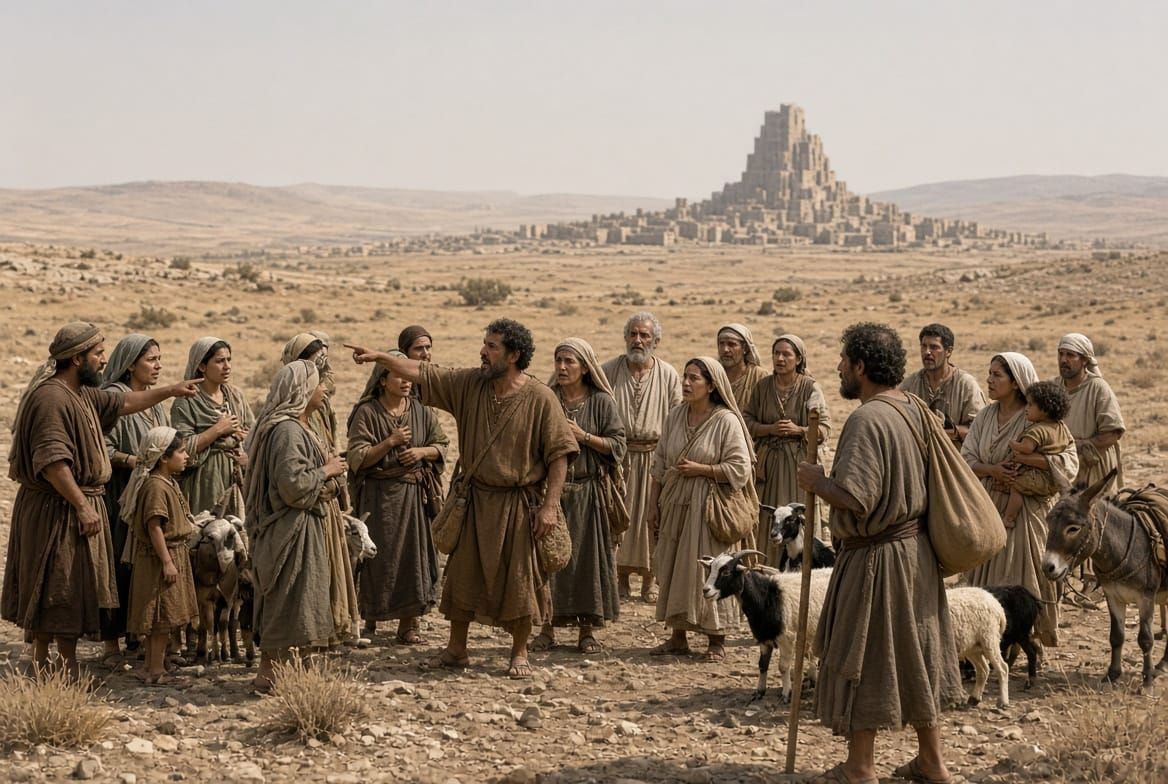
The plains of Shinar held the best farmland left in the post-catastrophe world. According to the specification under scrutiny, thousands of people — all speaking one language, all descended from eight survivors — had concentrated rather than scattered. They were building a city and a tower "whose top may reach unto heaven." Not exploring. Not dispersing. Accumulating.
Then the language broke.
The specification attributes this to divine intervention (Genesis 11:7–9). But what matters for the dispersal model is the outcome: a unified population that had functioned as a single coordinating unit could no longer communicate across family lines. The construction project collapsed. The social fabric tore along the only seams that still held — kinship. Groups that could still understand each other stayed together. Everyone else became foreigners overnight. No one could settle disputes among groups. No one could coordinate the work projects. Even trading among them would have been strained.
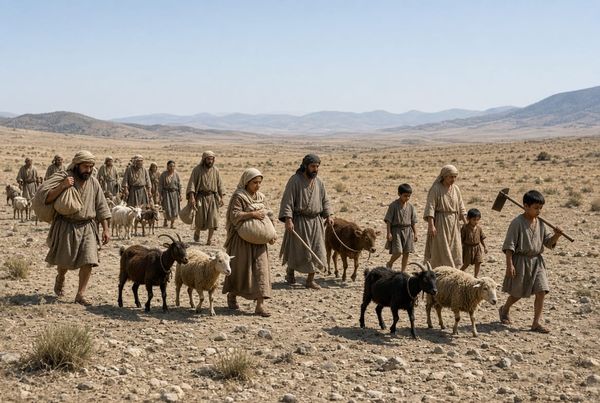
Within days — perhaps hours — the decision cascaded through the camps. Families gathered their seed stock, their breeding animals, their metal tools, and the practical knowledge carried from the pre-Flood world. And they walked.
Approximately 3,000–4,000 people left the half-built tower in roughly 25 clan-sized groups. They entered a corridor system two centuries in the making — the overland trunk vegetated, open, and already carrying the dispersing animal kinds. The sea-level bridges to the outer continents, however, had not yet opened. Those would follow over the centuries after the new ocean basins solidified, as the falling sea slowly bared the shelves. The overland highways were ready. The passengers had been missing — and where a sea gap still barred the way, the clans would reach the water's edge and wait for it to withdraw.
This paper is about how that dispersal worked.
The Diaspora Series built the corridors and timed the bridges. The Diversification Series calibrated the genetic clock. Paper 6 ("Where Did the Kinds Walk?") followed every animal kind from the Armenian Highlands to six continents, and noted in its closing pages that one kind walked the same corridors, crossed the same bridges, experienced the same millennia of drift — and remained one species. The human question was deferred.
This paper picks it up. Not the genetics — that is Paper 11 ("How Did Humanity Diversify?"), where the drift equation meets its eighth and most interesting dataset. Not the civilization — that is Paper 12 ("How Did Civilization Appear So Fast?"), where retained knowledge meets the archaeological record. This paper is about the mechanics of getting 25 families from one central plain to every habitable continent within a window that would one day be closing.
2. How Many Were Standing at Babel?
Eight survivors at year 0. Four men, four women. The specification is explicit, and the number is a granted premise.
The question is how many people are standing on the plain of Shinar when the language fractures them. The answer is arithmetic.
Pre-industrial populations with high fertility, no epidemic disease, and abundant resources grow at 1.5–3.5% per year. The lower end reflects realistic constraints — infant mortality, learning curves, environmental exposure. The upper end reflects the specific advantages of this founding population: no pathogen reservoir (the bottleneck eliminates the epidemic disease that dominates pre-industrial mortality), a genomically complete founding stock (tamim), and year-round growing conditions in the warm, wet Armenian Highlands.
The population did not stay where it landed. The specification records the move: "as they journeyed from the east, they found a plain in the land of Shinar; and they dwelt there" (Genesis 11:2). Over the growth phase the people came down out of the Armenian Highlands and into the Mesopotamian plain — a practical migration as the post-catastrophe climate settled into its new pattern and the lowland plain became the better farmland, "the best farmland left in the post-catastrophe world." They largely moved together, which is why the fragmentation finds them concentrated in one place rather than already scattered. The landing zone is Armenia; the growth happens across the descent; the dispersal launches from Shinar.
The Babel event is placed in the days of Peleg, whose birth dates to approximately year 100 in the Masoretic genealogy. The working estimate for Babel is year 200, noting that shifts of ±50 years do not materially affect the dispersal model.
From 8 founders at 3.0–3.2% sustained annual growth over 200 years: approximately 3,000–4,000 people. This is the working population. The number matters for the genetics (Paper 11) but not for the corridor mechanics — the bridges do not care how many people cross them.
The 3% figure is aggressive, and the conclusion does not depend on it. The dispersal mechanics require viable clans, not a specific total, and the model degrades gracefully as the assumed growth rate falls. At 2.5% sustained, the same 200 years yield roughly 1,100 people — still enough for several independent clans of 80–150. At 2.0%, roughly 420 — enough for a handful. Lowering the growth rate reduces the number of simultaneous dispersal units, not the feasibility of dispersal itself; even the conservative case launches multiple viable founding groups. As with the ±50-year tolerance on the Babel date, the mechanism is robust to the parameter rather than balanced on it.
3. The Fragmentation
Animals disperse naturally. Population pressure and reproductive instinct push them into new territory without any external trigger. The wave-front model from Paper 6 handles animal dispersal with no fragmentation event required.
Humans are different. Humans build cities. The specification says so — Cain built one before the catastrophe, and the Babel population is building one when the fragmentation occurs. Left to natural behavior, humans concentrate. They specialize. They stay.
The specification attributes the language confusion to divine intervention (Genesis 11:7–9). This paper takes the outcome — a sudden fracture of mutual comprehension along family lines — as the granted input and models forward from it, consistent with the project's methodology throughout.
How Many Groups?
The number of dispersal units can be estimated from two independent sources.
The linguistic estimate. Modern historical linguistics identifies a finite number of deep language families that resist further grouping — families so structurally distinct that no known method can trace them to a common ancestor. The largest six to eight (Indo-European, Sino-Tibetan, Niger-Congo, Austronesian, Afro-Asiatic, Austroasiatic, Dravidian, Trans-New Guinea) account for the vast majority of the world's population and languages. Adding another five to fifteen smaller but ancient families and isolates — Pama-Nyungan for Australia, various Amazonian and Papuan stocks, early isolates representing first branches — covers the full observed diversity. Most of the approximately 7,000 languages spoken today are later descendants that diverged within continents after isolation. Rapid language splitting in isolated populations is well-documented — the Austronesian and Niger-Congo radiations are textbook examples. Working backward from the modern tree to the irreducible roots gives approximately 20–30 base languages. The working estimate is 25.
The Table of Nations cross-check. Genesis 10 lists approximately 70 named descendants of Noah's three sons through three generations. These names function in the text as clan founders. Not all 70 represent independent dispersal units at Babel — some are sub-clans that split later, some are individuals who became prominent after settlement. The functional dispersal units are the groups large enough to sustain independent travel and reproduction: a minimum of roughly 50–100 individuals, below which immediate inbreeding depression threatens viability. The Table of Nations structure is consistent with approximately 20–40 functional groups — converging on the same range as the linguistic estimate from a completely independent source.
The arithmetic. At 3,000–4,000 total population divided into ~25 groups, the average founding group is 120–160 people, with natural variation from ~80 at the small end to ~250 at the large end. These are healthy, mobile, survivable clan sizes — large enough to avoid immediate inbreeding depression, small enough to move as a unit.
The Genetic Consequence
The sorting is linguistic, but the resulting groups are not random genetic samples. They are family clusters — brothers, cousins, in-laws. Each clan carries a non-random, family-biased subset of the alleles present in the Babel population. This is not an additional hypothesis. It is a mathematical consequence of family-structured fragmentation, and any population geneticist modeling a family-based split from a small founding population would predict it. Paper 11 quantifies the result.
4. The Corridors — Human Edition
The Diaspora Series modeled seven corridors radiating from the Armenian Highlands. The geography has not changed. The bridges are the same. The climate is the same. What changes is the passenger, and the differences widen every corridor.
Three Human Advantages
Technology. Humans carry fire, tools, and the knowledge to make clothing and shelter. The Beringia corridor — below freezing year-round, tundra shrubland — excludes tropical animals entirely. A human with fire, sewn clothing, and marine hunting knowledge walks through it. Technology does not change the climate. It changes the effective filtering.
Environmental modification. Animals walk through corridors. Humans reshape them — burning undergrowth, building fish traps, constructing temporary shelters that become semi-permanent camps. A modified corridor supports a larger transiting population, which affects the wave-front genetics that Paper 11 quantifies.
Intentional navigation. Animals disperse by population pressure — the wave front advances because the territory behind it is full. Humans choose to move and choose where. Social conflict — which the Babel event guarantees — is a powerful dispersal motivator that operates independently of population density. The Hebrew word for scattered, puts, in Genesis 11:8 describes an active fragmentation, not a gradual drift.
This changes the dispersal from a diffusion model to a directed migration. Clans do not drift outward from an expanding edge. They leave — deliberately, with distance as the goal.
Corridor Selection
Which clans take which corridors? The model does not attempt to answer with specificity. The Table of Nations provides a structural framework — Japheth's descendants are associated with northern territories, Ham's with southern, Shem's with the central Near East — but this paper does not trace specific clans to specific routes.
What the model predicts is the pattern: nearest corridors fill first, the most distant continents are settled by the most motivated or most pressured groups, and the founding populations of the most distant destinations show the strongest serial founder effects. Bridge-opening order reinforces this: the shallow near straits open first, the deep far sills last, so the outer continents are reached later both because they are farther and because their gates open later. That prediction is tested in Paper 11.
5. How Fast?
The animal wave front advances at 5–15 km/yr — limited by generation time and dispersal distance per generation. Humans are one to two orders of magnitude faster — but not continuously, and the difference matters.
A migrating clan with children, elderly, and belongings covers 10–20 km on a travel day. At 100–200 travel days in a year given over to movement, the burst rate is on the order of 1,000–3,000 km/yr. But a clan carrying seed grain and breeding stock does not travel like that year after year. It is a farm on the move, and a farm has to stop — to plant, harvest, rebuild the herd, and lay in supplies before the next leg.
The rhythm is concrete. A clan moves through a productive season, then reaches terrain it can plant and halts. It clears ground and sows the carried seed; it waits out the growing season and harvests; it holds a further season or two while the breeding animals drop young and the herd rebuilds to travel strength; it dries and stores enough grain and stock to provision the next march. Then it moves again — a burst of a few hundred to a thousand kilometers — and repeats the cycle at the next plantable ground. Each layover is measured in a small number of years; the marches between them in weeks to months. A single major leg is therefore assembled from a handful of these plant–harvest–rebuild–move cycles, and a distant continent from a chain of them.
Real transit is punctuated: bursts of rapid movement separated by settled cultivation cycles. The effective advance is therefore far slower than the burst rate — years to decades per major leg — but still one to two orders of magnitude faster than the animal wave front, and still small against the windows it has to fit inside.
The table below gives pure-travel time at 1,000 km/yr — the floor, ignoring layovers. Distances are measured from the plain of Shinar, the fragmentation point, not from the Armenian landing zone where the animal corridors originate. Each distance is given as a range: the lower figure is the straight-line (great-circle) distance, a hard floor; the upper is a practical walked-path estimate allowing for detours around water, mountain, and desert (roughly 1.4–1.7× the straight line). Without a climate-and-terrain model the true path cannot be drawn, but the ballpark is enough — the travel itself is never the binding constraint.
| Destination | Distance from Shinar (km) | Pure-travel time at 1,000 km/yr |
|---|---|---|
| Western Europe | ~4,000–6,000 | ~4–6 years |
| East Africa | ~3,700–5,500 | ~4–6 years |
| Southeast Asia | ~6,700–10,000 | ~7–10 years |
| Australia (via Sunda/Sahul) | ~10,400–15,500 | ~10–16 years |
| Beringia crossing | ~8,800–13,500 | ~9–14 years |
| Southern South America | ~14,400–24,000 | ~14–24 years |
These are absolute-minimum transit times, assuming continuous travel with no stops. Real effective rates are substantially lower — several times lower, once the plant–harvest–rebuild cultivation layovers are included — so a journey the table shows as a decade may in practice take several decades. Even at the long end of both the distance range and the layover penalty, every route completes well inside its bridge window. The table establishes a floor, not an estimate.
Even at the punctuated pace, humans reach any corridor mouth on Earth within a generation or two of setting out. The bridge windows are hundreds of years wide. Transit time — even with farming layovers folded in — is modest by comparison.
This means the bridge lifecycle controls access, not travel. The limiting factor is not how fast a clan can move but whether the bridge is open when it arrives. For the overland trunk, always open, the answer is immediate. For the sea gaps, the answer is often not yet: a clan moving quickly out of Shinar reaches the water's edge decades before the falling sea has bared the floor. It does there exactly what it would do anywhere on a long journey — settles, raises crops, waits — and crosses when the gap opens. The farming layover and the bridge-wait are the same behavior. Together they leave a distinctive mark: staging populations that sit at the chokepoints for a time, then pass through relatively quickly once the way clears.
A directed-migration model with staging also produces a distinctive archaeological signature: occupied endpoints with sparse evidence of corridor transit, and occasional denser staging sites at the sea gaps — now themselves submerged. Humans appear at distant locations "suddenly" — not because they traveled instantaneously, but because small groups moving in punctuated bursts through established ecosystems, using perishable materials, leave almost nothing that survives 5,000 years.
6. The Timing Overlay
The critical test: does the human dispersal window fit inside the bridge lifecycle? The bridge dates below are taken directly from the companion Diaspora paper ("When Did the Waters Part?"), which anchors all sea-level change to the solidification of the new ocean floor at approximately year 290.
| Event | Year |
|---|---|
| Flood onset | 0 |
| Ark passengers disembark | Day 371 (~year 1) |
| Overland trunk open, vegetation established | Year 1 onward |
| Population growth, Armenian Highlands | Years 1–200 |
| Babel fragmentation | ~Year 200 |
| Overland dispersal begins | ~Year 200 |
| New ocean floor solidifies (sea-level clock starts) | ~Year 290 (bracket 219–361) |
| English Channel / Doggerland opens | Year 270–440 |
| Bering Strait opens | Year 290–480 |
| Bass Strait opens | Year 320–540 |
| Sunda / Sahul opens | Year 430–820 |
| Red Sea / Arabia opens | Year 440–860 |
| All major sills cleared (central estimate) | ~Year 600 |
| Continental isolation (gradual closure) | Closed today; schedule not predicted |
Babel lands two centuries into the recovery — before the sea-level bridges open, not after. This is the sequence, and it matters. At year 200 the overland trunk is long open and vegetated (the Diaspora Series established that vegetation is ready before the bridges, in every corridor), and the animal kinds have been moving along it for generations. But the new ocean basins do not solidify until about year 290, and only then does the sea begin to fall. The sea-level bridges follow: the shallow straits within a century of solidification, the deepest within a few centuries, every major sill cleared by about year 600 at the central estimate and within the first millennium at the conservative end.
So the clans do not walk out of Shinar onto a fully open highway system. They walk onto an open overland trunk, disperse along it immediately, and — where the route requires a sea crossing — arrive at the water's edge to find the gap not yet open.
The staging behavior is the mechanism that absorbs this offset, and it requires nothing the clan was not already doing. A clan bound for a sea-gap continent departs Babel around year 200 and reaches its chokepoint — the Bering approach, the Sunda margin, the Bab el-Mandeb narrows — within a decade or two of punctuated travel. The sill there is still under water; solidification has only just occurred, and the sea has not yet fallen far enough to bare the floor. The clan does at the chokepoint exactly what it did at every plantable halt along the way: it clears ground, sows, harvests, rebuilds the herd, and holds — except that here it holds not for the two or three seasons a provisioning layover needs, but for as many cycles as the falling sea requires, which for the deeper sills is a span of decades to a few centuries. When the net drop clears the sill, the gap opens, and the staged population crosses in the months a bridge crossing takes. The farming layover and the bridge-wait are the same behavior; the only difference is duration, set by the sill depth rather than by the granary. Because the wait is simply a longer instance of the cycle the clan already runs, the ~70-to-660-year offset between Babel and each bridge's opening is not a gap the model must explain away. It is absorbed by populations that sit, farm, and cross when the water withdraws — which is also why the chokepoints, not the open corridors, are where the transit phase leaves its densest (and now submerged) trace.
At the deepest, latest-opening sills — Sunda/Sahul and the Red Sea, which may not clear until years 820–860 — the wait is long enough that "clan holding at a chokepoint" understates it. A group that farms one location for two to four centuries has not held its breath; it has settled and grown. The honest description is a split, not a pause: the staged population establishes, expands over the wait, and when the gap finally opens a daughter fraction crosses to found the far-continent lineage while the remainder stays as an established near-side settlement. This is not a weakening of the transit picture but a sharpening of it, and it makes a specific prediction — a permanent settled population on the near side of each deep sill, genetically parent to a smaller, later founder population on the far side. It also relaxes the demographic demand: a settlement that has grown for centuries needs only to spare a viable daughter group for the crossing, not to keep an entire clan mobile and intact across the whole wait.
These two inputs — the genealogical timeline (Babel at ~year 200) and the sea-level budget (bridges opening between years 270 and 860 after solidification) — are derived from independent sources. One is textual. The other is physical. They were not adjusted to produce agreement, and notably they do not need to coincide: Babel precedes the bridge openings, and the clans' staging behavior at the sea gaps absorbs the offset between departure and access.
The model is robust to ±50 years in the Babel date. Because dispersal along the overland trunk begins immediately and the sea crossings are gated by bridge opening rather than by departure date, the sequence tolerates substantial uncertainty in the Babel placement. It would fail only if Babel were placed so late that the clans arrived after the corridors had re-drowned — which the early post-flood placement, anchored to Peleg, does not approach.
7. The Invisible Transit
The archaeological record of early human dispersal is sparse. Isolated tool finds separated by vast distances. Occupied endpoints without corridor evidence. Apparent "sudden" appearances at distant locations with no local developmental sequence. In the conventional framework, this pattern requires tens of thousands of years of undetectable migration.
In this model, the sparsity is the prediction. Five factors converge to make the transit archaeologically invisible:
Small numbers. Twenty-five groups of 50–200 people spread across six continents produce a population density below one person per thousand square kilometers — far below the detection threshold of any archaeological survey method.
Perishable technology. Wood, hide, bone, plant fiber, unworked stone. A clan on the move uses expedient tools from available materials and discards them. The resulting scatter is sparse, informal, and nearly impossible to distinguish from naturally fractured rock.
Submerged routes. The easiest dispersal paths follow coastlines — abundant marine protein, reliable freshwater, level terrain, navigation landmarks. These are precisely the routes destroyed by subsequent sea-level change. The land bridges are now under water. The coastal camps — and the staging sites at the sea gaps — are under 50–150 meters of ocean. The primary archaeological evidence of the transit is on the modern continental shelf, inaccessible to conventional survey.
Tropical decomposition. Open-air sites in tropical and subtropical environments — the climate of most corridors — have preservation potential measured in decades. Organic materials decompose. Unfired structures collapse. Hearths disperse.
No monuments. Transit-phase populations are mobile. They do not build permanent structures, accumulate refuse middens, or dig storage pits. The activities that produce archaeologically visible sites — long-term occupation, food storage, construction — belong to the settlement phase, not the transit.
8. Initial Conditions and Predictions
The dispersal model establishes the initial conditions that the genetic and cultural models require. These are stated here so that Papers 11 and 12 can evaluate them without circular reasoning.
Founding genome (year 0): Eight individuals, tamim — genomically complete, high heterozygosity, no accumulated mutational load.
Population at fragmentation (year 200): 3,000–4,000, grown as a single interbreeding unit. Effective population size during the growth phase is small — perhaps 50–200 — because the population traces to eight founders only 6–8 generations earlier.
Dispersal units: ~25 groups averaging 120–160 individuals (range ~80–250), each a family-biased genetic sample of the Babel population.
Isolation timing: Each continental population becomes isolated when its corridor re-drowns. Bridge opening is dated (years 270–860 after solidification, per the companion paper); closure is not — the companion paper establishes that the corridors are closed today but does not predict the schedule, because closure is driven by the slower return of water and sediment to the basins. The window of potential gene flow therefore runs from each bridge's opening to its undated closure — at least several centuries, and longer for the deeper, later-opening straits. Paper 11 treats this window as bounded below by the opening dates and above by present-day isolation.
Predictions Committed Before Testing
Four predictions follow from the dispersal mechanics in this paper. All are testable against published data. None are adjusted after the fact.
1. Human FST must be systematically lower than animal FST. Every animal kind began dispersing from day one — immediate wave-front expansion, immediate drift. Humans stayed together as a single interbreeding population for 200 years before fragmenting. The drift clock for humans starts later, and the pre-fragmentation population was larger and better-mixed than any animal kind's wave front. The model does not merely permit low human FST. It requires it. Paper 11 tests this.
2. The genetic diversity gradient should peak near the Mesopotamian plains and decline with corridor distance. Serial founder bottlenecks along each corridor progressively reduce heterozygosity. The founding populations of the most distant continents — Australia, southern Africa, the southern tip of South America — should carry the lowest diversity. This mirrors the pattern already documented in the animal kinds but predicts a specific origin point. Paper 11 tests this head-to-head against the conventional African-origin gradient using the Ramachandran et al. (2005) dataset.
3. Multiple civilization centers should appear within a narrow absolute window. If clans carrying the same retained knowledge base (metallurgy, agriculture, animal husbandry, administration) arrive at the major river valleys within decades of each other, and if population growth rates are comparable, then the Tigris-Euphrates, Nile, Indus, and Yellow River civilizations should emerge within a calculable window — not separated by tens of thousands of years. All should display metallurgy, agriculture, and administrative systems from their earliest strata, because they are remembering, not inventing. Paper 12 tests this.
4. The early archaeological record should be sparse, coastal, and consistent. The transit-phase populations are small, mobile, using perishable materials, traveling routes now submerged. The earliest evidence at distant locations should be sparse rather than dense, coastal or near-coastal rather than interior, toolkit-consistent reflecting shared origin rather than showing local developmental sequences, and often below current sea level — with the occasional denser staging site at a former sea gap, likewise submerged. Paper 12 evaluates this alongside the settlement record.
9. What This Paper Does Not Claim
This paper does not claim to identify which modern population descends from which Babel clan. The Table of Nations provides structural input — approximately 70 clan-founders organized into three lineages — but the mapping from ancient clan to modern people is not attempted.
This paper does not claim to explain the Babel mechanism beyond what the specification states. The language fragmentation is a granted input. The paper models the consequences — the dispersal pattern, timing, and corridor selection — forward from that input.
This paper does not claim that human dispersal was exclusively post-Babel. Local exploration from the Armenian Highlands may have occurred during the 200-year growth phase. The claim is that continental-scale dispersal is triggered by the Babel fragmentation.
This paper does not assign continental-isolation dates. Bridge opening is taken from the companion Diaspora paper; bridge closure is not predicted there and is not predicted here. The gene-flow window is therefore bounded below by the opening dates and above by the observed present-day isolation, without a specific closure schedule.
10. The Stage Is Set
Eight survivors. Two hundred years of growth. A language event that shattered a construction project and scattered 25 families onto every corridor the recovering planet would open. An overland trunk already paved in grass and stocked with game. Sea-level bridges that would open on a clock started after the clans set out — so that the families reached the water's edge and waited for it to fall. Transit measured in years, staging measured in decades, through windows measured in centuries.
The passengers are ready. The overland highways are open, and the sea gaps open in turn. Four envelopes are sealed. The genetic clock starts ticking the moment the clans separate.
Paper 11 opens the first two envelopes.
© 2026 D. L. White. Licensed under CC BY-ND 4.0 — share it freely and unaltered, with attribution.
This paper was developed collaboratively using Claude (Anthropic) for technical modeling, calculations, and co-development of the reasoning chain. Grok (xAI) provided independent adversarial review. Neither AI system endorses all conclusions as settled.