How Did Civilization Arise Abruptly?
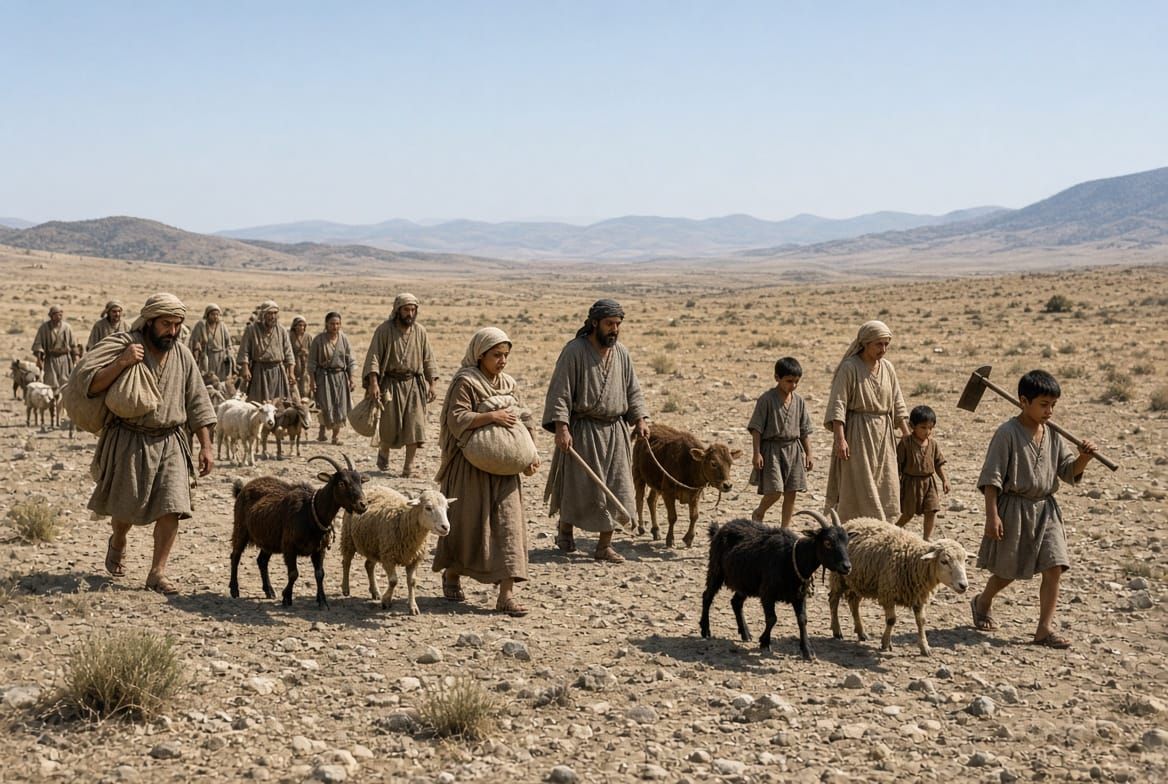
Part Three of the Differentiation Series. They walked out of Shinar with uneven knowledge. Every clan could farm and keep a fire. Only some could smelt, administer, or raise a city. Civilization did not have to be invented. Population had to catch up to what they already knew.
How Did Civilization Arise Abruptly?
The Re-Establishment of Knowledge After the Babel Dispersal
Part 3 of the Differentiation Series (Project Paper 12)
1. What the Clans Carried
The Babel population was not primitive. They were building a city and a tower. The specification places metalworking (Tubal-Cain, bronze and iron — Genesis 4:22), agriculture (Cain as tiller — Genesis 4:2), animal husbandry (Abel as keeper, Noah with the clean and unclean distinction), and city construction (Cain built a city — Genesis 4:17) in the pre-catastrophe world. Two hundred years of post-catastrophe growth — from the Armenian landing down into the plain of Shinar — preserved and practiced these skills. By the time the language broke, the population at Babel had specialization — masons, metalworkers, potters, farmers, breeders, toolmakers, administrators. They were coordinating a construction project that required organized labor across multiple trades.
The fragmentation shattered this coordination but did not erase the knowledge. What it did was distribute the knowledge unevenly across approximately 25 clan-sized groups. The distribution follows a predictable three-level structure.
The first level is universal knowledge — skills so basic that every family practices them regardless of specialization. Fire-making, basic agriculture, basic shelter construction, animal handling, food preservation, water sourcing, social organization within a family group. Every clan carries this because every adult knows it.
The second level is witnessed knowledge — technologies that clan members observed but never personally practiced. Your friend’s father was the metalworker. You watched him work the bellows and pour the bronze. You know the general principles. You might produce a crude version given the right ore and enough failed attempts. But you cannot replicate his skill, and if he is not in your clan when the language breaks, his expertise leaves with him. What remains is a memory — degraded, incomplete, but not zero.
The third level is specialist knowledge — capabilities held by one or a few people in the entire Babel population. Specific smelting techniques, specific architectural methods, specific administrative systems, specific breeding programs. If the specialist is in your clan, you carry that knowledge at full fidelity. If not, it is gone until someone reinvents it, reconstructs it from witnessed memory, or trades for it.
This three-level distribution generates a specific, testable expectation for the archaeological record: technology retention should correlate with transit distance from the origin. The clans that settle closest to Babel — in the Tigris-Euphrates valley, the Levant, the Nile corridor — travel the shortest distances, lose the fewest people on the walk, and arrive with the most complete knowledge suites. Near-origin groups should show near-complete technology from their earliest settlement layers: planned construction, metallurgy, agriculture, animal husbandry, and the administrative concepts that eventually produce writing.
Groups with moderate transit distances — into the Indus Valley, the Yellow River basin, the Mediterranean coast — should retain agriculture and basic construction but may show gaps in specialist knowledge. Metallurgy might appear later, or in cruder form, or through trade rather than local production.
Far-transit groups — those reaching Australia via the island Southeast Asian corridor, crossing Beringia into the Americas, penetrating deep into Central Africa or the Amazon — undergo the most bottlenecks, the longest walks, and the most attrition of specialist carriers. These groups should retain universal knowledge (fire, basic toolmaking, complex social organization, oral tradition) but arrive without metallurgy, without monumental construction capability, and without administrative systems. The technology they lack is not evidence that they were primitives who had not yet evolved these concepts. It is evidence that the metalworker was not in their clan, or died on the walk, or that the raw materials were not available in the new environment.
This is not speculation about specific clans. It is a structural prediction of the lumpy knowledge distribution model: a gradient from near-complete technology suites at the origin to universal-only technology at the far termini, driven by transit distance and bottleneck attrition. The archaeological record either shows this gradient or it does not.
2. What They Found
The corridors were ready. Paper 4 ("Where Did the Dove Find Peace?") established post-catastrophe climate recovery. Paper 5 ("When Did the Waters Part?") timed the bridge openings. Paper 6 ("Where Did the Kinds Walk?") followed the animal kinds through the corridor system from the Armenian Highlands to six continents. By year 200, the landscape the clans entered was not barren. It was vegetated, watered, and stocked with game.
The first clans to reach the major river valleys — Tigris-Euphrates, Nile, Indus, Yellow River — found the richest agricultural land on Earth, unpopulated, with abundant water, deep alluvial soil, and wild game supplementing whatever livestock they brought. The groups that reached these valleys did not need to invent agriculture. They needed to plant. They did not need to discover animal husbandry. They needed to breed what they brought and, where useful, apply known techniques to local wild stock. They did not need to develop social organization. They needed to apply it at a smaller scale than Babel.
The constraint was not knowledge. It was population. A clan of 150 cannot build a city. It lacks the labor force for monumental construction, the surplus for full trade specialization, and the density for administrative bureaucracy. What it can do is farm, keep animals, make tools, organize a village, and grow. The city comes when the population catches up with the knowledge — not when the knowledge finally appears.
This inverts the conventional narrative. The standard model treats early settlement as the beginning of a long developmental process: hunter-gatherers slowly learning to farm, slowly domesticating animals, slowly developing construction techniques, slowly accumulating the social complexity that eventually produces cities. The project's model treats early settlement as the deployment of existing knowledge under a population constraint. The skills were present from day one. The scale was not. Everything that follows is population growth catching up to retained capability.
3. Organized from Founding
If the clans carried knowledge rather than developing it locally, then the archaeological record at early settlement sites should show a specific signature: organized construction from the earliest occupation layers, with no preceding phase of primitive experimentation visible in the stratigraphy. People who knew how to build should build from the moment they arrive — at whatever scale their population supports.
Multiple independent civilization zones show this pattern.
Eridu, conventionally dated as the earliest Sumerian city, has a mud-brick temple on an artificial terrace from its first occupation layer. There is no preceding phase of experimental construction. The builders knew what they were doing when they laid the first course.
Catalhoyuk, in south-central Anatolia, shows densely packed houses with standardized layouts from its earliest layers. The settlement plan is organized — not the ad hoc accumulation of shelters that a group learning to build would produce. It is the work of people who had built before.
Jericho shows a fortified settlement with stone walls and a stone tower from its earliest layers. The tower is not a late addition built after centuries of gradual development. It is present from the beginning. The people who built it arrived knowing how to cut stone, lay courses, and organize communal labor.
Mohenjo-daro and Harappa, in the Indus Valley, show fully planned urban layouts with baked-brick construction, sophisticated drainage systems, and standardized weights and measures from the earliest Mature Harappan layers. The degree of standardization — consistent brick ratios across sites separated by hundreds of kilometers — implies not just construction knowledge but administrative coordination.
Erlitou, in the Yellow River basin, shows palace complexes and organized urban layout from its founding layers.
Caral, on the coast of Peru, shows monumental pyramids and a planned ceremonial center from its founding layers — the earliest known urban center in the Americas, with no local developmental precursor in the archaeological sequence.
Six zones. Multiple continents. The same pattern: organized construction from the first layers, with no visible primitive precursor phase. The conventional model requires each of these populations to have independently developed the concepts of planned construction, standardized building materials, and organized communal labor through local experimentation — six times, independently, each time without leaving a visible record of the learning process. The project's model requires only that experienced builders from a city-building culture applied what they knew when they arrived.
4. The Technology Gradient
The transit-distance prediction from Section 1 can now be checked against the archaeological record. If technology retention correlates with distance from the origin, then the six civilization zones — plus the far-transit populations that do not produce "civilizations" in the conventional sense — should arrange themselves along a gradient.
The near-origin settlements show the most complete technology suites. Eridu, Uruk, and the Mesopotamian sequence have metallurgy, planned construction, irrigation agriculture, livestock management, pottery, textile production, and administrative record-keeping from early in their sequences. The Levantine sites — Jericho, Catalhoyuk — show planned construction and agriculture but with different specialist profiles; Catalhoyuk has sophisticated wall painting and obsidian working but no early metallurgy at the site itself. The Nile corridor shows organized agriculture, monumental construction, and a mature writing system appearing rapidly.
The mid-transit settlements show organized construction and agriculture but with visible gaps. The Indus Valley has planned cities and standardized construction but a writing system that remains undeciphered and may represent a different level of administrative complexity than Sumerian cuneiform. Erlitou has palace construction and bronze-working but its writing system (oracle bone script) appears later in the Chinese sequence than cuneiform appears in the Mesopotamian sequence.
The far-transit populations show the universal knowledge layer — fire, toolmaking, complex social organization, sophisticated oral tradition, detailed ecological knowledge — but lack metallurgy, monumental construction, and writing. Aboriginal Australians maintained extraordinarily complex kinship systems, astronomical knowledge, and land management techniques (fire-stick farming) without metallurgy or permanent construction. Amazonian populations developed complex social structures, extensive botanical knowledge, and sophisticated land management (terra preta soils) without writing or metallurgy. These are not primitive cultures. They are cultures founded by clans that carried the universal knowledge layer but lost the specialist layer during long-distance transit.
The gradient is not perfect. Caral sits at a far-transit terminus (coastal Peru) yet shows monumental construction — which suggests either that its founding clan happened to include skilled builders, or that the lumpy distribution is precisely that: lumpy, not smoothly correlated with distance. Individual clan composition matters. A single skilled mason in a far-transit clan produces Gobekli Tepe or Caral. A near-origin clan that happened to lack a metalworker shows a gap in an otherwise complete suite. The gradient is statistical, not deterministic, and the exceptions are themselves consistent with the model's mechanism: knowledge distribution was lumpy because specialist knowledge was carried by individuals, not uniformly distributed across the population.
The prediction is not that every near-origin site has everything and every far-origin site has nothing. The prediction is that the probability of retaining specialist knowledge decreases with transit distance, that the archaeological record shows a broad correlation consistent with this prediction, and that the exceptions are explicable by individual clan composition rather than by developmental sequence.
5. The Livestock Connection
The specification distinguishes clean animals from unclean: seven pairs of each clean kind versus one pair of each unclean kind (Genesis 7:2–3). The clean animals — cattle, sheep, goats — are the domesticated livestock kinds. Seven pairs means 14 founding individuals per kind: substantially more genetic diversity from the start than the unclean kinds received. These are animals that humans had been keeping, breeding, and selecting for the two centuries between the landing and the Babel dispersal.
Each dispersal clan takes some of its livestock when it walks. As clans enter different corridors and reach different environments, three processes operate on the animals simultaneously.
The first is double selection. Natural selection culls animals that cannot handle the new environment — the cold, the heat, the altitude, the available forage. The breeders simultaneously cull animals that do not meet their needs — insufficient milk, poor temperament, inadequate wool. Both pressures operate on the same population in the same generation. This is faster diversification than either mechanism alone. Belyaev's silver fox experiment achieved visible morphological changes — floppy ears, curled tails, coat color shifts — within 10 generations of selection on a single trait (tameness). Experienced breeders applying multi-trait selection under simultaneous environmental pressure should match or exceed this rate.
The second is local stock acquisition. Clans that encounter useful local wild species in their new environment apply known domestication techniques to unfamiliar animals. They are not discovering the concept of animal husbandry. They are applying a well-practiced skill to new raw material. This produces a local "domestication sequence" visible in the strata — morphological changes from wild-type to domestic-type — but the sequence is driven by knowledge and intentional selection, not by accidental discovery over millennia.
The third is transported domesticates — and this is the most directly testable. In at least three documented cases, domestic animals appear at archaeological sites with no local wild precursor population. Sheep appear in early Egyptian contexts, but there are no wild mouflon in Africa. Cattle appear in the Indus Valley without a clear local aurochs domestication transition. Pigs appear on islands in Southeast Asia where they could only have arrived by boat, imported from the mainland.
These transported domesticates are direct evidence of livestock carried by people who knew how to keep them. The morphological transitions visible in the strata at these sites are not naive hunter-gatherers stumbling into animal husbandry. They are experienced breeders reshaping stock to meet new conditions.
The clean-unclean distinction in the specification produces its own testable expectation. The clean kinds — cattle, sheep, goats — received more founding genetic diversity (seven pairs versus one pair). The Diversification Series established that founding diversity constrains subsequent diversification potential. If the clean kinds received more founders, they should show greater breed diversity within each kind than unclean kinds of comparable body size and generation time. This is observed: the number of recognized cattle, sheep, and goat breeds vastly exceeds the breed diversity of, say, cats or horses, even when adjusted for the duration and intensity of human selection. The model does not claim this as proof — the economic importance of livestock is an obvious confound — but the direction of the prediction is correct and worth noting.
6. Writing and Administration
Sumerian cuneiform appears at Uruk in the conventional chronology around 3200 BC as a relatively systematic administrative tool. It is not crude pictographs gradually evolving toward abstraction. The earliest tablets are accounting records — inventories, transactions, labor allocations. Within 200 to 300 years of the earliest examples, the system reaches full administrative capability. Egyptian hieroglyphs appear as a mature mixed logographic and phonetic system. Chinese oracle bone script, though appearing later in the conventional sequence, shows a fully functional divination and record-keeping system from its earliest attestation.
The conventional model requires writing to be independently invented at each center through a long process of local experimentation — a process that, in every case, left remarkably little evidence of its own development. The project's model requires something simpler: people who had lived in an administered city recognized the need for records when their own population grew large enough to require them, and reconstructed administrative tools from retained knowledge of the concept.
The prediction is precise in what it claims and what it does not. It does not claim that cuneiform was used at Babel. It does not claim that the specific symbols, grammar, or medium of any writing system were carried from a common source. It claims that the concept of written administration — recording transactions, tracking inventory, organizing labor, communicating across distance — was carried by people who had lived in a society that used it. The implementation at each new center was local and distinct. The concept behind it was shared.
This explains a pattern that the conventional model handles awkwardly: multiple writing systems appear independently within a relatively narrow temporal window (narrow even under conventional chronology), all serving administrative functions first, all reaching functional maturity rapidly rather than developing slowly from primitive precursors. The concept did not need to be invented from scratch at each location. It needed to be re-implemented by people who already knew what writing was for, even if they had to design a new system to do it.
The witnessed-knowledge model from Section 1 applies directly. Not every clan member at Babel was a scribe. But many watched the scribes work. Many participated in the administered system — received rations tracked on tablets, contributed labor recorded by overseers, traded goods whose quantities were tallied. The concept of administration was universal knowledge even if the practice of writing was specialist knowledge. When the population at a new settlement reached the threshold where informal memory could no longer track transactions — somewhere around the village-to-town transition — the concept re-emerged because the need re-emerged, and people who remembered that writing existed found ways to make it work again.
7. Trade as Necessity
The conventional model treats long-distance trade as a late development — a consequence of surplus production and social complexity that emerged after societies had already established themselves. The archaeological record tells a different story. Obsidian trade networks spanning hundreds of kilometers appear in the earliest Near Eastern settlement layers. Lapis lazuli from Afghanistan and carnelian from Gujarat appear in early Mesopotamian contexts. Marine shells from the Mediterranean appear at inland Levantine sites from early occupation layers.
The project's model predicts early trade not as an invention of prosperity but as an immediate structural necessity of the lumpy knowledge distribution. Each clan carried an incomplete set of specialist skills. Your clan has a potter but no metalworker. The clan that settled two valleys east has the metalworker but no potter. You need metal tools. They need storage vessels. Neither of you needs to invent trade as a concept — you traded at Babel. What you need is to find each other and establish exchange.
This generates a specific prediction about the composition of early trade: the earliest long-distance trade goods should be specialist products that require specific knowledge to produce. Obsidian tools require knowledge of source locations and advanced knapping technique. Metal implements require smelting knowledge. Finished ceramics require pottery skill. If trade arose from knowledge gaps rather than surplus accumulation, then the first goods traded over long distances should be the specialist products — not bulk commodities, not luxury decorations, but the outputs of skills that some clans had and others lacked.
The archaeological record is consistent with this prediction. The earliest documented long-distance trade goods in the Near East are obsidian, metal ore and finished metal goods, and high-quality ceramics. Bulk agricultural trade — grain shipments, textile bales — appears later, after populations have grown and surplus production has begun. The sequence matches the model: specialist goods first (filling knowledge gaps), bulk commodities later (exploiting surplus).
Trade also serves as a transmission mechanism for the witnessed-knowledge layer. A clan that lacked a metalworker but traded regularly with a clan that had one would, over time, observe the techniques, acquire the concepts, and eventually develop its own metalworking capability — perhaps cruder at first, improving over generations. Trade does not just move goods. It moves knowledge. The lumpy distribution smooths itself out over time through this mechanism, and the archaeological record should show specialist technologies gradually appearing at sites that initially lacked them, spreading outward from the centers that had them first. This pattern of technology diffusion from early centers is well documented in the conventional literature, though it is conventionally interpreted as independent invention followed by cultural contact rather than as knowledge recovery driven by trade.
8. The Population Arithmetic
Paper 10 established founding group sizes of approximately 120 to 160 from the Babel fragmentation. These groups are healthy, mobile, and reproductively viable. They settle in productive environments — river valleys, coastal plains, fertile uplands — and begin growing.
At pre-industrial growth rates of 2 to 3 percent per year — rates consistent with well-documented historical populations under favorable conditions with abundant land — each settlement reaches predictable population thresholds on a calculable schedule. From a founding group of 150 at 2.5 percent annual growth:
The village threshold of approximately 500 to 1,000 people is reached in approximately 7 to 10 generations, or 190 to 270 years from founding. This is the minimum population for basic craft specialization, communal construction projects, and simple administrative coordination. Below this threshold, the knowledge is present but the labor force is not.
The urban threshold of approximately 5,000 people is reached in approximately 13 to 16 generations, or 350 to 430 years from founding. This is the population required for full trade specialization, monumental construction, and administrative bureaucracy — the scale at which a settlement begins to look like what archaeologists call a city.
The city threshold of approximately 20,000 to 40,000 — the scale of Uruk or Mohenjo-daro at their documented peaks — is reached in approximately 18 to 22 generations, or 490 to 600 years from founding.
From the Babel fragmentation at approximately year 200 post-catastrophe, these thresholds predict first urbanism at approximately year 550 to 630, and peak city scale at approximately year 690 to 800 — within the window when the corridors remain open for inter-settlement trade. (The Diaspora Series dates the bridge openings, roughly years 270–860, but not the closures; the corridors are certainly open across this period, and the river-valley centers are in any case linked overland rather than by sea-gap bridge.)
These are not tuned to match any archaeological date. They are calculable outputs from Paper 10's founding conditions and standard demographic parameters. The growth rate is not a free parameter — it is bounded by documented pre-industrial populations. The founding size is not a free parameter — it comes from the linguistic estimate and Table of Nations cross-check. The thresholds are not free parameters — they come from documented relationships between population size and social complexity.
The model predicts that the sprint from village to city should take approximately 300 to 400 years. This is fast by conventional archaeological standards — but it is what the arithmetic requires when the starting population already carries the knowledge and the constraint is labor force, not invention.
9. Gobekli Tepe
Gobekli Tepe is the single strongest data point for the model's central prediction.
Located in southeastern Turkey, approximately 150 kilometers from the northern edge of the Mesopotamian plain, the site contains monumental T-shaped stone pillars up to 5.5 meters tall and weighing up to 10 tonnes, arranged in circular enclosures and carved with sophisticated animal reliefs. The quarrying, transport, carving, and erection of these pillars required organized labor, engineering knowledge, and an artistic tradition. The site was constructed, used, and deliberately buried — intentionally backfilled with debris, preserving the structures for later excavation.
No pottery has been found at Gobekli Tepe. No metallurgy. No evidence of permanent residential occupation at the site itself during its primary construction phase. No preceding sedentary settlement in the local archaeological sequence that could represent a developmental precursor.
The conventional model struggles with Gobekli Tepe because it requires pre-agricultural hunter-gatherers — people supposedly without permanent settlement, without surplus food production, without the social complexity that conventionally accompanies monumental construction — to organize and execute a construction project that would challenge many later societies. The standard response has been to revise the model: perhaps monumental construction preceded agriculture rather than following it. Perhaps the social complexity required for organized labor does not require sedentism after all. Each revision accommodates Gobekli Tepe at the cost of weakening the assumptions that the rest of the conventional framework depends on.
The project's model does not struggle with Gobekli Tepe. It predicts it.
Gobekli Tepe is what happens when experienced builders from a city-building culture arrive at a new location and build something with the skills they brought. They do not need local developmental precursors because they did not develop the skills locally. They brought them. The sophisticated carving is not the culmination of a local artistic tradition. It is the deployment of a tradition developed elsewhere — at Babel and in the two centuries of settlement between the Armenian landing and Babel.
The absence of pottery and metallurgy at the site is the lumpy knowledge distribution in its clearest form. The clan or clans that built Gobekli Tepe included skilled stone masons and stone carvers — and they worked at full competence from day one. They may not have included a potter or a metalworker. The skills they had, they deployed immediately. The skills they lacked, they lacked entirely. Full competence in the specialties carried by the group's members, complete absence of the specialties that were not. No partial versions. No primitive precursors.
The deliberate burial of the site is an additional datum. People who valued what they built enough to preserve it by backfilling — rather than abandoning it to erosion — suggest a population that understood permanence as a concept, that planned beyond the immediate, and that treated constructed space as significant. These are not behaviors that emerge from a hunter-gatherer band experimenting with stone arrangement. They are behaviors consistent with people from a culture that built things that mattered.
10. The Exponential Silence
The most consequential period in post-catastrophe human history — the sprint from Babel to the founding of civilizations — happened before anyone was writing it down.
This is not a gap in the record. It is a predictable consequence of the model. Section 6 established that writing re-emerged when populations crossed the administrative threshold — when informal memory could no longer track transactions. At a clan size of 150, everyone knows everyone. There is no need for tablets.
The need re-emerges at the village-to-town transition — somewhere around 500 to 1,000 people, when informal memory can no longer track who owes what to whom. By the population arithmetic of Section 8, this transition occurs approximately 200 to 300 years after settlement. By the time a scribe exists to record events, the founding sprint is over. The settlement is established. The trade networks are functioning. The livestock have been diversifying for a dozen generations. The first historians record the slow roll — the stabilization phase — not the explosive founding period.
The conventional model interprets this silence as evidence of a long, slow developmental period. No written records from the early period means the early period was pre-literate, which means the early population had not yet developed the complexity required for writing, which means civilization emerged gradually over millennia. Each step in this chain is an inference, not an observation. The absence of written records is an observation. The interpretation — that absence of records means absence of capability — is a conclusion that assumes what it sets out to prove.
The project's model interprets the same silence differently. The founding period was short, fast, and transformative — but it happened below the population threshold for written records. The archaeological evidence of the sprint survives: organized founding layers, transported domesticates, early trade networks in specialist goods, mature-appearing construction techniques deployed without developmental precursors. The written evidence does not survive because writing was re-implemented only after the population grew large enough to need it. The gap between the physical evidence and the written record is not a gap in human activity. It is a gap in human documentation.
This is the exponential silence. The most rapid phase of growth — the phase when small populations double and redouble in productive environments, when knowledge is being deployed and adapted and transmitted — is the phase least likely to produce durable records. The records begin when the growth slows, the populations stabilize, and the administrative systems catch up. By then, the story has already happened. What the first scribes wrote down was the world they inherited, not the world their grandparents built.
11. What This Paper Establishes
The Differentiation Series opened with a question that Paper 10 posed and Paper 11 answered genetically: if 25 clans walked out of Babel into every open corridor on the planet, what should we see in their genomes? The answer — FST consistent with the master clock, matrilineal and patrilineal coalescence in the same window, a diversity gradient traceable to the Near East, and a three-tier genome maintaining species unity across the full range of human variation — was consistent with the model.
This paper asks the next question: what should we see in what they built?
The lumpy knowledge distribution model — universal, witnessed, and specialist knowledge distributed unevenly across clan-sized groups and degrading with transit distance — generates specific expectations for the archaeological record. Organized construction from founding layers. A technology gradient from near-complete suites at the origin to universal-only knowledge at the far termini. Transported domesticates appearing at sites without local wild precursors. Trade networks emerging early and carrying specialist goods. Writing systems appearing independently but within a narrow window, all serving administrative functions, all reaching maturity rapidly. Population growth arithmetic predicting the timing of urbanization from known founding conditions. And one site — Gobekli Tepe — that fits the model precisely and fits the conventional model only with significant revision.
The model does not explain everything. It does not map specific clans to specific sites. It does not resolve the chronological discrepancies between the project's timeline and conventional archaeological dating — that task belongs to the Dating Capstone. It does not claim that every technology at every site was carried from Babel; local innovation and adaptation occurred, and the model expects them to. What it claims is that the foundational concepts — agriculture, construction, metallurgy, animal husbandry, administration — were carried by people who already knew them, not independently invented by people who did not.
The archaeological record is consistent with this claim. The silence of the exponential growth phase is consistent with this claim. The technology gradient is consistent with this claim. The transported domesticates are consistent with this claim. No single datum proves the model. The pattern — six independent zones showing the same organized-from-founding signature, a transit-distance gradient matching the prediction, early trade in specialist goods, rapid writing emergence, and Gobekli Tepe — constitutes a convergence that the conventional model accommodates only by revising its own assumptions at each new site.
The Differentiation Series is complete. Paper 10 modeled how the families dispersed. Paper 11 modeled what happened to their genomes. Paper 12 modeled what they built. The master clock runs through all three. The Dating Capstone collects the evidence.
What This Paper Does Not Claim
This paper does not claim to identify which clan built which civilization. The mapping from Babel clans to specific archaeological sites is not attempted. The model predicts a statistical gradient, not a deterministic assignment.
This paper does not claim that all knowledge at each founding site was carried from Babel. Local innovation and adaptation occurred. The claim is that the foundational concepts — agriculture, construction, metallurgy, administration — were carried, not independently invented.
This paper does not claim to resolve the conventional chronological discrepancies. The conventional dates for the six civilization zones span millennia under standard archaeological chronology (approximately 9000 BC to 1200 BC). The project's framework places them within centuries of each other. Resolution of this discrepancy belongs to the Dating Capstone, not this paper.
This paper does not claim that the Babel account provides a complete inventory of pre-catastrophe technology. The specification mentions metalworking, agriculture, animal husbandry, and city-building. Other technologies may have existed and been carried forward.
This paper does not claim that every "gradual domestication sequence" in the strata is actually rapid. The stratigraphic data on domestication transitions lacks the layer-by-layer quantitative detail to determine actual elapsed time independently of the conventional chronology. This is noted as a data gap, not resolved.
This paper does not claim that the populations at the far termini of the corridor system were cognitively inferior or culturally impoverished. The three-tier genome of Paper 11 establishes that all human populations share the same fundamental cognitive architecture. The technology gradient reflects knowledge distribution at founding, not capability. Given time, materials, and population, any group can and did redevelop technologies that their founding clan did not carry.
This concludes the Differentiation Series. The paper that follows — the Dating Capstone — collects the independent lines of evidence developed across all four series and examines whether the convergence holds under scrutiny.
--
© 2026 D. L. White. Licensed under CC BY-ND 4.0.
This paper was developed collaboratively using Claude (Anthropic) for technical modeling, calculations, and co-development of the reasoning chain. Grok (xAI) provided independent adversarial review and data retrieval. Neither AI system endorses all conclusions as settled.