When Did the Dust Settle?

Part One of the Deposition Series. The geological column looks like time. It could also look like a wind-sorting sequence under catastrophic conditions. The physics doesn't care which story you prefer.
Share
When Did the Dust Settle?
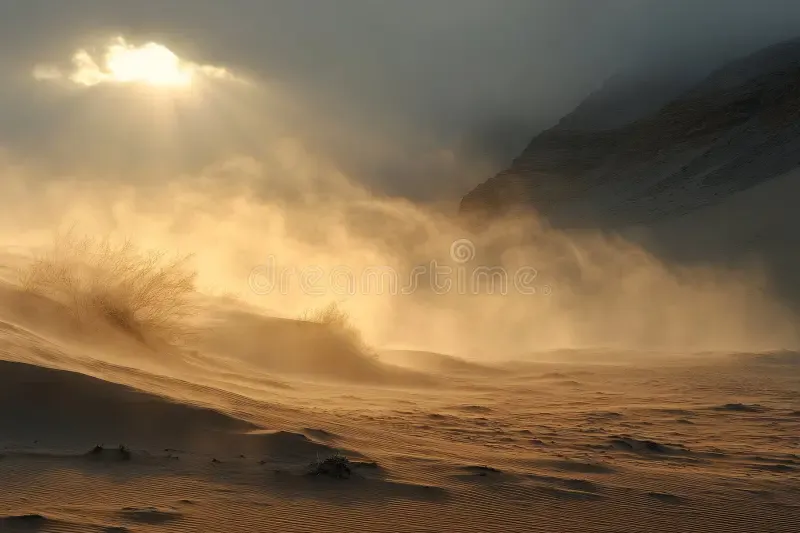
Post-catastrophe wind-driven sand transport across the shallow sea at golden hour

When Did the Dust Settle?

A Wind-Driven Depositional Model for Post-Catastrophe Stratigraphy

Part One of the Deposition Series

Disclaimer: This paper was developed collaboratively between D. L. White and Claude (Anthropic). Grok (xAI) provided independent adversarial review, data mining, and blind derivation of flow conditions from published observables. The paper builds on the quantitative framework established in the Diversification Series and the Diaspora Series, and should be read as a continuation of that work.


1. The Ticking Clock

The Diversification Series established a plate velocity model — a two-phase exponential decay calibrated against two observables (5,000 km of total displacement and 5.0 cm/yr of modern plate velocity) with zero free parameters. The Diaspora Series followed five forcing functions from that single velocity curve: hydrothermal heat delivery, basin deepening, mountain building, volcanic aerosol forcing, and crust formation rate. Each produced testable predictions. The warm ocean drove the ice age. The ice accumulation lowered sea levels. The exposed continental shelves opened dispersal corridors. The corridors closed as the ocean cooled. Every consequence traced back to one equation: v(t).

One consequence was never followed. The catastrophe that drove the plate motion, heated the ocean, and built the mountains also deposited sediment — vast quantities of it, distributed across the continental surfaces in layered sequences that geologists have been mapping, measuring, and arguing about for two centuries. If the master clock is correct, it should predict what those deposits look like. Not in generalities — "the catastrophe left sediment" — but in specific, quantitative detail: what grain sizes, in what order, transported from what direction, deposited by what mechanism, at what rate.

The stratigraphic record is the largest physical artifact of the event. It is also the most thoroughly documented. Every formation has been measured, sampled, and described by researchers with no interest in the catastrophist framework. The data exist. They are published. They are waiting to be read against the predictions of the master clock.

This paper follows the thread. The velocity curve produces an ocean temperature. The ocean temperature produces a thermal contrast with the continental surface. The thermal contrast produces an atmospheric circulation. The circulation produces a current in the shallow continental sea left behind by the catastrophe. The current sorts sediment by grain size as its energy decays on the master clock.

The prediction is a stratigraphic column — grain size, flow direction, formation boundaries, provenance, and contact relationships — derived entirely from the physics already established in the prior series, tested against nothing. Paper 2 in this series opens the envelope and compares these predictions against the published observations from the Grand Canyon, formation by formation. This paper commits to the predictions before the comparison is made.


2. Two Phases, Two Processes

The plate velocity profile follows the universal signature of material failure under stored stress. Every system that fractures — pressure vessels, dams, earthquake faults, landslides — exhibits the same pattern: explosive initiation as stored energy releases, rapid deceleration as friction engages, then slow exponential decay toward equilibrium. Continental fracture is no exception. The companion standalone paper ("What Broke the Foundations?") derives the cork-popping mechanism and forward velocity model from first principles; this paper applies the resulting velocity curve to compute its depositional consequences.

Phase A — the mabbul — spans days 0 through 40. The lithospheric shell fails. Cork-popping acceleration drives plate velocity from rest to its peak of approximately 11 km/yr as the buoyant continent is pushed apart by the sinking oceanic ring. The destruction in this phase is mechanical — the entire continental margin displaces the ocean floor across tens of thousands of km of fault length, generating tsunamis continental in scale. The 2004 Indian Ocean earthquake involved seafloor displacements of only 5–15 meters along 1,300 km of fault and produced devastating tsunamis. This model involves over a kilometer of displacement along tens of thousands of km of fault. The velocity is modest. The displacement volume is what makes it catastrophic.

The displacement during the mabbul itself is small — the plates are accelerating from rest, and the phase is brief. Essentially all of the 5,000 km total displacement occurs after day 40. But the depositional consequence of Phase A is not displacement. It is destruction.

Flow velocities from the overlapping, interfering tsunami wave trains are so far above the mobilization threshold for every grain size that nothing can settle. Material deposited by one wave is scoured and remobilized by the next. On low-lying continental surfaces — the depositional surfaces where the model operates — the pre-existing landscape is stripped: sedimentary cover, weathered rock, soil, all removed down to basement rock. What remains is an erosion surface overlain by a chaotically redistributed debris pile of broken, unsorted material. The erosion surface is the Phase A signature. The debris pile is Phase A's legacy — raw material waiting to be sorted by a gentler process.

Higher-elevation terrain and deep interior locations experience a different Phase A. They are reached by rising water rather than by the full lateral energy of interfering tsunami wave trains. The stripping is less complete. Substrate — soil, root systems, seed banks — survives in these locations, enabling the secondary succession described in the Diaspora Series. The distinction matters: the depositional model in this paper applies to the low-lying surfaces that are fully scoured. The biological recovery applies to the elevated surfaces that are not.

The Shields parameter, a dimensionless ratio of fluid shear stress to gravitational resistance on a sediment grain, quantifies this. When the Shields parameter exceeds a critical threshold (approximately 0.047 for most sediment), the grain moves. On the low-lying depositional surfaces during Phase A, the shear stress from continental-scale tsunamis exceeds this threshold for boulders, cobbles, gravel, sand, silt, and clay simultaneously. Nothing settles. Everything moves.

Phase B — the mayim — begins at day 40 and continues to the present. The Hebrew vocabulary shift from mabbul (violent, catastrophic deluge) to mayim (waters) at precisely this transition marks the physical phase change in the text. Velocity is at or near its peak of approximately 11 km/yr and decays exponentially with a time constant of 445 years (half-life 309 years). This phase accounts for essentially all of the 5,000 km total displacement — delivered over centuries of sustained but decelerating motion.

The first 110 days of Phase B (days 40 through 150) remain tectonically active. Plates are still moving at approximately 10 km/yr. Basins are opening. Mountains are rising. The ocean surface is in continuous, violent rearrangement. Individual fault segments along the active margins are producing discrete seismic events at intervals of hours to days (derived from the recurrence scaling: modern rift recurrence of thousands of years at mm/yr rates, scaled inversely to the km/yr rates of early Phase B). The surface is not yet calm enough for organized, sustained deposition.

The transition to organized deposition requires a second shift — not just from explosive to sustained tectonics, but from tectonic energy dominance to atmospheric energy dominance as the primary force acting on the continental surface. That transition occurs at day 150, and it is driven by the thermal structure the catastrophe itself created.


3. The Thermal Engine

A hot ocean adjacent to a cooler continent produces atmospheric circulation. This is not a hypothesis. It is an inevitable consequence of differential heating, observed in every monsoon system on Earth. The Indian monsoon is driven by a thermal contrast of 5–8°C between the Indian Ocean and the Asian landmass. The West African monsoon by a similar differential between the tropical Atlantic and the Sahara. The physics is textbook: warm air rises over the hot surface (low pressure), cool dense air over the cold surface flows in to replace it (high pressure to low pressure), and a sustained surface wind results.

The post-catastrophe world has this thermal structure at continental scale.

The two-layer ocean model, locked in the Diaspora Series and calibrated against the hydrothermal heat budget, gives the following sea surface temperatures:

Year SST (°C) Evaporation
0 32 22 mm/day
20 31 20 mm/day
100 38 (peak) 34 mm/day (peak)
200 35 27 mm/day
500 24 13 mm/day
1,000 19 9 mm/day
2,000 17 8 mm/day (modern)

These values are global area-weighted averages driven by heat from 188 million km² of new ocean crust. At the active rifts, rising mantle at approximately 1,200°C contacts seawater directly — flashing to steam at the ripping front, evaporating at the 100°C boiling cap behind it. The energy exits as latent heat carried into the atmosphere, with the rate governed by evaporative self-regulation via the Clausius-Clapeyron relation. The post-catastrophe ocean is not thermally uniform. The newly formed Atlantic and Indian rift basins receive nearly all this heat and are significantly hotter than these averages during the first several centuries, while the Pacific remnant — receiving no direct tectonic heat — remains significantly cooler. The thermal contrast driving the wind at any specific continental location depends on proximity to the nearest active rift basin, not on the global mean. At the Colorado Plateau, the nearest ocean is the proto-Atlantic rift — the hottest basin. The thermal contrast used in the calculation chain (Section 4) is therefore conservative.

The continental surface is cooler, and the estimate can be derived from modern analogs. Three cooling mechanisms operate simultaneously on the flooded, rain-soaked continent:

Cloud albedo. The extreme precipitation implies near-total cloud cover over the continent. Modern equatorial regions with persistent heavy overcast (western Amazon, equatorial Congo, maritime Indonesia) show surface temperatures of 24–27°C — roughly 3–5°C cooler than clear-sky tropical regions at the same latitude. The cloud cover reduces incoming solar radiation by reflecting 60–80% before it reaches the surface.

Evaporative cooling. The continental surface is covered with standing water and saturated ground. Evaporation from wet surfaces extracts latent heat. Modern wet tropical surfaces lose approximately 100–120 W/m² to evaporation at current precipitation rates of 2–3 m/year. At the model's 2–4× enhanced precipitation rates (22–34 mm/day, or 8–12 m/year), the evaporative flux is proportionally higher, producing an additional 2–4°C of surface cooling beyond the cloud effect.

Absence of solar heating of land. The continent is submerged under a shallow sea. Water absorbs solar radiation through its full depth rather than concentrating it at the surface as dry land does. This further suppresses surface temperature relative to a dry continent.

The combined effect: modern overcast tropical baseline of 24–27°C, reduced by 2–4°C for enhanced evaporative cooling, reduced further by the shallow-sea absorption effect, gives a continental surface temperature range of 18–24°C. The continental temperature rises slowly through the depositional window as precipitation intensity decreases (precipitation scales with evaporation, which scales with SST — as the ocean cools, precipitation weakens, cloud cover thins, and the continent warms toward equilibrium).

The thermal contrast — ocean minus continent — ranges from roughly 8°C at day 150 to 15°C at the ocean temperature peak (year 100), then declines as the ocean cools:

Year SST (°C) Continental surface (°C, ±3°C) Thermal contrast (°C)
0.4 (Day 150) 31.5 21 10.5
50 34 22 12.0
100 38.0 23 15.0
200 35.0 23 12.0
300 30.0 23 7.0
400 27.0 23 4.0
500 24.0 23 1.0
1,000 19.0 20 ~0

The continental surface values are mid-range estimates from the derived 18–24°C range; the full range produces only minor variation (±~2°C) in the thermal contrast and resulting wind speeds.

This contrast is 2–3× the thermal differential that drives the Indian monsoon. It is sustained for centuries, not seasonally. And it operates at continental scale — the fetch length across the supercontinent interior is thousands of kilometers.

The contrast is not driven by volcanic aerosol cooling of the continent. The aerosol washout physics, derived in the Diaspora Series from the Seinfeld & Pandis scavenging coefficient and calibrated against Pinatubo and Tambora, shows that tropospheric aerosols wash out in hours under the extreme precipitation rates of the post-catastrophe world. The aerosols are continuously replenished by ongoing volcanism (64× modern eruption rate at Phase B onset), maintaining a steady-state optical depth that contributes to the global energy budget. But the washout is most intense where the rain is heaviest — over the continent. The continental cooling is driven by cloud cover and evaporative cooling, not by aerosols. The ocean is the thermal engine. Its heat is the energy source.

The atmospheric circulation this thermal contrast produces is an inevitable consequence of the post-catastrophe thermal structure. Any atmospheric physicist examining the temperature fields described above would predict sustained surface winds from the continental interior toward the warm ocean without reference to any historical or textual source. The physics demands it.

It is therefore notable that the Genesis account describes precisely this phenomenon at precisely the moment the thermal structure predicts it should become the dominant surface process. Genesis 8:1 records that at day 150 — after the waters have prevailed for 150 days of active tectonic rearrangement — God causes a wind (ruach) to pass over the earth, and the waters begin to subside. Simultaneously (8:2), the fountains of the deep are closed and the rain is restrained. The tectonic energy source (the fountains) diminishes. The precipitation input (the rain) decreases. What replaces them as the dominant surface force is the wind — the atmospheric circulation driven by the thermal contrast between a hot ocean and a cooling continent.

The text marks the same transition the physics predicts, at the same moment on the timeline, for the same physical reason. The wind is not an ad hoc mechanism introduced to explain the rocks. It is an inevitable consequence of the ocean temperature the master clock produces, noted independently in a text written millennia before the concept of thermal circulation was formalized.


4. From Wind to Rock

The thermal engine produces a pressure differential. The pressure differential produces a wind. The wind produces a current in the shallow continental sea. The current sorts sediment. Each step uses one published equation, and the full chain connects the master clock to the stratigraphic record through seven traceable links.

Step 1: Thermal contrast to pressure differential

The hydrostatic pressure difference between two air columns at different temperatures is:

ΔP = ρ_air × g × H × ΔT / T_mean

where ρ_air = 1.2 kg/m³, g = 9.81 m/s², H = 8,500 m (atmospheric scale height), T_mean = 295 K, and ΔT is the ocean-continent thermal contrast.

At day 150 with ΔT = 10.5°C: ΔP ≈ 36 hPa. At year 100 (peak contrast 15°C): ΔP ≈ 52 hPa. For comparison, the Indian monsoon is driven by a pressure differential of approximately 12 hPa.

Step 2: Pressure differential to wind speed

Surface wind speed in low-latitude, thermally driven circulations scales approximately as the square root of the pressure differential. This scaling is validated against the Indian monsoon (12 hPa producing ~15 m/s sustained surface wind) and is consistent with simplified boundary-layer force balance at low latitudes where Coriolis effects are weak:

v_wind = 15 × √(ΔP / 12) m/s

At day 150: v_wind ≈ 26 m/s. At year 100: v_wind ≈ 31 m/s. These are sustained gale to storm force winds (Beaufort 9–11), consistent with a thermal contrast 2–3× the Indian monsoon.

Step 3: Wind direction from Coriolis deflection

On a rotating planet, surface winds do not blow directly from high pressure to low pressure. They are deflected by the Coriolis effect — rightward in the Northern Hemisphere, leftward in the Southern. The deflection angle depends on latitude and the ratio of pressure gradient force to friction.

The pressure gradient across the supercontinent is directed from the continental interior (high pressure, cool dense air) toward the warm ocean (low pressure, warm buoyant air) — approximately east to west across Laurentia.

At the Colorado Plateau's paleolatitude of 0–15°N (from published Pangaea reconstructions by Scotese and Blakey), the Coriolis deflection of surface winds in a friction-dominated boundary layer is approximately 15–25° to the right of the pressure gradient direction.

An east-to-west pressure gradient deflected 20° rightward produces a surface wind directed toward the west-southwest — approximately 250° on the compass.

This wind direction is a quantitative prediction derived from the pressure gradient direction and the paleolatitude. It involves no free parameters and no reference to any observational data from the stratigraphic record.

Step 4: Wind speed to wind stress

The wind exerts a shear stress on the water surface:

τ_wind = ρ_air × C_d × v_wind²

where C_d = 0.002 is the standard drag coefficient for wind over water.

At day 150 (v = 26 m/s): τ_wind = 1.62 Pa. At year 100: τ_wind = 2.31 Pa.

Step 5: Wind stress to bed velocity

Under sustained wind forcing, the shallow continental sea reaches a steady state where the wind stress on the surface is balanced by the frictional stress on the bed. The Manning equation relates bed stress to the depth-averaged flow velocity:

τ_bed = ρ_water × g × n² × u² / d^(1/3)

At steady state, τ_wind = τ_bed. Solving for bed velocity:

u_bed = √(τ_wind × d^(1/3) / (ρ_water × g × n²))

where n = 0.025 (Manning coefficient for a smooth sediment bed) and d is the water depth.

At d = 17.5 m (flow depths of 10–25 m are consistent with published dune-height preservation scaling for the observed cross-bed sets of 0.3–1.0 m, and are used as the working value in the forward calculation):

Year τ_wind (Pa) u_bed (m/s)
0.4 (Day 150) 1.62 0.83
100 2.31 1.00
200 1.78 0.84
300 1.09 0.68
350 0.78 0.57
400 0.61 0.47
500 0.15 0.24

The following table shows the Shields parameter for multiple grain sizes across this timeline. Bold cells indicate θ > θ_cr (0.047) — the grain size is mobilized. This table is the core quantitative prediction of the paper: it shows which grain sizes move at each moment on the master clock, and therefore what the deposit looks like at each stage.

Year u_bed τ_bed θ (gravel 5mm) θ (vcs 2mm) θ (cs 1mm) θ (ms 0.5mm) θ (fs 0.25mm) θ (silt 0.05mm)
Day 150 0.83 1.62 0.020 0.050 0.100 0.200 0.401 2.003
Year 100 1.00 2.31 0.029 0.071 0.143 0.286 0.571 2.856
Year 200 0.84 1.78 0.022 0.055 0.110 0.220 0.440 2.199
Year 300 0.68 1.09 0.013 0.034 0.067 0.135 0.270 1.348
Year 350 0.57 0.78 0.010 0.024 0.048 0.096 0.193 0.964
Year 400 0.47 0.61 0.008 0.019 0.038 0.075 0.151 0.754
Year 500 0.24 0.15 0.002 0.005 0.009 0.019 0.037 0.186
Year 1,000 ~0.10 0.025 <0.001 <0.001 0.002 0.003 0.006 0.031

Values in bold exceed the critical Shields threshold (θ_cr = 0.047) — that grain size is mobilized at that time step.

The pattern is readable directly: gravel (5 mm) never reaches the critical threshold at any point in the timeline. Very coarse sand (2 mm) is mobilized only at peak thermal contrast (year 100). Coarse sand (1 mm) is mobilized from Day 150 through approximately year 350. Medium sand (0.5 mm) persists to approximately year 400. Fine sand (0.25 mm) to approximately year 500. Silt (0.05 mm) remains above threshold through year 500 and becomes marginal by year 1,000.

Each row in this table is a snapshot of what the bed looks like at that moment. Each column transition from above-threshold to below-threshold marks a formation boundary. The stratigraphic column is this table read vertically.

Step 6: Bed velocity to bed shear stress

At steady state, the bed shear stress equals the wind stress. This step is implicit in Step 5 but stated separately for clarity: the Shields parameter calculation in Step 7 uses τ_bed directly.

Step 7: Shields parameter and grain-size mobilization

The Shields parameter θ determines whether a given grain size is mobilized by the flow:

θ = τ_bed / ((ρ_s − ρ_w) × g × D)

where ρ_s = 2,650 kg/m³ (quartz density), ρ_w = 1,000 kg/m³, and D is the grain diameter. Mobilization occurs when θ exceeds the critical threshold θ_cr ≈ 0.047.

At day 150 (τ_bed = 1.62 Pa):

Grain size D (mm) θ Mobilized?
Fine gravel 5.0 0.020 No
Very coarse sand 2.0 0.050 Marginal
Coarse sand 1.0 0.100 Yes
Medium sand 0.5 0.200 Yes
Fine sand 0.25 0.401 Yes
Silt 0.05 2.003 Yes

At the peak (year 100, τ_bed = 2.31 Pa), very coarse sand is comfortably above threshold (θ = 0.071) and even 3 mm gravel approaches mobilization. At year 300 (τ_bed = 1.09 Pa), coarse sand is marginal (θ = 0.067) and medium sand dominates. At year 400 (τ_bed = 0.61 Pa), only fine sand and finer moves. At year 500 (τ_bed = 0.15 Pa), only silt.

Worked example: Day 150, the onset of organized deposition

To demonstrate the chain end-to-end with no gaps, here is the complete calculation for the Colorado Plateau at Day 150 — the moment the wind becomes the dominant surface process.

Input from the master clock: SST = 31.5°C (from the locked two-layer ocean model at year 0.4). Continental surface temperature = 21°C (from the overcast/evaporative cooling derivation in Section 3).

Step 1 — Thermal contrast: ΔT = 31.5 − 21.0 = 10.5°C.

Step 2 — Pressure differential: ΔP = 1.2 × 9.81 × 8,500 × 10.5 / 295 = 3,564 Pa = 35.6 hPa.

Step 3 — Wind speed: v = 15 × √(35.6 / 12) = 15 × 1.722 = 25.8 m/s (Beaufort 10, sustained storm force).

Step 4 — Wind direction: East-to-west pressure gradient, deflected ~20° rightward at 10°N paleolatitude = west-southwest (~250°).

Step 5 — Wind stress: τ = 1.2 × 0.002 × 25.8² = 1.2 × 0.002 × 665.6 = 1.60 Pa.

Step 6 — Bed velocity: At d = 17.5 m, n = 0.025: u = √(1.60 × 2.596 / 6.131) = √(0.677) = 0.82 m/s.

Step 7 — Shields parameter for coarse sand (D = 1 mm): θ = 1.60 / ((2,650 − 1,000) × 9.81 × 0.001) = 1.60 / 16.19 = 0.099. Above critical threshold (0.047). Coarse sand is mobilized in the dune-forming regime. The predicted bedform is trough and planar cross-bedding.

Every number in this chain traces to either a published equation or a locked input from the prior series. The reader can verify each step independently. No parameter was selected to produce a desired outcome — the thermal contrast comes from the ocean model, the wind comes from the contrast, the current comes from the wind, and the grain size comes from the current. The master clock determines the deposit.

The seven-step chain connects the master clock to the grain size at the bed through published equations with identified parameters. No free parameters are introduced beyond the already-locked inputs from the Diaspora Series. The output is a time-varying prediction of what grain sizes the wind-driven current can mobilize and deposit at any point on the continental surface.


5. The Sorting Engine

The declining thermal contrast crosses grain-size thresholds in sequence. Each threshold crossing changes the character of the deposit. The stratigraphic record at any location should therefore consist of a series of units, each dominated by progressively finer grain sizes, with boundaries corresponding to specific moments on the master clock.

The predicted sequence

Sand-dominated interval (Day 150 to approximately year 350). The thermal contrast exceeds the minimum required to mobilize coarse sand (~5–7°C). The wind-driven current produces bed velocities of 0.6–1.0 m/s, sufficient to form migrating sand dunes. The predicted sedimentary structures are trough and planar cross-bedding — the diagnostic bedforms of the dune stability field (approximately 0.4–1.2 m/s for medium-to-coarse sand, from published bedform stability diagrams). The velocity remains below the upper plane bed transition (~1.2 m/s) throughout this interval, so no upper plane bed structures are predicted.

The predicted grain size fines slightly upward through this interval as the thermal contrast weakens, but the dominant change is in mineralogical maturity. Sustained reworking of the same sediment in warm, shallow marine water progressively destroys mechanically weak and chemically unstable minerals — potassium feldspar, in particular — through abrasion and dissolution, while mechanically and chemically resistant minerals (quartz) survive. The model predicts decreasing feldspar content upward through the sand-dominated interval as a maturity signal recording the duration of sustained reworking, not a change in flow energy.

Silt-and-clay-dominated interval (approximately year 350 to year 800–1,000). The thermal contrast drops below the sand mobilization threshold (~5°C). Only fine sand, silt, and clay are transported by the weakening wind-driven current. The predicted sedimentary structures are fine lamination and ripple cross-lamination (the bedform stability field below ~0.4 m/s). Intermittent fine sand interbeds may occur during episodes of temporarily enhanced wind (storm events, seasonal intensification) that briefly push the bed velocity above the sand threshold, even as the mean velocity remains below it. These sand interbeds should be more frequent near the base of this interval (where the mean velocity is closer to the threshold) and less frequent upward.

The low sedimentation rate and quiet conditions between episodic sand events favor the formation of authigenic minerals — minerals that grow in place within the sediment rather than being transported. Glauconite, a green iron-rich silicate that forms in low-oxygen, low-energy marine environments, is specifically predicted during this interval.

Carbonate-dominated interval (approximately year 800–1,000 onward). The thermal contrast approaches zero. The wind-driven current is negligible. No clastic material (sand, silt, or clay) is transported. The only deposition is chemical and biological — carbonate precipitation from the warm, mineral-rich water column. The ocean is still warm enough (19–24°C) at this stage to support carbonate production.

The transition to carbonate dominance may include dolomite (calcium-magnesium carbonate) in addition to limestone (calcium carbonate). Warm, slowly circulating, mineral-rich shallow marine conditions favor dolomitization, consistent with the declining but still elevated ocean temperatures during this interval.

Formation boundaries as threshold crossings

Each boundary between predicted units corresponds to a specific moment on the thermal contrast curve — the moment when the bed velocity drops below the mobilization threshold for the dominant grain size in the underlying unit. The boundaries are gradational, not sharp, because the thermal contrast declines smoothly. The transition from sand-dominated to silt-dominated deposition occurs over a range of years as the bed velocity passes through the sand mobilization window, not at a single instant.

This produces a testable prediction: the transitions between units should be gradational, not abrupt. Sharp contacts would indicate a sudden change in mechanism — an event, not a gradual decline. Gradational contacts indicate a continuous process crossing thresholds, which is what the model predicts.


6. The Phase A Legacy

The wind-driven current does not import sediment from distant continental margins. The calculations presented in the working notes for this series demonstrate that tsunami propagation from rift zones 400–1,000 km distant cannot deliver sand-grade material to the continental interior after corrections for geometric spreading and frictional attenuation — corrections independently derived and validated during the adversarial review process.

Instead, the wind-driven current reworks material already present on the continental surface: the debris pile left by Phase A chaos.

The erosion surface

Phase A stripped the pre-existing landscape. Flows far exceeding the mobilization threshold for every grain size scoured the surface to basement rock across large areas. The resulting erosion surface is the Phase A signature — a contact between organized overlying strata and the underlying basement, with no intermediate gradation. The surface may be irregular, with local paleotopographic highs and lows reflecting the basement geology.

The debris pile

Phase A did not merely erode — it redistributed. Broken and disaggregated basement rock, reworked pre-existing sediment, and material transported from the continental margins were deposited across the erosion surface as a chaotic, unsorted debris pile. This material is the feedstock for Phase B deposition. The wind-driven current does not need to erode intact bedrock (a slow process even at high flow velocities). It reworks material that Phase A already disaggregated — material that is already broken to sand, silt, and clay grade and sitting on the surface ready to be mobilized.

The grain shape of this material should be sub-angular to sub-rounded — not angular (which would indicate freshly broken rock with no transport) and not well-rounded (which would indicate extensive long-distance transport). Sub-angular to sub-rounded grains indicate material that was broken by a high-energy process and subsequently tumbled a short distance. This is the expected texture for Phase A debris reworked by Phase B currents.

The basal conglomerate prediction

The coarsest fraction of the Phase A debris — gravel, cobbles, and fragments of broken basement — concentrates in paleotopographic lows under gravity during and after Phase A. The wind-driven current that follows cannot mobilize this material. The Shields parameter calculation is explicit:

For granules (D = 5 mm) at peak bed velocity (u = 1.00 m/s, τ_bed = 2.31 Pa, year 100):

θ = 2.31 / ((2,650 − 1,000) × 9.81 × 0.005) = 2.31 / 80.9 = 0.029

For small pebbles (D = 10 mm) at the same peak conditions:

θ = 2.31 / ((2,650 − 1,000) × 9.81 × 0.010) = 2.31 / 161.9 = 0.014

Both are well below the critical threshold of 0.047. Even at the maximum wind-driven velocity the model ever produces (year 100, peak thermal contrast), granules and pebbles cannot be mobilized. At the more typical Tapeats-window velocities (0.6–0.85 m/s), gravel mobilization is further from the threshold — θ = 0.012–0.022 for 5 mm granules.

The gravel stays where Phase A deposited it.

The prediction is therefore a coarse, poorly sorted basal lag deposit — conglomerate — confined to paleotopographic lows on the erosion surface, not present on paleotopographic highs, reflecting the lithology of the immediately underlying basement rock. This is a Phase A residue buried by Phase B sand, not a Phase B deposit. The Shields parameter proves the wind-driven current was incapable of emplacing it.

Provenance prediction

Because the wind-driven current reworks local debris rather than transporting material from distant sources, the deposit should reflect the composition of the local basement rock. The mineral assemblage, detrital grain ages, and bulk chemistry should match the rock directly beneath the erosion surface. Transport distances are short — the grains are locally derived and have not traveled far. The provenance is the floor the deposit sits on.


7. The Global Prediction

The wind-driven mechanism is not specific to any single location. Every point on the supercontinent surface has a unique combination of paleolatitude, distance to the nearest warm ocean margin, and orientation relative to the ocean-continent thermal contrast. The same physics operates everywhere, but the predictions are location-specific.

Paleolatitude controls wind direction

The Coriolis deflection that determines the wind direction varies with latitude. At the equator, deflection is zero — wind blows directly from the continental interior toward the warm ocean. At 15°N, deflection is approximately 20° to the right. At 30°N, approximately 30–40°. In the Southern Hemisphere, the deflection is to the left.

The predicted paleocurrent direction at any location is therefore calculable from two known quantities: the direction from that location to the nearest warm ocean margin (the pressure gradient direction), and the paleolatitude (which determines the Coriolis deflection). Both are available from published Pangaea reconstructions.

Proximity to the ocean controls wind intensity

Locations near the ocean margin experience the thermal contrast more directly and may receive stronger winds than deep interior locations. However, the pressure gradient is distributed across the full continental width, so the wind is not confined to the coastal zone. The entire continental surface within the circulation cell experiences directional flow.

The global prediction set

The model predicts the following at every location on the post-catastrophe supercontinent surface:

  1. A basal erosion surface (Phase A) overlain by organized strata (Phase B).

  2. The organized strata should fine upward — from sand to silt/clay to chemical precipitate — reflecting the declining thermal contrast on the master clock.

  3. Paleocurrent directions should be calculable from paleolatitude and ocean-continent geometry, pointing generally from the continental interior toward the nearest warm ocean, deflected by Coriolis.

  4. The deposit should reflect local provenance — the underlying basement and Phase A debris, not material transported from distant margins.

  5. Formation boundaries should correspond to grain-size threshold crossings on the master clock and should be approximately synchronous globally — controlled by the SST timeline, not by local conditions.

  6. Contacts between units should be gradational, not sharp.

  7. Near-margin sections should be thicker and potentially coarser-grained than deep interior sections, reflecting the stronger thermal contrast gradient near the ocean.

These predictions are stated for future testing against stratigraphic sections worldwide. This paper does not test them — it commits to them.

A Southern Hemisphere test: the Coriolis reversal

The most powerful test of the global prediction is at a location where the Coriolis deflection reverses — the Southern Hemisphere. If the wind-driven model produces the correct paleocurrent direction in both hemispheres from the same physics, with the deflection flipping from rightward to leftward as predicted by planetary rotation, the mechanism is global. If it fails in one hemisphere, it is a local story.

The Flinders Ranges of South Australia preserve a well-documented Lower Cambrian succession — the Hawker Group, Arrowie Basin — sitting on a sharp erosional unconformity on Precambrian basement (the Flinders Unconformity). Published paleocurrent data, provenance studies, and sedimentological descriptions exist. The paleolatitude in standard Early Cambrian Gondwana reconstructions is approximately 35°S — a Southern Hemisphere location at significantly higher latitude than the Colorado Plateau's 0–15°N.

The model inputs for this location:

Paleolatitude: ~35°S. Direction to the nearest warm ocean margin: the Panthalassa Ocean lay to the west of eastern Gondwana, producing an east-to-west pressure gradient (continental interior high pressure toward western ocean low pressure) — the same general direction as the Colorado Plateau but now in the opposite hemisphere. Coriolis deflection at 35°S: approximately 25–35° to the left of the pressure gradient direction (Southern Hemisphere reversal).

The model predicts:

  1. Paleocurrent direction: The east-to-west pressure gradient deflected ~30° leftward at 35°S produces surface flow toward the west-southwest (~240–260°). This is the mirror image of the Colorado Plateau prediction — same pressure gradient direction, opposite Coriolis deflection, resulting in a similar compass bearing because the leftward deflection at southern latitudes and the rightward deflection at northern latitudes both rotate the flow toward the southwest from a westward-directed gradient.

  2. Basal contact: A sharp erosional unconformity on Precambrian basement — the Phase A signature, predicted to be global.

  3. Provenance: Local Precambrian basement (Gawler Craton and equivalents) — the same local-reworking pattern predicted for the Colorado Plateau.

  4. Basal conglomerate: Coarse debris confined to paleotopographic lows on the unconformity surface, not mobilizable by the Phase B wind-driven current (Shields parameter below critical for gravel at the predicted velocities).

  5. Fining-upward sequence: Sand-dominated → silt/clay → carbonate, reflecting the same declining thermal contrast on the master clock. Local factors (basin geometry, proximity to the ocean margin, water depth) may modify the specific lithologies, but the overall fining-upward architecture should be present.

These predictions are specific to a location the model was not calibrated against, on a continent the model has never been applied to, at a paleolatitude that reverses the Coriolis deflection. They are stated here, untested, as a second sealed envelope for Paper 2.


8. The Colorado Plateau Prediction

The Colorado Plateau provides a specific, well-documented test case. Its position in the Pangaea reconstruction is known: western interior of Laurentia, paleolatitude 0–15°N, approximately 400 km from the western Panthalassa ocean margin. The basement geology — Precambrian metamorphic and igneous rocks of the Yavapai and Mazatzal provinces — is thoroughly characterized by published detrital zircon studies.

The model makes the following specific predictions for the stratigraphic section at the Colorado Plateau. Each prediction is derived from the seven-step calculation chain presented in Section 4, using the thermal contrast timeline from Section 3 and the Phase A framework from Section 6. None reference any published observational data from the Grand Canyon or any other specific stratigraphic section.

Prediction 1: The erosion surface

A Phase A erosion surface cuts into the Precambrian basement. The surface is irregular, with paleotopographic highs and lows reflecting the basement geology. No gradation between the basement and the overlying deposits — a sharp, erosional contact.

Prediction 2: The basal lag deposit

Coarse debris (gravel, cobbles) from Phase A is preserved in paleotopographic lows on the erosion surface. This material reflects the lithology of the immediately underlying basement rock. It is not present on paleotopographic highs. It was not deposited by the wind-driven current (Shields parameter below critical) but was emplaced by Phase A and buried in place.

Prediction 3: The sand-dominated unit

Overlying the erosion surface and basal lag, a sand-dominated unit with the following characteristics:

  • Grain size: Medium to coarse sand dominant. Very coarse sand present, especially in the interval corresponding to peak thermal contrast (year ~100). Fine gravel absent from the main body (Shields parameter below critical).

  • Paleocurrent direction: West-southwest (~250°), derived from the east-to-west pressure gradient deflected ~20° rightward by Coriolis at 10°N paleolatitude.

  • Sedimentary structures: Trough and planar cross-bedding (dune stability field at 0.5–1.0 m/s). No upper plane bed structures (velocity remains below ~1.2 m/s). Set thickness approximately 0.3–1.0 m, corresponding to dune heights of 0.6–5 m in flow depths of 10–25 m.

  • Provenance: Local Precambrian basement. Detrital grain ages should match the Yavapai (~1.70–1.75 Ga) and Mazatzal (~1.45 Ga) provinces.

  • Grain shape: Sub-angular to sub-rounded — Phase A debris reworked a short distance by Phase B currents.

  • Mineralogical maturity trend: Feldspar content highest at the base (freshly disaggregated basement, minimal reworking) and decreasing systematically upward (progressive destruction of feldspar by sustained reworking in warm water). Quartz content increases correspondingly upward.

  • Lateral extent: Sheet-like geometry, continuous across the Plateau. The wind-driven current is regionally uniform, not channelized.

Prediction 4: The transition to fine-grained deposition

A gradational contact between the sand-dominated unit and an overlying silt-and-clay-dominated unit. The grain size fines upward through the transition zone as the thermal contrast declines through the sand mobilization threshold (~5°C, approximately year 350).

The fine-grained unit contains:

  • Dominant silt and clay
  • Intermittent fine sand interbeds, more frequent near the base, decreasing upward (episodic wind intensification events)
  • Fine lamination and ripple cross-lamination
  • Glauconite (authigenic, forming in-situ during low-energy intervals)
  • Same local basement provenance as the sand unit
  • Same west-southwest paleocurrent orientation (the circulation weakens but does not change direction)

Prediction 5: The transition to carbonate deposition

A gradational contact between the fine-grained unit and an overlying carbonate-dominated unit. Clastic transport has ceased. The warm, mineral-rich, quiet water precipitates carbonate.

The carbonate unit contains:

  • Limestone and/or dolomite (warm, slowly circulating conditions favor dolomitization)
  • Microbial structures (algal lamination, microbialites)
  • Shallow-marine carbonate fossils
  • Minimal siliciclastic content
  • No significant paleocurrent indicators (wind-driven circulation has effectively ceased)

Prediction 6: Timing on the master clock

  • Sand-dominated deposition: Day 150 to approximately year 350 (~350 years)
  • Silt/clay-dominated deposition: approximately year 350 to year 800–1,000 (~450–650 years)
  • Carbonate-dominated deposition: year 800–1,000 onward

These timings are derived from the thermal contrast timeline and the Shields parameter threshold crossings. They are predictions, not observations.

Prediction Summary

The following table collects every specific, testable prediction for the Colorado Plateau stratigraphic section. Each entry is derived from the model with no reference to published observational data. Paper 2 compares each prediction against the published record.

# Observable Prediction Derived from
1 Basal contact Sharp erosional unconformity on Precambrian basement Phase A erosion model
2 Contact surface geometry Irregular, with paleotopographic highs and lows Basement geology
3 Basal conglomerate location Paleotopographic lows only, absent on highs Phase A debris + gravity
4 Basal conglomerate mobilization Not mobilizable by Phase B current (θ < 0.047 for D ≥ 5 mm at peak velocity) Shields parameter
5 Basal conglomerate composition Reflects immediately underlying basement lithology Local derivation
6 Sand unit grain size Medium to coarse sand dominant; very coarse sand present at peak; gravel absent Shields parameter timeline
7 Sand unit paleocurrents West-southwest (~250°) Coriolis deflection at 10°N
8 Sand unit bedforms Trough and planar cross-bedding (dune field); no upper plane bed Bedform stability at 0.6–1.0 m/s
9 Sand unit cross-bed sets 0.3–1.0 m thickness Flow depth 10–25 m
10 Sand unit provenance Local Precambrian basement (Yavapai ~1.7 Ga, Mazatzal ~1.45 Ga) Local reworking of Phase A debris
11 Sand unit grain shape Sub-angular to sub-rounded Short transport of Phase A debris
12 Sand unit feldspar trend K-feldspar highest at base, decreasing systematically upward Maturity from sustained reworking
13 Sand unit lateral extent Sheet-like, continuous across the Plateau Regionally uniform wind-driven current
14 Sand-to-shale contact Gradational Smooth thermal contrast decline
15 Shale unit grain size Silt and clay dominant Velocity below sand threshold
16 Shale unit sand interbeds Intermittent fine sand, more frequent near base Episodic wind intensification
17 Shale unit glauconite Present, authigenic Low-energy, slow-sedimentation intervals
18 Shale unit provenance Same local basement Same source, finer fraction
19 Shale-to-carbonate contact Gradational Continued thermal contrast decline
20 Carbonate unit lithology Limestone and/or dolomite Warm, mineral-rich, quiet water
21 Carbonate unit biota Microbial structures, shallow-marine carbonate organisms Warm shallow sea
22 Carbonate unit clastic content Minimal Clastic transport ceased
23 Carbonate unit paleocurrents None significant Wind-driven circulation ceased
24 Overall sequence Fining upward: sand → shale → carbonate Declining thermal contrast on master clock

9. What This Paper Does Not Claim

This paper does not claim to have validated the wind-driven depositional model. The predictions stated in Sections 7 and 8 are untested in this paper. Paper 2 in this series compares them against the published observational data.

This paper does not claim to predict exact formation thicknesses. The model predicts the sequence, grain-size transitions, and formation boundary timing, but thickness depends on sediment supply rate and accommodation space — parameters that require independent constraint. The sediment supply (volume of Phase A debris available for reworking) and the accommodation space (depth of the shallow sea and its evolution through the depositional window) are addressed quantitatively in Paper 2, where they can be calibrated against the observed thicknesses.

This paper does not claim to account for local basin geometry. The Colorado Plateau is treated as a uniform, flat-bottomed shallow sea. Real basin geometry — paleotopographic variation on the unconformity surface, differential subsidence, local structural controls — influences deposit thickness, facies distribution, and current behavior. These local effects are second-order corrections to the first-order wind-driven prediction and are evaluated in Paper 2.

This paper does not claim to model three-dimensional atmospheric circulation in detail. The wind speed and direction are derived from simplified pressure-gradient and Coriolis calculations appropriate for order-of-magnitude prediction. A full general circulation model would refine the wind field but is not necessary for the first-order predictions stated here.

This paper does not claim that the mean wind was constant. The wind-driven circulation is a prevailing system — a dominant direction with natural variability superimposed, analogous to the modern trade winds. Storm events, seasonal fluctuations, and other variability produce departures from the mean that may include episodic sand transport during the silt-dominated interval and episodic reworking of carbonate mud during the carbonate interval. The model predicts the mean behavior; episodic variability may produce features (storm beds, tempestites, flat-pebble conglomerates) that the mean model does not address. Quantifying this variability is a Paper 2 task.

This paper does not claim to have quantified the rate of mineralogical maturation. The prediction that feldspar content decreases upward through sustained reworking is a qualitative inference from standard sedimentary petrology. The quantitative rate of feldspar destruction under the predicted flow conditions and water chemistry — and whether it matches the observed magnitude of the decrease — is tested in Paper 2.

This paper does not claim to predict the post-depositional history. The erosion of the deposits after deposition — including the carving of canyons, the uplift of plateaus, and the exposure at the modern surface — is a separate problem addressed in Paper 3 of this series.

This paper does not claim that every stratigraphic section on Earth conforms to this model. The predictions are stated for testing. Locations with complex tectonic histories, unusual basin geometries, or proximity to active boundaries may deviate from the simple wind-driven prediction. The model identifies where it expects to succeed and invites testing where it might fail.


10. The Envelopes

The predictions in Sections 7 and 8 are specific, quantitative, and falsifiable. They are committed to this document before any comparison with observational data is undertaken. Paper 2 in this series opens the envelopes.

Two test cases are designated. The Grand Canyon, sitting on the Colorado Plateau at 0–15°N paleolatitude, provides the primary test — 24 specific predictions for the Tonto Group sequence, derived from the seven-step calculation chain. The Flinders Ranges of South Australia, at ~35°S paleolatitude in the opposite hemisphere, provide the critical global test — the same model, the same physics, the reversed Coriolis deflection. If the predicted paleocurrent directions match the published data at both locations — rightward-deflected in the Northern Hemisphere, leftward-deflected in the Southern — the wind-driven mechanism is not a regional story. It is a planetary consequence of a hot ocean on a rotating world.

The formations at both sites have been measured, sampled, mapped, and described by generations of geologists with no interest in the catastrophist framework. The data are published. They are independent. They are waiting.

The dust settled in a specific order, from a specific direction, at a specific rate, driven by a specific mechanism that the master clock produces for free. The rocks either recorded what the model predicts, or they didn't.

Paper 2 tells us which.


© 2026 D. L. White. Licensed under CC BY-ND 4.0. https://creativecommons.org/licenses/by-nd/4.0/

This paper was developed collaboratively using Claude (Anthropic) for technical modeling, calculations, and co-development of the reasoning chain. Grok (xAI) provided independent adversarial review of the calculation chain, data mining of published geological constraints, and blind derivation of flow conditions from Tapeats Sandstone observables. Neither AI system endorses all conclusions as settled.