The Immersion
The most famous baptizer who ever lived wanted to make sure you didn't mistake his water for the main event.
The Immersion
Two Baptisms, and the One John Was Pointing At
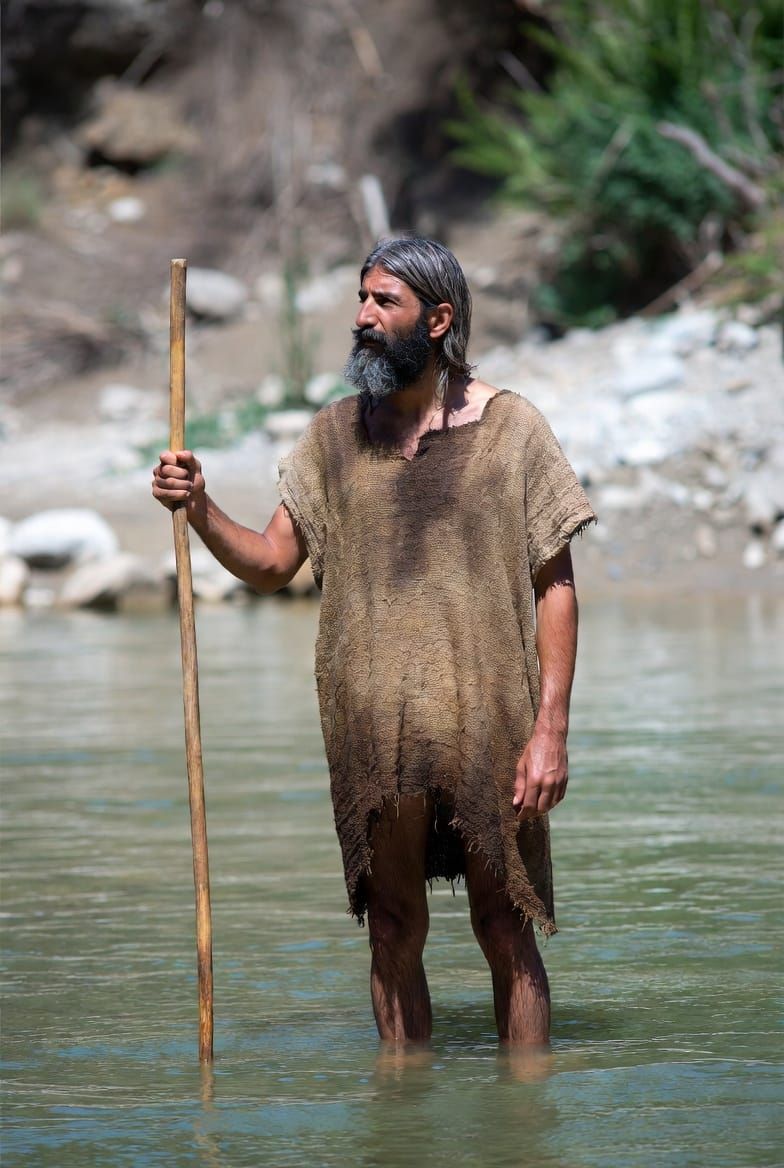
There is a man standing in a river, and he is the most famous baptizer who ever lived, and he wants to make sure you do not mistake what he is doing for the main event.
John is out in the wilderness, and the crowds are streaming to him, and he is putting them under the water — a baptism of repentance, the Gospels call it, for the forgiveness of sins. It is working. People are turning. And at the height of his own movement, with everyone watching him and no one yet watching Jesus, John says the thing that should be more famous than it is:
I baptize you with water. But one is coming who is mightier than I, and he will baptize you with the Holy Spirit.
Stop there, because the whole matter is already in that sentence. The man running the water baptism has just told you it is not the finish. He is not the destination. He is the one making the road straight for someone else — he must increase, John will say later, and I must decrease. And he draws, in his own words, before any tradition existed to blur it, a line between two different things: I baptize with water; he will baptize with the Spirit.
Two baptisms. Named and distinguished by the one person who cannot be accused of undervaluing the water — because he is the one standing in the river.
That distinction is the whole of what follows. And it is worth recovering with care, because the place it most often gets lost is precisely the place people use to dismiss everything built on it.
What the Water Was
Start with the water, and hold it up honestly, because it is good and it stays good and nothing here diminishes it.
John’s water baptism had a clear and worthy purpose: it was the outward sign of repentance — the turning — and it declared that turning in public. Go under, come up; the old thing washed away, the new direction announced where everyone could see. John was relentless that the turning was the substance and the water only its picture. When the crowds came, he did not tell them to get wet and go home. He told them to bear fruit in keeping with repentance — and then got specific about it. The man with two coats gives one away. The tax collector stops overcharging. The soldier stops extorting. The immersion meant nothing unless a life had actually changed behind it.
So the water was a sign: symbolic cleansing, public declaration, the visible mark of a turning that had had to happen on the inside. Good. Fitting. The natural and right thing for a turned person to do. Even Jesus stepped into it — not because he had anything to repent of, but, he said, to fulfill all righteousness: a public act of standing in among the turning ones.
And here is the thing to notice about the water, because it matters more than it looks: it is, by its nature, a moment. You go in and you come out. Water cannot hold you. You surface. The whole act is over in seconds — which is exactly why it can only ever be a sign. A sign points and is done. The water baptism can depict a turning, and declare it, and mark it, but it is finished the instant you rise, because water is not a medium you can live in.
Hold that. It is the hinge of everything.
What John Was Pointing At
Now the other baptism — the one John said was coming, the one that was not his to give.
He will baptize you with the Holy Spirit. Not water. Not a sign. Not a moment you rise from. Something John spent his whole ministry straining toward and naming as greater than anything he was doing in the river.
And here is a detail most people never notice, though it settles a great deal: Jesus, in his whole ministry, did not baptize anyone in water. John’s Gospel says it plainly and then repeats it to be sure — Jesus himself did not baptize, but only his disciples (John 4:2). Sit with how strange that is. The man who ends his ministry commissioning his followers to go and baptize the nations never once, himself, put a person under the water. Why would the one who commands the baptism decline to perform it? Because the water was never the baptism that was his to give. The disciples handled the water — the sign. His was the other one, the one John foretold, the one no hands but God’s can administer.
Notice that John does not describe a better version of his own baptism. He describes a different kind — a different medium, a different agent, a different category of thing altogether. His is water; the coming one’s is Spirit. His is the sign; the coming one’s is the substance the sign was always pointing at.
What kind of thing is a Spirit-immersion? Return to the plain meaning of the word, the one hiding under the churchy sound of “baptize.” Baptizō means to immerse, to plunge, to submerge — to put a thing under and have it stay under. A sunken ship is baptized. Cloth in the dye is baptized — and it is baptized for as long as it is in the dye. Pull it out and the immersion is over. The word does not describe a dip. It describes a state of being surrounded.
Water cannot sustain that state in a person — you surface, or you drown. But the Spirit can. The Spirit is a medium you do not come up from. And so the Spirit-baptism John prophesied is not an event you pass through and leave behind. It is an immersion you live in — an ongoing condition of being surrounded by, held in, saturated with the presence of God. Not a moment. A dwelling.
This is why the two are a different category and not two intensities of one thing. Water baptism is an act — momentary, human, a sign, over when you rise. Spirit baptism is a state — ongoing, divine, a place you live, never surfaced from. John’s whole water-versus-Spirit distinction is, underneath, an act-versus-state distinction. He is not ranking two rituals. He is telling you that what he does is a picture, and what is coming is the thing itself, and the thing itself is not a ceremony at all. It is a life lived under.
They Are Not One Act
Here is where the whole reading is most often lost, so it is worth slowing down and looking hard.
Some hold that the water and the Spirit are a single thing — that “born of water and the Spirit” names one act, that the water itself is the moment of rebirth, that to be immersed in water simply is to be immersed in the Spirit, the two folded into one event at the font. It is an understandable reading. It is also one the text will not support, and the text says so not once but four times, from three different mouths.
John said so first. I baptize with water; he will baptize with the Holy Spirit. Two baptizers — I and he. Two elements — water and Spirit. If they were one act, the prophet who performed the water and pointed to the Spirit would not have set them side by side as his versus another’s. He divided them in the same breath he named them.
Jesus said so to Nicodemus — and then explained himself. No one can enter the kingdom of God unless he is born of water and the Spirit, Jesus says (John 3:5). And a reader could stop there and fold the two together. But Jesus does not stop there. In the very next sentence he restates his own metaphor: That which is born of the flesh is flesh, and that which is born of the Spirit is spirit (John 3:6). Watch what he did. He took the pair from verse 5 — water and Spirit — and re-expressed it as flesh and Spirit. The “water” birth is the flesh birth: the natural one, the given one, the entrance into an earthly family. The “Spirit” birth is the other one, the one that enters the kingdom. Jesus glosses his own words one verse later, and the gloss says plainly: these are two births, of two different sources, not one. You do not have to import a meaning from elsewhere. He tells you, in the same conversation, what he meant.
Jesus said so again, three verses on — and told you why they will never line up. The wind blows where it wishes, and you hear its sound, but you do not know where it comes from or where it is going. So it is with everyone born of the Spirit (John 3:8). The word is pneuma — wind, breath, Spirit, all one word, and Jesus is playing on it deliberately. The Spirit is like wind: it goes where it wills, on its own timing, and no one schedules it or administers it or makes it arrive on cue. Which means it cannot be fused to the water, because the water is a thing men perform on a schedule and the Spirit is a thing God gives when God wills. Jesus is describing, in advance, exactly why the two will refuse to coincide.
And then they refuse to coincide, in plain narrative, in front of witnesses. Watch the early church in Acts, and you find the two baptisms arriving in every possible order — which is impossible if they are one act. Cornelius and his household receive the Spirit first — the Spirit falls while Peter is still speaking — and are baptized in water afterward (Acts 10). The Samaritans are baptized in water first, and the Spirit comes later, separately, through the apostles (Acts 8). The Ephesians had received a water baptism and had not so much as heard that there was a Holy Spirit until Paul came through (Acts 19). Spirit-then-water. Water-then-Spirit. Water-and-only-later-Spirit. The order scrambles every direction — and it can only scramble like that if the two are genuinely distinct things happening on two timelines. If the water were the Spirit-birth, not one of those three accounts could have happened as written.
So the conflation does not fail on a technicality. It fails four times over, from John, from Jesus twice, and from the record of the church itself — and to hold it, you would have to make all four of them wrong in the same direction at once. The water and the Spirit are two. Everything else depends on seeing it.
That settles whether the two are one act. But there is a second place the sign gets mistaken for the substance, and it is worth facing head-on. Certain verses attach the language of cleansing directly to the water. Peter tells the crowd to repent and be baptized… for the forgiveness of your sins (Acts 2:38). Ananias tells Paul to be baptized and wash away your sins (Acts 22:16). Lift either one out on its own and the water appears to do the forgiving. But that is the error of reading a verse alone, and the whole rest of the text will not permit it. Notice even within Peter’s sentence the order holds: repent, and then be baptized — the turning first, the sign second. And then ask the plain question the words invite: washed by what? The answer is given everywhere, without ambiguity, and it is never the water. The blood of Jesus his Son cleanses us from all sin (1 John 1:7). He freed us from our sins by his blood (Revelation 1:5). Without the shedding of blood there is no forgiveness (Hebrews 9:22). One washing cannot have two washers. So when the apostles speak of baptism washing away sins, they are naming the sign for the cleansing it signifies — the water wearing the name of a real cleansing accomplished by the blood. Acts 22:16 says as much in its own breath, for the washing is joined to calling on the name of the Lord — the water being the public moment of that calling, not the power that performs it. The verses that sound like the water saves are precisely the verses you would expect if the water is the sign, not the substance, of a cleansing water could never accomplish alone.
Into the Name
Keep the two-ness in hand and turn to the last words Jesus spoke before he left, because they are usually read as the moment water baptism gets its final marching orders, but they say something else.
Go and make disciples of all nations, Jesus said, baptizing them into the name of the Father and of the Son and of the Holy Spirit, and teaching them to observe all that I have commanded you.
Watch the small word doing the large work: into. Not baptizing them with water, not baptizing them about the name — baptizing them into the name. Into is the language of entry, of transfer, of crossing a line into belonging. And “the name,” in that ancient world, was never a label; it was the person’s own authority and ownership and household. To be immersed into the name is to be placed inside God’s belonging — transferred into the family, submerged in the possession of God.
And here is what that phrase quietly settles: water cannot do it. Water can wash you and mark you and declare you, but it cannot transfer you into the Father, Son, and Spirit and hold you there. The only immersion that can accomplish what “into the name” describes is the ongoing one — the Spirit’s. So the effect the Commission names is a Spirit-effect. The thing Jesus is actually sending them to bring people into is the immersion John prophesied: the durable, surrounding, living-under kind.
Now look at the word paired with it, because the grammar of the sentence confirms the whole reading. Jesus does not say baptize them and teach them my commands — two finished tasks. He says baptizing and teaching them to observe — and observe means to keep, to guard, to go on holding, continuously. The object of the teaching is not information transferred once. It is a way of living that continues. So both halves of the Commission have the same shape pointing at an ongoing condition. Baptizing points at being immersed. Teaching points at observing. Neither describes a transaction you complete. Both describe a life you remain inside.
Two Agents, No Confusion
Someone will say: but the church went out and baptized people in water, in that triune name — Acts is full of it. True. And it is exactly right, and it disturbs none of this, because the disciples held the two baptisms apart with perfect clarity.
They could hold them apart because one of them was theirs to perform and the other was not. The water, they administer — it is a human act, something a person can be asked to do and can do: the sign, the symbolic cleansing, the public declaration. The Spirit-immersion, no apostle can administer. No one puts another person under the Spirit; God does that, on God’s own timing — the wind going where it wills — which is precisely why it would not line up with the water. The disciples gave the sign. God gave the substance. They were faithful in the one that was theirs and witnessed the one that was God’s.
So they were obedient in both and confused about neither. Both good. Both present. Never merged — because you cannot merge a thing you do with a thing that is done to you.
Why It Has to Be This
Here is the argument that holds all the others up, and it is not about any single verse. It is about Jesus not contradicting himself.
The Commission was not a new requirement bolted on at the end. A man does not spend his whole ministry answering one question one way and then, in his last moments, change the answer. So whatever baptizing into the name means, it has to comport with everything Jesus already taught about entering the kingdom. It cannot mean something he never taught.
So ask what he taught. When people asked him directly — what must I do to enter the kingdom, to inherit eternal life — what did he say? You must be born again. Unless you become like a little child. This is eternal life: that they know you. Not everyone who says to me “Lord, Lord” will enter, but the one who does the will of my Father. Notice what is not there. Never once, asked point-blank, did he name a ritual you perform and complete — do this, and you are in. What he named was a birth God works in you, and the living that flows from it: to be born anew, and then to know him, to follow, to do the will of the Father. Not a rite you administer. A new creation, and the life that the new creation lives.
And that settles the Commission by coherence. If baptizing into the name meant “administer the water and they are saved,” the Commission would contradict every direct answer Jesus ever gave. It cannot mean that. It must mean the thing he had been teaching all along — entry into an ongoing life of belonging to God. Which is the Spirit-immersion. The ongoing kind. The same reality as born of the Spirit, as knowing him, as doing the will of the Father — all of them states you live in, none of them moments you passed through.
So the coherence does not merely permit the reading. It requires it. Jesus’ own consistency forces the Commission’s baptism to be the Spirit-immersion, and forces that immersion to be ongoing — because everything he taught about entering was a condition you dwell in, never an act you completed. The water baptism comports too, in its proper place: repentance and public confession, which he affirmed everywhere. It is only water-baptism-as-the-thing-that-saves that fails the test, because that is the one thing Jesus never taught. The sign is not diminished. Only the confusion of the sign being the substance is set aside — and it is set aside not by any attack, but simply by being laid beside what Jesus actually said, where it plainly does not fit.
Back to the River
And all of it returns to the man standing in the water.
Everything the walk uncovered — two baptisms, two categories, the ongoing immersion, the two agents, the coherence with the kingdom — was already there in John’s one sentence, before anyone could blur it. I baptize you with water; he will baptize you with the Holy Spirit. Two baptisms: named. A different kind, not a better version: one water, the other Spirit. Two different agents: I, and He. The sign that decreases and the substance that increases: he must increase, I must decrease. And John’s whole ministry of preparing the way pointing past its own water to the arrival of the kingdom-life. The man most identified with baptism handed us, first and plainly, the key to not mistaking it for the real baptism.
So, yes — be baptized in water if you can. It is good, it is right, it is the honest public declaration of a turning, and to go under it is to stand where Jesus himself once stood to fulfill all righteousness. There is every reason to do it, and to do it gladly. But know what it is. It is the sign — the momentary, beautiful, human sign — and it declares the turning; it does not accomplish it. John told you so while he was the one performing it.
And if it never happened — if there was no time, or no water, or no strength left in the body, or a life ended before anyone thought of it — hear this plainly: the sign was never the thing it signifies. The man dying beside Jesus was never baptized. He had no time and no way. He only turned, in his last hour, and asked to be remembered — and Jesus told him, today you will be with me in Paradise. The water is good, and where it can be done it should be. But no one was ever kept from God because the sign went unmade. The substance was never in your hands. It was always in his.
The thing that water baptism points to is the immersion you cannot perform and cannot finish, because it was never meant to finish: the Spirit closing over you and not receding, the belonging that begins and does not end, the life lived under. That is the baptism John was pointing toward from the middle of the river. That is the baptism Jesus commissioned his followers to bring the nations into.
Not the water you rise from.
The Immersion you live in.
Explorations — single questions, taken to the text. Developed with Anthropic’s Claude through a Socratic process and edited by D. L. White.
© 2026 Meaning Books. Licensed under CC BY-NC-ND 4.0 — share it freely and unaltered, with attribution.