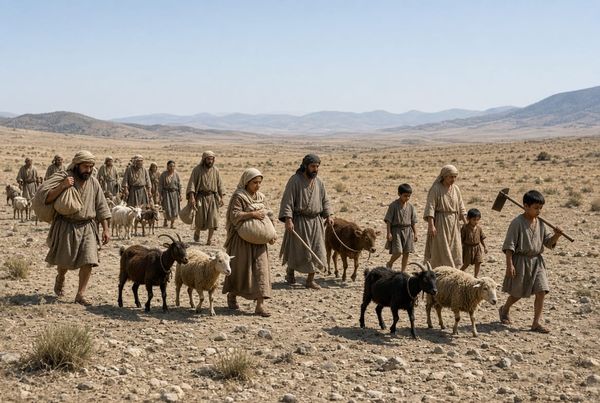
The Act That Love Compels
What if God's most devastating acts are not what they appear? Physical death is not the end of the story. The scaffolding comes down. The building remains.
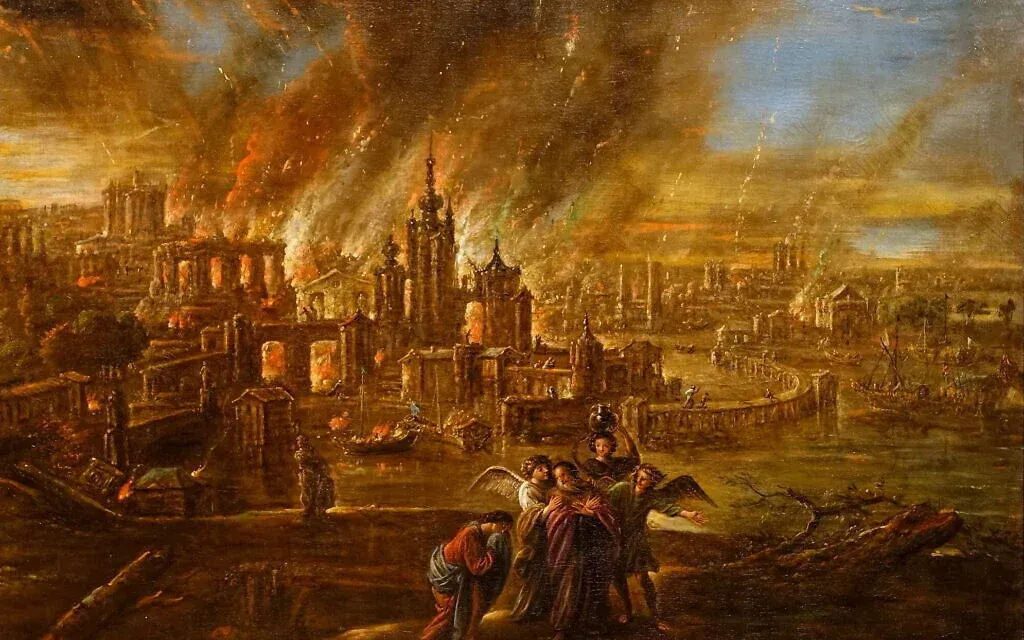
The Act that Love Compels
What If God’s Most Devastating Acts Are Not What They Appear?
•
The Scaffolding
There is a Jewish teaching story about a boy who watches a wheat field get destroyed. First the plow tears open the ground. Then the sickle cuts the stalks. Then the threshing floor beats the grain from the husk. Then the millstone grinds it to powder. The boy watches each stage in horror. Devastation after devastation, one worse than the last. Then his mother takes the flour and makes bread.
The boy saw destruction. The mother saw a process. The same events, witnessed from two positions — one inside the sequence with no view of the end, one outside it with full knowledge of the product. Neither was lying about what they saw. But only one of them understood what was happening.
That story is the entire problem of the Old Testament in miniature. God commands a flood. God rains fire on Sodom. God kills the firstborn of Egypt. God orders the destruction of the Amalekites. From inside the sequence, each one looks like carnage. From inside the mortal phase, where physical death looks like the end of the story, the God of the Old Testament looks like a monster.
This paper argues that the mortal phase is not the end of the story. That the people destroyed in those events were not discarded. That the physical creation is scaffolding, not the building. And that once you understand what physical death actually is in the biblical framework — and what it is not — the most devastating acts in the Old Testament stop looking like cruelty and start looking like the hardest kind of mercy in the story.
•
What God Is
The argument depends on a premise established elsewhere but essential here: God’s identity is love. First John 4:8 does not say God is loving. It says God is love. That is not a description of behavior. It is a statement about nature. Love is not one attribute competing with holiness and justice for priority. It is the core from which every other attribute operates. Justice is love’s integrity. Holiness is love’s purity. Wrath is love’s response to what destroys the beloved. They are expressions of a single nature, not members of a committee.
Job 34:10–12 draws the hard line: “Far be it from God to do evil, from the Almighty to do wrong. It is unthinkable that God would do wrong, that the Almighty would pervert justice.” The language is not preference. It is categorical impossibility. Evil is incompatible with what God is, the same way darkness is incompatible with light. Not because he lacks the power, but because it contradicts his nature.
If that is true, then every act God takes — including the ones that look like devastation from the inside — must be consistent with love. Not consistent with sentimentality. Not consistent with human comfort. Consistent with the actual nature of love, which includes discipline, correction, protection of the vulnerable, and the willingness to do hard things for the sake of the beloved’s ultimate good. Hebrews 12:6 states the principle plainly: “The Lord disciplines the one he loves.” And if God is not willing that any should perish, then God loves everyone — because unwillingness to lose someone is what love is.
The question is not whether God authorized destruction. He did. The question is whether that authorization is consistent with love. And the answer requires understanding what the destruction actually destroyed.
•
What Humans Actually Are
Genesis 2:7 — God formed the body from the dust of the ground, then breathed the spirit into it. Two components, assembled. Zechariah 12:1 — God forms the spirit of man within him. The spirit is a distinct creation, not a byproduct of biology. Ecclesiastes 12:7 — at death, the dust returns to the ground and the spirit returns to God who gave it.
The body is a vehicle. The spirit is the person. Death is the separation of the two. The body goes back to dirt, because dirt is what it was made from. The spirit — the actual person, the thing God created in his image — does not cease to exist. It returns to God.
This changes everything about how we read the word “kill.” When God ends a mortal life, he has not annihilated a person. He has terminated a phase. The spirit that inhabited that body still exists, still stands before God, still has an eternal trajectory. Physical death is not execution in the ultimate sense. It is a transfer out of the temporary environment and into whatever comes next.
This does not make physical death trivial. The mortal phase is where character is formed, where choices are made, where the development happens. Ending it has real consequences for what can still be accomplished within it. But ending the mortal phase is a categorically different act than ending the person. And conflating the two is what makes the Old Testament judgments sound like genocide when they are actually something else entirely.
•
What the Creation Actually Is
Romans 8:20–21 makes a claim that most people read and then immediately forget: “For the creation was subjected to futility, not willingly, but because of him who subjected it, in hope that the creation itself will be set free from its bondage to corruption and obtain the freedom of the glory of the children of God.”
Three things in that passage. First, the creation was subjected to futility. Passive voice, identified actor. God did this. Deliberately. The mortal environment — decay, entropy, death, the whole system where things break down and do not last — is not an accident. It is an imposed condition.
Second, not willingly. Creation did not volunteer. Romans 8:22 says the whole creation groans together in the pains of childbirth. The temporary, decaying, mortal environment is not the natural state of things. It is a deliberate downgrade.
Third, in hope. The subjection has a purpose. The futility is not pointless. It is the condition under which something is being produced that could not be produced any other way. And the product is stated in the next verse: the freedom of the glory of the children of God. The entire temporary system exists to produce finished, tested, glorified children of God. That is the product. The futility is the manufacturing environment.
The physical creation is scaffolding. It is the temporary structure erected so the permanent thing can be built. You do not mourn scaffolding when it comes down. You do not accuse the builder of destruction when he removes temporary framework that has served its purpose. The scaffolding was never the building. The body was never the whole person. It was always going to come down. The only question was when, and that was always the builder’s call.
When God ends a mortal life within this system, he is not destroying his masterpiece. The masterpiece is the spirit. The physical environment is the workshop. And sometimes the workshop needs to be cleared so the work can continue.
•
What Evil Does to the Workshop
The previous paper in this series — The Necessary Adversary — established that evil enters the system through the free choices of created beings, not through God’s authorship. Freedom produces evil as a byproduct because genuine choice necessarily includes the option of choosing wrong. That evil provides the raw material for character development, governed by God’s permission structure, opposed by angelic defense, and filtered through individual armor.
But freedom does not distribute evil evenly. It concentrates. When a culture collectively turns away from God’s nature, the corruption compounds across generations. Norms shift. Institutions degrade. What was once recognized as evil becomes normal, and what was normal before becomes impossible to sustain. Given enough time, a civilization can reach a state where the environment itself has become an engine of corruption rather than development.
Genesis 6:5 describes exactly that state in the pre-flood world: “Every inclination of the thoughts of his heart was only evil continually.” Every. Only. Continually. Three absolute terms stacked on one another. This is not a population with a sin problem. This is a population where the capacity for God-orientation has been functionally eliminated from the culture.
If the purpose of the mortal environment is character development, then a world where every inclination is only evil continually is an environment that has ceased to serve its purpose. It is not producing character. It is producing destruction. And a God who built the system for a purpose does not let a broken system run indefinitely when it is destroying the people it was designed to develop.
•
The Surgical Principle
Love that refuses to act against what destroys the beloved is not love. It is indifference. A parent who watches their child being consumed by something destructive and does nothing is not patient. They are negligent.
When corruption reaches the point where it is actively destroying the people immersed in it, ending the environment is not a violation of love. It is love’s most urgent expression. The flood, Sodom, the plagues of Egypt, the Amalekites — in every case, the text describes a population or system that has become so thoroughly corrupted that it is consuming the people within it and threatening everyone around it.
God’s response in each case follows the same pattern. The corruption is identified. Opportunity to turn is extended. The reachable are extracted. And the judgment falls on what remains after mercy has exhausted every avenue.
Noah preached for the duration of the ark’s construction. Sodom could not produce ten righteous when Abraham negotiated. Egypt received ten escalating warnings, each one an opportunity to reverse course. The Amalekites had four hundred years of national trajectory that never corrected. The pattern is not sudden rage. It is extended patience followed by action only when every alternative has been foreclosed.
•
The Negotiation
Genesis 18:23–32 is the clearest window into God’s posture toward judgment, and it reveals a God who is looking for every reason not to act.
Abraham asks: will you destroy the city if there are fifty righteous in it? God says no, he will spare the whole city for fifty. Abraham drops to forty-five. God says yes. Forty. Yes. Thirty. Yes. Twenty. Yes. Ten. Yes.
Six rounds. God said yes every time. He never pushed back. He never set a minimum. Abraham is the one who stopped asking. Not God. Abraham lost his nerve. God was still saying yes.
And even after the negotiation ended, even after ten righteous could not be found, God still extracted the ones with remaining orientation. The angels physically seized Lot and his family and dragged them out when they were too slow to leave on their own. Genesis 19:16 says they did this because the Lord was merciful to him.
The destruction of Sodom was what remained after mercy had exhausted every avenue. God was willing to spare the entire city — every guilty person in it — for the sake of ten who were not. That is not a God looking for reasons to destroy. That is a God searching for any remaining foothold for mercy and finding none.
•
The Millstone
The strongest evidence that a God of love can authorize death comes from Jesus himself.
Matthew 18:6, Mark 9:42, and Luke 17:2 all record the same statement: whoever causes one of these little ones to stumble, it would be better for him to have a great millstone hung around his neck and to be drowned in the depth of the sea.
Better. That is a comparative judgment. Jesus is weighing two outcomes and declaring that death — violent, immediate death — is the preferable one. The alternative being: continued life in which that person keeps corrupting the vulnerable. And the word is better for him. Not just better for the victims. Better for the corrupter. Because every additional day in that pattern compounds the damage to others and compounds his own accountability.
Jesus — God incarnate, love in a body — looked at a specific scenario and said death is the merciful outcome. Not reluctantly. Not with hedging. He stated it in the most vivid terms available – if you are going to continue in these ways, the millstone is the better option — and you are running out of time to recognize it.
This is the Genesis 6 principle coming from Jesus’ own mouth. There are conditions under which continued mortal existence produces a worse outcome than ending it. Not because life is cheap. Because corruption compounds. A world where every inclination is only evil continually is a world full of people causing little ones to stumble. Every child born into it is a little one being destroyed by the environment. Every day the system runs, the damage deepens.
The objection that a loving God would never kill is demolished by the one person the objectors usually try to pit against the Old Testament. The gentle shepherd. The friend of sinners. Jesus, the Christ of God. He said the millstone is better. And if the millstone is better for one corrupter in one village, the same principle scales to civilizations where the corruption has consumed everything.
•
The Mercy Inside the Judgment
If the mortal phase is temporary by design, and the spirit survives physical death, and God evaluates every individual by the heart rather than by the circumstances of their death — then what does destruction actually look like from the eternal perspective?
Consider the people trapped in the pre-flood world. A child born into an environment described by Genesis 6:5 has no model for anything else. No exposure to goodness that has not been corrupted. No relationship that is not poisoned. No concept of God-orientation because nothing in the environment reflects it. Every day that child remains, the corruption sinks deeper. Every year adds layers of damage between that spirit and any remaining capacity to turn toward God.
Ending their mortal phase stops the bleeding. It removes them from an environment that is only making their situation worse. And it brings them before a God who sees their heart as it actually is — not as the corrupted environment shaped it, but the spirit underneath. The one God knew when he formed it.
For hearts that had genuine orientation buried under environmental corruption, physical death is not punishment. It is evacuation from conditions that were destroying what was real in them. The worst thing that could happen to those spirits was not the flood. It was another century in a world that was grinding them into something they were never meant to become.
Even for those whose corruption was fully self-chosen, the destruction carries a mercy most people do not see. Every additional day a fully corrupted person operates, they compound their own accountability. Every person they influence, every little one they cause to stumble, every act they propagate — all of it accrues. Ending their mortal phase does not save them from judgment, but it limits the scope of what they will be judged for. That is not the mercy anyone wants. But it is mercy that only a God who sees the eternal trajectory would apply.
•
The People of Sodom Are Still in the System
Jesus said something in Matthew 10:15 that should stop everyone who assumes the destroyed populations were simply discarded: “Truly, I say to you, it will be more bearable on the day of judgment for the land of Sodom and Gomorrah than for that town.”
Two things are operating in that sentence. First, Sodom still has a court date. If the fire that fell on them were the final verdict, there would be nothing left to evaluate. You do not compare future sentences for a defendant who has already been executed without trial. Jesus is saying the people of Sodom still face evaluation. Their physical destruction did not determine their eternal outcome.
Second, the evaluation is scaled to opportunity. Sodom had no Torah, no prophets, no miracles, no incarnation. The towns that rejected Jesus had him standing in their streets performing wonders. Greater light, greater accountability. Lesser light, lesser accountability. The people of Sodom, for all their corruption, operated under lesser light than a town that watched Jesus raise the dead and shrugged.
This demolishes the assumption that the destroyed populations were thrown away. Jesus would not reference Sodom in a comparison about future judgment if their story were over. The fire was exactly what we have said it was: termination of the mortal phase in a corrupted environment. Not the final word. Not the end of the person. A transition out of the temporary system and into the hands of a God who evaluates every spirit individually, by the heart, scaled to what they had access to and what they did with it.
•
He Went After Them
The Sodom passage establishes that the destroyed populations are still in the system. The next passage escalates the claim from passive to active. They were not merely retained for future evaluation. God went to them.
First Peter 3:18–20 — “For Christ also suffered once for sins, the righteous for the unrighteous, to bring you to God. He was put to death in the body but made alive in the Spirit. After being made alive, he went and made proclamation to the imprisoned spirits — to those who were disobedient long ago when God waited patiently in the days of Noah while the ark was being built.”
Jesus — put to death in the body, made alive in the Spirit — went to the spirits of the flood generation. Not an angel. Not a message relayed through intermediaries. He went himself, in spirit, to the specific people who drowned in the judgment that has troubled readers for four thousand years.
Why them? Because they are the one generation the text describes as totally environmentally compromised. Every inclination, only evil, continually. Noah preached, but he was preaching into an environment so saturated with corruption that the message could not penetrate. The culture was louder than the preacher. These spirits lived and died in the one environment in human history where a fair hearing was functionally impossible. If anyone had a legitimate case that they never got a clean shot at the truth, it was the generation of the flood.
So Jesus went to them. In spirit. After his body was killed and before he returned in a new one. Between the cross and the resurrection, the Son of God visited the spirits of people who had been dead since the flood — and he preached to them. He told them what the environment had made impossible to hear while they were in it.
First Peter 4:6 completes the picture: “For this is the reason the gospel was preached even to those who are now dead, so that they might be judged according to human standards in regard to the body, but live according to God in regard to the spirit.”
Judged according to human standards in regard to the body — yes, they lived corrupted lives in a corrupted world. But live according to God in regard to the spirit — evaluated by what is underneath, by heart orientation, by what they do when they finally receive the hearing the mortal environment denied them.
This demolishes every reading that treats the flood as final judgment. God drowned them and then sent his Son to preach to them personally. That is not a God who discarded a population. That is a God who pursued them past death itself to offer what the world could not. The mercy did not stop at the waterline. It followed them through it.
•
The Lesson That Outlives the Destruction
Isaiah 26:9 states: “When your judgments are in the earth, the inhabitants of the world learn righteousness.” The judgments are pedagogical. They teach. And the students are not the ones under the judgment. They are the inhabitants of the world who witness it and learn from it.
First Corinthians 10:11 makes the principle explicit: “Now these things happened to them as examples, and they were written down for our instruction.” Paul does not say we turned those events into examples after the fact. He says they happened for that purpose. The events themselves were designed to instruct future generations.
The destruction of a civilization is a lesson written in a font large enough for the rest of the world to read. And the lesson is not “be afraid.” The lesson is “this is where that road leads.” Every person across four thousand years who has read the flood narrative and recognized the trajectory of their own culture has received mercy through the judgment that fell on someone else. The destroyed populations, in a way they never intended and could not have imagined, have been turning strangers toward God for millennia.
That does not retroactively make their suffering pleasant. But it means the destruction was not wasted. Not one ounce of it.
•
What the Text Says About God’s Heart in the Middle of It
Lamentations 3:31–33 — “For the Lord will not cast off forever, but, though he cause grief, he will have compassion according to the abundance of his steadfast love; for he does not afflict from his heart or grieve the children of men.”
He does not afflict from his heart. The Hebrew is millibbo — not from his heart. The grief he causes is real. The affliction is real. But it does not originate from the core of who he is. It originates from necessity — from the requirements of love confronted with what is destroying the beloved.
Ezekiel 33:11 — “As I live, declares the Lord God, I have no pleasure in the death of the wicked, but that the wicked turn from his way and live. Turn back, turn back from your evil ways, for why will you die?” No pleasure. The invitation to turn is still open in the same breath as the declaration of judgment. The heart of God, even in the passage about consequences, is aimed at life.
Second Peter 3:9 — “The Lord is not slow to fulfill his promise as some count slowness, but is patient toward you, not wishing that any should perish, but that all should reach repentance.” Not wishing that any should perish. Every act of destruction in the Old Testament occurred against the explicit wish of the God who authorized it. He did not want it. He exhausted every alternative. He extracted everyone who could be extracted. And when it came, it grieved him. Genesis 6:6 says it grieved him to his heart.
The God who sent the flood was not a God who had stopped loving. He was a God who loved too much to let the beloved keep being destroyed by a system that had turned against them.
•
The Scaffolding Comes Down
Return to where we began. The boy watches the wheat field and sees destruction. The mother sees bread being made. The difference is not intelligence. It is perspective. The boy can only see the current stage. The mother sees the product.
The mortal creation is scaffolding — temporary by design, subjected to futility on purpose, aimed at producing something permanent. When God acts within that scaffolding — ending mortal lives, resetting corrupted environments, clearing fields that have gone to rot — he is not destroying the building. He is managing the temporary structure so the permanent thing can be completed.
The spirits are the building. Every one of them still exists after the scaffolding around them comes down. Every one returns to the God who formed them. Every one is evaluated individually, by heart, scaled to light received. The scaffolding served its purpose or it failed to serve its purpose, and either way, the builder’s commitment is to the building, not to the scaffolding.
The accusation says God killed people. The text says God made decisions within a temporary system he designed to be temporary, ending the mortal phase for spirits who continue to exist, removing corrupted environments that were destroying the people immersed in them, extracting the reachable, and receiving every spirit into his hands for evaluation based on what he alone can see.
From inside the mortal phase, that looks like devastation. From the eternal perspective, it looks like a surgeon operating on a patient who cannot yet see the healing — in an operating room where the only one who can see the outcome is the one holding the blade.
•
The Resolution
God’s direct acts of destruction in the Old Testament are not the cruelest judgments in the story. They are the acts that love compels.
Mercy toward the trapped — ending their exposure to an environment that was destroying them. Mercy toward the corrupters — stopping the compounding of their own accountability before it grew worse. Mercy toward the watching world — providing the lesson that has been turning future generations toward life for four thousand years. Mercy toward the system — preserving the developmental environment that produces the children of God.
Every one of these acts was preceded by exhaustive patience, extended opportunity, and the extraction of everyone who still had remaining orientation toward God. Every one grieved the God who authorized it. Every one fell on people whose spirits still exist, still face individual evaluation, still are known to God by heart rather than by circumstance.
The objection says: a loving God would never do this. Jesus says: there are conditions where love requires it. The objection says: destruction proves God does not care. The text says: destruction grieved him to his heart, and he does not afflict from his heart, and he takes no pleasure in the death of the wicked, and he wishes that none should perish.
A God who refused to act — who let the corruption run, who watched the little ones be consumed, who allowed the environment to grind every spirit in it to dust rather than end the mortal phase and receive those spirits into his own hands — that God would not be loving. He would be complicit. And complicity in the destruction of the beloved is the one thing that love, by its nature, cannot do.
The scaffolding comes down—the body dies. The temporary was always going to come down. The building remains—the refined spirit lives on. And the builder always knew the difference between the two — even if the people standing on the scaffolding must discover it for themselves.