But You Have Said
You're furious with God, and ashamed of the fury. But you cannot accuse someone you don't believe is there.
The Anger That Is Faith Holding On
There is a kind of loss that no explanation can touch.
The call in the middle of the night. The doctor who won’t meet your eyes. The room that was supposed to be filled and is empty, and will stay empty. While everyone keeps bringing casseroles and saying he’s in a better place, you want to put your fist through the wall.
And underneath the grief — where you’d never say it out loud — there’s something worse. You’re angry. Not just at the driver, not just at the disease, not only at yourself. At God. He could have stopped it. He didn’t. You prayed and the answer was no, and now you’re standing at a grave you never thought you’d have to stand at, and you are furious with the One who let it happen.
And then, because someone taught you this somewhere along the way, you feel ashamed of the anger — as if the rage were a sin stacked on top of the loss. As if a faithful person would have found a way to say blessed be the name and mean it, and your failure to do that is one more thing you got wrong.
Maybe it wasn’t a child. Maybe it was the diagnosis, the marriage, the years you can’t get back, the thing you’ve never told anyone. Whatever took you down — the thing that no explanation could ever make right — you know the place. Alone, in the dark, angry, and ashamed of being angry.
Hold that there for a minute. Because there’s a man in the Bible standing in exactly that spot, and what happens to him is not what you were taught.
The Man at the River
His name is Jacob, and he has run out of road.
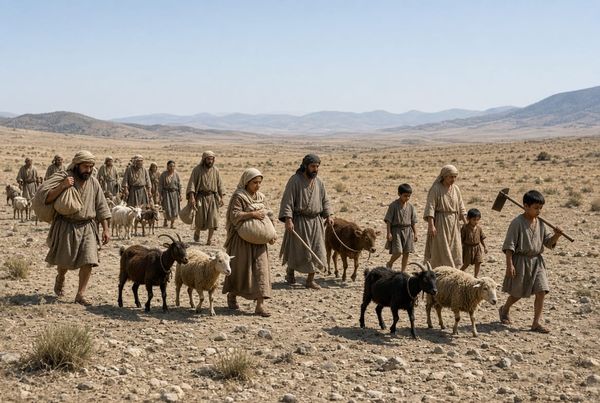
For twenty years he’s been away, and now he’s coming home, and home means Esau — the brother he cheated, the brother he stole from and ran from, who is at this moment riding toward him with four hundred men. Jacob is certain the morning brings his death, and the deaths of his wives and children. He has done everything a frightened man can do. He’s split the camp so half might survive. He’s sent wave after wave of gifts ahead to soften his brother. He’s prayed. And now it’s night, and there’s nothing left to do but wait for a sunrise he’s dreading.
So he sends everyone across the river, and he stays back, alone. Maybe his life alone will satisfy his brother’s rage.
This is the lowest point of his life. Maximum fear, no more moves, no one beside him, the dark pressing in and the worst still coming.
And here is the thing worth carrying into what happens next: God had made him a promise. Twenty years earlier, fleeing this same brother, alone in the wilderness with a rock for a pillow, Jacob had heard God say it plainly — I am with you and will watch over you wherever you go, and I will bring you back to this land. I will not leave you until I have done what I have promised you. A promise with no expiration and yet to be delivered. I will not leave you until…
And that night at the river, none of it was finished. Jacob wasn’t safely home. Esau was still coming. The promise was still in force — which means God was still bound by it.
And there is one more thing, that same day, before the sun went down.
With Esau closing in, Jacob prays. And the prayer is not a resigned thy will be done. Watch how he builds it.
He opens by quoting God’s own words back to him — you who said to me, “Go back to your country… and I will make you prosper.” Then he takes his own merit off the table, completely: I am unworthy of all the kindness and faithfulness you have shown your servant. Then the demand, with the fear right out in the open: Save me, I pray, from the hand of my brother Esau, for I am afraid he will come and attack me.
And then, in the last line of the prayer, the hinge the whole thing turns on:
But you have said.
And he quotes the promise back a second time.
That is a man with nothing left — no leverage, no merit, no plan — holding God to God’s own word. Look at what his case is not built on. He doesn’t argue that he deserves rescue; he says outright that he doesn’t. He doesn’t point to his faithfulness, because he hasn’t got any to point to. He is a liar and a thief and he knows it. His entire claim rests on a few words: you said this.
Hold onto both of those — the promise and the prayer. Because a few hours later, Jacob is going to stake the same claim with his hands.
And that night, with a twenty-year-old promise still dangling over him unfulfilled, is the moment God chooses to confront him.
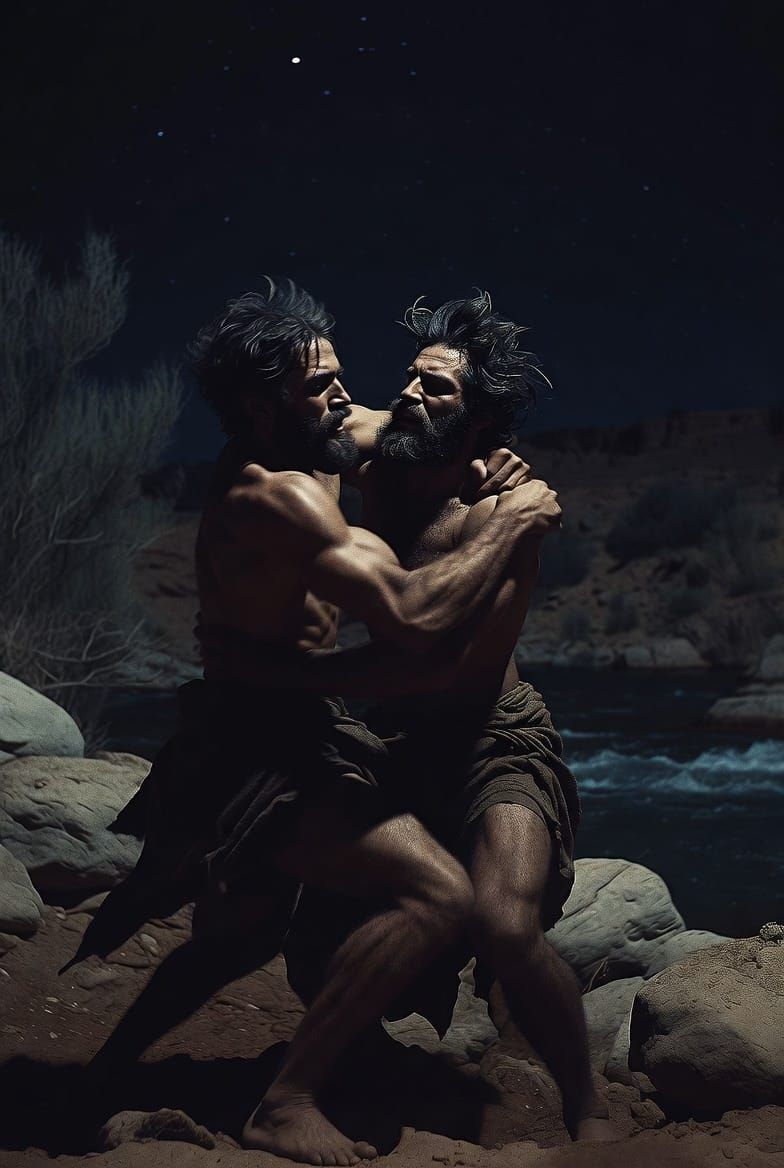
Read the text carefully, because almost everyone reads past the strangest part: a man wrestled with him. Jacob doesn’t go looking for God. Jacob doesn’t reach up in his distress and take hold of heaven. God lays hands on him first. The grip that starts the fight is God’s, not Jacob’s.
Notice the timing, because it matters more than the wrestling itself. God had said wherever you go — so he had been with Jacob the whole time. Through Haran. Through the years with Laban. Through the good stretches when the flocks multiplied and Jacob thought he was managing fine on his own. God didn’t arrive for the first time at the river. He was there through all of it.
What changed at the river was Jacob. Stripped of everything, out of schemes, nobody left to hide behind, alone in the dark for the first time in his life.
And that timing is what God doesn’t miss. The night the man finally had nothing left to work with was the night God moved and took hold of him. In his perfect timing.
And then something happens that should have been edited out of any respectable religious book. They fight. All night. Jacob — dishonest, desperate, frightened Jacob — grapples with God in the dirt until daybreak. And here is the line that breaks the Sunday-school version wide open: the man could not overpower him — the man being God.
Sit with that. The God who spoke galaxies into being could not break the grip of one terrified man.
The obvious objection comes fast, and it should: nobody is stronger than God. That’s true, and it isn’t the answer. Scripture describes a whole category of things God cannot do — and every one of them is a limit of character, not of power.
The book of Hebrews says it as bluntly as it can be said. When God made his promise to Abraham, there was no one greater for him to swear by, so he swore by himself. He bound himself, deliberately, to his own word. And the writer says the promise and the oath are two unchangeable things, because it is impossible for God to lie. Not unlikely. Impossible. Paul writes the same construction to Timothy: even if we are faithless, God remains faithful — because he cannot disown himself. And God says it in his own voice in the Psalms: I will not violate my covenant or alter what my lips have spoken.
That is not weakness. It’s the opposite. A God who could break his word whenever it got inconvenient would be a God whose promises were worth nothing. The “cannot” is what makes the promise a promise.
And then Hebrews tells you why God bound himself, which is the part that should stop you cold. He confirmed it with an oath, the writer says, so that those who have fled for refuge would have strong encouragement to take hold of the hope set before us. God swore an oath so that desperate people would have something to grab. He gave them a handle on purpose.
So take that back to the river.
God had given Jacob his word: I will not leave you until I have done what I have promised. That word was still in force, and Jacob was gripping it. Which means when God says let me go and Jacob won’t, God is standing inside a limit he set himself, twenty years earlier, on purpose. He will not tear loose from his own promise to get away from the man clinging to it. The “could not” is not failed strength. It is covenant fidelity. Jacob isn’t overpowering God. Jacob is holding God to God’s own word — which is precisely the handle God gave him.
And if you think that means God was helpless in that fight, watch what happens next. He reaches out and touches Jacob’s hip and throws it out of joint — one touch, and the strongest man at the river is crippled for life. That is not a God who couldn’t end it. That is a God demonstrating he could end it any moment he chose.
And Jacob, wrecked, hip out of its socket, still does not let go.
That is the picture. God can stop this whenever he likes, and won’t break his word to escape it. Jacob can’t win, and won’t release the promise. The two of them locked together until dawn, and it’s the holding on — after the injury, past the point where any sensible man would have quit — that the story is about.
At dawn the man says, Let me go.
And Jacob — hip screaming, exhausted, still gripping — says the most audacious thing in the passage: I will not let you go unless you bless me.
That is not the voice of patient, quiet endurance. That is a demand. That is a man who has God in his grip and refuses to release him without getting something out of it. He is not accepting his lot. He is not saying thy will be done.
It is the prayer again. But you have said — this time with his hands.
And God’s response to this audacity is the whole point.
He blesses him.
Not despite the wrestling — because of it. He gives Jacob a new name: Israel. And he says what it means: because you have struggled with God and with men and have overcome. The struggle is not a sin that God overlooks. The struggle, the striving with him directly, is the thing God honors. He renames the man for the fight. And then — because you never come away from gripping God unchanged — Jacob walks into the sunrise with his blessing and his limp, marked for the rest of his life, carrying more than he brought to the river.
That is the story. Now look at where you’re standing.
That Is You
You are at the river.
The grip in the dark you’ve been reading as God’s absence — look again at Jacob. God had been with him for twenty years before that night, in the good stretches and the bad, exactly as he’d promised. He was not more present at the river than he’d been in Haran. What was different was that Jacob finally had nothing left to hold onto but God.
And that is the moment God does not let pass. He’s there in the good years, whether or not you notice. But when a person is finally stripped down and ready to grapple, he moves in and takes hold — because that’s when there’s something to take hold of.
So whatever has closed around you is not evidence that he left. It may be God’s response to you being ready to wrestle.
So grab back.
The anger you’ve been ashamed of — look again at Jacob. He made demands of God, held God to his word, refused to release God, and was blessed for it. Here is the thing no one told you: you cannot accuse someone you don’t believe is there. The person who has truly let go — who has decided the sky is empty — doesn’t shake a fist at it. There’s nothing to shake it at. They walk away quietly and get on with a smaller life. But you’re still yelling. You’re still saying you said you loved me. You’re still saying where were you. You’re still saying you promised. And every one of those words stands on a belief you can’t kill: that he is real, that he said those things, that he owes you an answer. You would not hold an empty sky to a promise.
Your fury is not the failure of your faith. It is the proof of it. The one wrestling with God is the one who still expects him to be who he said he is — faith carrying the heaviest load it will ever carry, and still refusing to let go.
Be clear about what makes the difference, though, because anger by itself doesn’t settle anything. People rage on their way out the door too — one last accusation thrown over the shoulder, and then gone. That isn’t Jacob. Jacob’s demand and Jacob’s grip were the same motion; he pressed his claim while holding onto God, and he was still holding on at sunrise. The fist that is faith is the fist that keeps hold. It isn’t the volume that matters, or how ugly the words get. It’s whether you’re still there in the morning, still gripping, still saying you said this. Rage and let go, and you’ve left. Rage and hang on, and you’re Israel.
And you have a promise to grip, the same as Jacob had. His was spoken at a rock in the wilderness. Yours is written down where anyone can hold it up: Never will I leave you; never will I forsake you. That is not a wish. It is a commitment, in his own words — and it is the exact thing your grief is screaming that he broke. You left. You forsook me. Where were you.
So say it back to him. You already have the words; Jacob left them for you. But you have said.
That is the whole prayer. Name the promise. Say what you’re living. Tell him the two don’t match. That is not blasphemy — it is the oldest prayer in the book, and God answered it that same night by showing up and letting a frightened man get his hands on him.
And if what stops you is the thought that you have no right to demand anything from God — not after what you’ve done, or what you’ve been thinking these last months, or how far you’ve drifted since the funeral — then look at Jacob one more time. He put that objection in his own prayer and went ahead anyway. I am unworthy of all the kindness you have shown your servant. He was a liar and a thief and he said so. He did not claim he deserved rescue. The claim was never built on deserving. It was built on a few words: you said this. Your unworthiness is not a disqualification. Jacob’s wasn’t.
Just be careful to hold him to the word he actually gave. He did not promise you’d never bury anyone. He did not promise the diagnosis would come back clean. He promised presence — that whatever came, he would not leave you alone inside it. That promise he cannot break, and that is the one you get to clench in your fist and refuse to release.
And if you have been gripping for a long time already with nothing to show for it, hear this before you decide the whole thing is a lie. Jacob wrestled all night. Not for a moment, not until he felt better — until daybreak, and daybreak came when it came and not when he wanted it. The same book that says God cannot break his word also holds up Abraham, who waited twenty-five years for the son he’d been promised — doubting, laughing at the prospect, and twice proposing a substitute heir. The wait was real. So was the promise. A night that has gone on longer than you can stand is not evidence that no one is holding onto you. It may only mean the sun is not up yet.
And the thing you’re most afraid of — that coming at God like this means you’ve given up — look one more time at Jacob. He didn’t endure his trial by going quiet. He endured it by wrestling. The holding on and the fighting were the same act; he lasted till daybreak by refusing to release. So don’t believe the framework that told you patient endurance and honest anger are opposites, that to bring the fist is to quit the trial. Enduring is gripping the God who hasn’t yet delivered and not letting go. Bringing the heat is not the abandonment of your faithfulness. It might be its truest form.
So do both. Endure and bring the heat. Tell him he said he loves you and you are not feeling it. Tell him exactly where you expected him to be and exactly where he wasn’t. Tell him what you can’t tell anyone else, in the words you’d never use in church. He is not going to flinch. He is not fragile. He is not offended. You will not say anything he cannot hold — and you would not be able to say any of it if some stubborn, unkillable core of you didn’t still believe he was there to hear it.
And you are not the only one in this company. Job lost everything and refused to perform peace — he challenged God to his face, and when it was over, God said he had spoken rightly, and the friends who’d defended God so politely had it wrong. Open the Psalms and the fist is on half the pages — how long, LORD? Why do you hide your face? Those aren’t the prayers that got cut. They’re the ones God kept, printed and read for three thousand years, so that when your own words run out you’d have his people’s words to borrow. You are standing in a long line of the faithful, disappointed, and angry.
One thing, before you go to the river.
Jacob was alone that night, but you were not made to be alone. The God who takes hold of people in the dark made us to carry each other’s burdens. So bring him the heat, and let someone who loves you sit with you while you do. A hand on your shoulder from a person and a fist raised at heaven are not rivals. If the weight of this is more than you can carry, that is not weakness and it is not faithlessness — it is the reason he gave you other people. And if the dark ever turns from anger toward not wanting to be here at all, reaching for help is not a break from the wrestling. It is part of holding on. Reach for him, and reach for them. He built the whole thing to be carried together.
So don’t perform a peace you don’t feel. And don’t walk away.
He has already taken hold of you. He is not your enemy in this. He did you no wrong. He is in it with you and refuses to stay at arm’s length, the way he took hold of Jacob. That grip you feel in your suffering is not proof he’s gone. It may be the surest sign he’s there.
So grab back. Say the unsayable thing. Bring the anger, and the questions, and the claim built on his own promise — but you have said — and bring it, and bring it, and keep bringing it, until the heat finally burns all the way down. Endure, and bring the heat, until there isn’t any more. Because Jacob’s grip held until daybreak, and the anger you carry all the way to God — not away from him, but straight at him — is the anger that finally turns. Not because someone talked you out of it. Because you brought it to the only One who could take it, and he took it, and he stayed, and he worked it toward a good you cannot see from here.
He is not standing across the room, arms crossed, offended.
He is close enough to grab, arms extended, ready to grapple with you.
He gave his word he would not leave — and he has never once let go first.
Don’t you let go either — until he blesses you.
Explorations — single questions, taken to the text. Developed with Anthropic’s Claude through a Socratic process and edited by D. L. White.
© 2026 Meaning Books. Licensed under CC BY-NC-ND 4.0 — share it freely and unaltered, with attribution.