A Hundred-Thousand People
The pre-fall population hiding in plain sight. Two commands given, two commands obeyed, for over a century, by a lot of people. The question was never about Cain's wife.
A Hundred Thousand People Nobody Talks About
The Pre-Fall Population Hiding in Plain Sight
•
There is a question that comes up almost every time someone reads the early chapters of Genesis for the first time: where did Cain get his wife? It seems like a reasonable thing to wonder. The story introduces Adam, Eve, Cain, and Abel. Cain kills Abel and leaves. Then suddenly he has a wife and is building a city. The arithmetic doesn’t appear to work.
The usual answers involve some combination of unnamed sisters born later, or a vague gesture toward people God created elsewhere. These answers have the feel of patches—quick fixes applied to a surface problem without looking at what the text actually says underneath.
Because the text does answer the question. It has always answered it. The answer just implies something that almost nobody has reckoned with: there were a lot of people on the earth before Adam ate the fruit. Possibly well over a hundred thousand. And the clues have been sitting in Genesis this whole time, waiting for someone to follow them.
•
Two Commands
God gave Adam and Eve two instructions at the start. The first: “Be fruitful and multiply.” The second: “Fill the earth and subdue it.”
These are operational commands. The mission brief. And God gave them the equipment to carry it out—immortal bodies in perfect health, unlimited energy, no disease, no complications. The tree of life was accessible and unrestricted, sustaining them indefinitely. They were not aging. They were not dying. And they had a direct mandate to populate the planet.
Now consider what follows from taking those commands seriously. If Adam and Eve were not multiplying before the fall, they were disobeying God’s first instruction. If their descendants were not going out to fill and subdue the earth, they were disobeying the second. And if either of those disobediences came first, then eating the forbidden fruit was not humanity’s original sin. Something else was.
The text doesn’t support that reading. The forbidden fruit is consistently presented as the first act of rebellion. Which means everything before it was obedience. Which means they were multiplying, their children were multiplying, and families were spreading out across the land—for a very long time.
•
The Timeline
Genesis 5:3 tells us that Adam was 130 years old when Seth was born. Seth arrived shortly after Abel’s death, which itself came after both Cain and Abel had grown into working adults—Cain a farmer, Abel a shepherd. These are not young children. They are established men with developed occupations and the maturity to bring offerings to God on their own initiative.
Working backward, Adam was well into his second century of life, at minimum, before the fall occurred. The text gives no indication that it happened quickly. Adam was placed in the garden, given his commission, and carried it out for what appears to be a very long time before the serpent arrived with his counter-offer.
Now consider the conditions during that time. Immortal bodies. Perfect health. No miscarriage, no infant mortality, no disease, no famine. A direct command to multiply. Nothing competing for their attention except tending a garden and exploring a planet. And they had well over a century.
Even at a conservative rate—one child per couple per year, which for immortals under divine instruction to multiply is almost absurdly restrained—the numbers compound quickly. Adam and Eve’s children grow up, pair off, and start families of their own. Their children do the same. No one dies. No one gets sick. There is zero attrition. The population doesn’t just grow; it accumulates. Conservative estimates based on these conditions land well above a hundred thousand within a century. The actual number could be significantly higher.
•
What the Text Shows You
This isn’t a theory imported from outside the Bible. The evidence is in the text itself, in details that are easy to read past if you’re not looking for them.
Start with Genesis 3:16. When God pronounces the curse on Eve, he says, “I will greatly increase your labor pains.” The word “increase” is doing quiet but important work. You can only increase something that already exists. Eve had already experienced labor. She had already given birth. The curse made childbirth harder, not new. If she had never borne a child before the fall, the text would say “I will give you labor pains,” not “I will increase them.”
Then Genesis 3:20, immediately after the curses: “The man named his wife Eve, because she was the mother of all the living.” Not “would become the mother.” Was. She was already the mother of all the living at the time this statement was made—right after the fall, before the expulsion from the garden, and before Cain and Abel are born in the new mortal condition.
Then Genesis 4:1. When Cain is born, Eve says something worth noticing: “With the help of the LORD I have brought forth a man.” If she had been having children for over a century, why does this birth get a special remark? Perhaps because this one was different. Cain was born in the new mortal condition. Whatever had changed about the human body and experience after the fall, it made this birth feel different and the child look different from those that came before.
Then Cain kills Abel and God banishes him. Cain’s immediate response: “Whoever finds me will kill me.” If Adam, Eve, and Cain are the only living people, this statement makes no sense. Cain is not speaking hypothetically about future generations. He is afraid of people who already exist, right now, who will want to avenge what he has done.
God’s response confirms it. He places a mark on Cain for protection. You don’t mark someone for protection against a threat that doesn’t exist yet. The threat is present because the people are present.
And then Cain goes out “from the presence of the Lord and lived in the land of Nod, east of Eden.” He doesn’t wander into empty wilderness. He goes to a place with a name, where people are already living. And he builds a city. Cities are not built for one man and an unexplained wife. Cities are built because there are people to fill them.
•
Who Were They?
They were Adam and Eve’s descendants. No mystery race. No second creation event. No people God made separately and never mentioned. They were the children and grandchildren and great-grandchildren of the original couple, born across more than a century of immortal life, obeying the command to be fruitful and multiply.
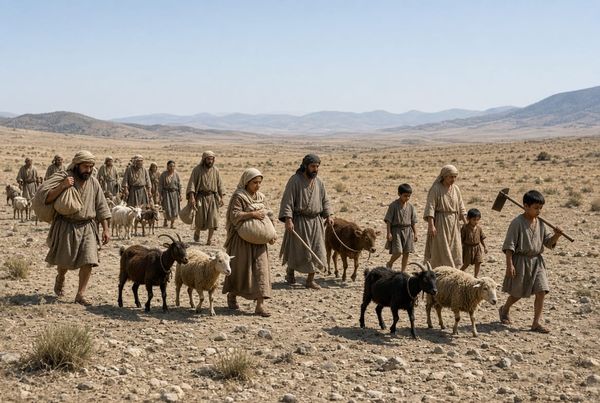
And it was the second command—fill the earth and subdue it—that put them in Nod. They didn’t wander there by accident. They were executing their commission, spreading out across the land, exploring and subduing the creation God had given them stewardship over. By the time Adam ate the fruit, his descendants were scattered across the earth in numbers that made Cain’s fear of encountering them perfectly rational.
When Adam ate the fruit, the curse fell on the entire human race—not just Adam and Eve in the garden, but every descendant everywhere. All became mortal in the same moment. The whole population, from the garden to the farthest settlements, was transformed simultaneously.
•
What Changed
The text gives very few details about what the transformation from immortal to mortal actually involved. But it gives one detail that is easy to read past.
The first thing Adam and Eve noticed after eating the fruit was that they were naked. Not that they were dying. Not that they were in pain. Naked. They had been naked the entire time, and it had never been a problem. Something that had been covering them, or something about their condition that made nakedness irrelevant, was suddenly gone.
What exactly changed? The text doesn’t say definitively, and it would be a mistake to be too dogmatic about it. But there are possibilities worth considering. One is that the transformation was primarily spiritual rather than physical—the removal of something like a covering of God’s presence that had shielded them. There is an interesting parallel in the story of Moses, who came down from the mountain after being in God’s direct presence with his face glowing so intensely that people couldn’t look at him. If prolonged proximity to God’s presence left that kind of mark on Moses temporarily, it’s at least worth wondering whether Adam and Eve, who lived in God’s presence continuously, might have carried something similar—and whether the fall involved its withdrawal.
Another possibility is that the change was entirely physical—a biological transformation from immortal to mortal bodies. Or some combination of both. The text leaves room for any of these readings. What it does make clear is that the change was immediate, it was dramatic, and the first thing the couple noticed about it was their own vulnerability.
God’s response was to make them coverings of animal skin—a physical substitute for whatever they had lost. And then he blocked access to the tree of life, ensuring that immortality in the new fallen condition would not be possible. Mortality became permanent. By design.
•
The World Remembers
Every people on earth remembers a lost paradise — a first age without death or toil, the divine close at hand, and then a fall out of it into the world we know. The details shift from culture to culture, but the story turns up everywhere humans do.
Look at what they actually report. Hesiod, writing in the eighth century BC, described a golden race of mortals who lived like gods, free of toil and grief, never aging, while the earth yielded its fruit on its own — an age that ended when a woman opened a sealed jar and loosed sickness and sorrow into a world that had known neither. Older still, the Sumerians remembered Dilmun, a land with no illness, no death, and no predator, where the gods walked among people. In India the Satya Yuga is the first and purest of four ages — immense lifespans, unbroken virtue, direct communion with the divine — and every age that follows is a step further down from that original. In China, Kwang-tze wrote of a first age when people lived in accord with the cosmos, before custom and code broke the original unity. Native American traditions keep a memory of a time before death. Polynesian stories carry a primal separation from the divine. African oral traditions describe an original closeness to the creator, lost through a single event.
The scenery is local, but the skeleton underneath is identical every time: deathlessness, the nearness of the divine, provision without labor, and a fall out of all three — often through one act or one person. That much agreement across that much distance is not the kind of thing cultures invent separately.
A memory like that does not survive unless the event behind it was overwhelming. And the fall was no quiet change to one couple in a garden. When the curse came, it came on everyone at once — a whole world of people who had been multiplying under no death and no disease for over a century, scattered across the land, made mortal in a single moment. A hundred thousand or more, immortal in the morning and dying by night. A catastrophe on that scale is the kind that burns itself into a people and gets told and retold — which is why the memory of it was still strong enough, generations later, to be worth carrying. The size of the pre-fall world is not what carried the story down to us. It is why there was a story worth carrying at all.
How it reached us is a matter of counting generations. A few generations after the fall, the Flood narrows the whole human race to one family — Noah and his sons — men only a few generations descended from the event, who heard it from fathers who heard it from men who were there. A few generations further on, that one family gathers on a single plain and is split apart. At Babel the common language breaks, the people fracture along family lines, and the clans walk off in every direction (Genesis 11). The nations do not predate the memory and reinvent it. The nations do not exist until the family that holds the memory divides into them. They are born carrying it. Babel scatters the bodies and hands out the story in one act — every departing clan walks out of the same camp with the same account in hand.
So the agreement among these myths is not independent witnesses converging. It is one memory, divided up at the moment one people became many. The skeleton holds because every clan carried it out of Shinar. The story morphs because after the scattering no two peoples ever compared notes again, and each one bent the inherited account toward its own concerns. Hesiod turned it into a lesson about honest labor. Kwang-tze turned it into a complaint against imposed order. Genesis keeps it about separation from God. The meaning belongs to the teller. The memory comes from before all of them.
This is why a detail like Dilmun matters. The Sumerian paradise predates any Sumerian contact with the Hebrew Scriptures — which does not make it independent invention. It makes it older than the text. Dilmun and Eden are not copies of each other; they are cousins, descended from one event upstream of both legends, kept sharp in one line and blurred in the other.
And the carriers have names. The text hands the nations to named sons of the survivors. Greece is Javan — the Hebrew word for the Ionian Greeks — a son of Japheth, son of Noah; so Hesiod, who kept the golden age, stands in the genealogy's own line of descent from the boat. Sumer rises in Shinar, the same plain it scattered from, in the kingdom of Nimrod, a grandson of Ham. The peoples whose memories this section leans on are branches of the very family that did the remembering.
Then there is the detail that settles the mechanism. The cultures that remember the paradise also remember the Flood. Sumer keeps Dilmun and it keeps Ziusudra. The Greeks keep the golden age and they keep Deucalion. The pairing repeats across India, China, and the Americas — the lost world and the drowned one, side by side in the same traditions. Independent invention would owe an explanation for two universal coincidences. Inheritance explains both at once, because the family that carried the memory of Eden was the same family that had just lived through the Flood. They planted both memories in every culture in one act, because they held both.
Richard Heinberg, surveying paradise myths across every inhabited continent, found no exceptions — the lost garden is everywhere people are. That is exactly what inheritance predicts. It is not that every culture independently dreamed the same dream. It is that every culture came down from the few who walked away from the same plain, each carrying the same memory of the same lost morning.
•
The People Behind the Question
Where did Cain get his wife? From the same population that was already living in Nod when he arrived—descendants of Adam and Eve who had been obeying God’s commands to multiply and fill the earth for over a century before the one command was broken that changed everything.
The answer has always been in the text. Two commands given. Two commands obeyed, for a long time, by a lot of people. A population that the details account for, if you follow them. But the answer opens a door onto something far larger than a marriage question. It opens onto a world — a whole civilization of immortal human beings, living under God's direct provision, filling the earth as they had been told to. And when that world ended, it ended for all of them at once, in a single moment. A loss on that scale does not disappear. The Flood would later sweep the civilization itself away — the whole teeming world reduced to a single family in a single boat — and humanity began again from eight. But the memory survived the water. It came down to those eight, and out from Babel, into every people who would ever tell the story of a paradise that was lost.
The question was never really about Cain's wife. It was about the world standing behind her — a hundred thousand strong, living without death until the morning everything changed — and a loss so complete that humanity, cut down to a single family and scattered across the earth, has never quite stopped remembering it